
SARMs & adjacent non-peptides
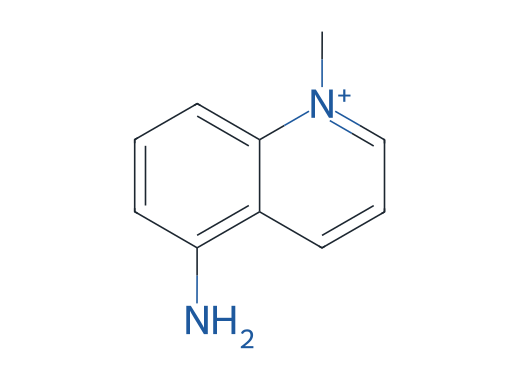
5-Amino-1MQ
Also called 5-amino-1-methylquinolinium, 5A1MQ, NNMT inhibitor
- US status
- Not approved
- DEA
- Not a federally scheduled controlled substance; it is an unapproved drug and is not a lawful dietary ingredient
- WADA
- S0 Non-approved substances; prohibited at all times
- Class
- SARMs & adjacent non-peptides
Jump to doses reported ↓ Dose math calculator
What it is
5-Amino-1MQ (5-amino-1-methylquinolinium) is a small molecule built to block an enzyme called NNMT, nicotinamide N-methyltransferase. It is marketed as a fat-loss and "metabolic" compound. It is a laboratory compound that has never entered clinical development, and it is sold through the grey market as capsules or as a vial of powder for injection.
How it works
NNMT consumes two things cells need: nicotinamide, which feeds the NAD+ pool that powers energy metabolism, and a methyl donor called SAM S1. 5-Amino-1MQ is a small, membrane-permeable molecule that blocks the enzyme, so more nicotinamide stays available for NAD+ and more SAM stays in the methyl pool S1. In fat cells, that was reported to cut the making of new fat and to shrink fat cells, and in obese mice the compound reduced body weight and fat mass S1S2. All of this is inferred from cell and rodent work: there is no human pharmacology, so what the enzyme block does in a person's metabolism is claimed rather than shown.
Legal status
- FDA: Not approved, and never entered clinical development. We found no published human study and no registered human trial of this compound S1S2.
- Dietary-supplement status: it is an unapproved drug and not a lawful dietary ingredient; selling it as a supplement is illegal.
- DEA: Not a federally scheduled controlled substance.
- "Research use only" products: 5-Amino-1MQ reaches consumers as research material whose identity, purity and sterility are unverified. See our explainer.
- WADA: Prohibited at all times under S0, the non-approved substances category covering substances with no current approval for human therapeutic use S4.
- International (short): Not reviewed for this page yet.
What the research actually shows
Evidence: D. Mice and cultured cells only, from one research group and the company founded around the work. The findings are consistent within that body of work, and they are also the only findings there are. No human has been studied.
| Study | Design | Subject | What it studied | Result |
|---|---|---|---|---|
| Neelakantan 2018 S1 | Cell and animal study | Cultured adipocytes; diet-induced obese mice on a high-fat diet | Whether blocking NNMT reduces obesity | The methylquinolinium inhibitors crossed membranes and were selective; in cells they raised NAD+ and SAM and suppressed the making of new fat; in obese mice they reduced body weight, white fat mass and fat-cell size and lowered total cholesterol, without changing food intake and without observed adverse effects |
| Babula 2024 S2 | Animal study with pharmacokinetics | Diet-induced obese mice, dosed once daily for 28 days | Body composition, metabolic measures and liver changes with 5A1MQ | Dose-dependently limited gains in body weight and fat mass, improved glucose tolerance and insulin sensitivity, reduced fatty liver and liver triglycerides, and normalized liver enzymes; exposure was good after subcutaneous dosing |
| Dimet-Wiley 2022 S3 | Animal study | Diet-induced obese mice | NNMT inhibition combined with calorie restriction | Reported a distinct gut microbiome in treated mice |
What we don't know: whether any of this happens in a person. There is no human pharmacokinetic study, no dose-finding, no safety study and no trial. NNMT is active in liver, fat and other tissues and sits on the pathways that handle NAD+ and methylation, which are involved in gene regulation throughout the body; what sustained inhibition does in a human has not been examined. The mouse work was done in obese animals, so even the animal evidence does not describe what happens in a lean person.
Reported benefits
None are established in people, because no person has been studied. In obese mice: less weight and fat mass gained, smaller fat cells, better glucose tolerance and insulin sensitivity, less fatty liver, lower cholesterol, with no change in how much the animals ate S1S2. What users report is user-reported, not tested.
Side effects
Common: unknown in humans; no human study has been published. The mouse reports state that no adverse effects were observed at the doses used S1. Serious: unknown. The absence of reported harm in short mouse studies is not a human safety record. Nobody has measured what blocking a methylation enzyme does in a person over months.
Dangers and red flags
- No human data at all. No published trial, pharmacokinetic study or case series S1S2.
- Animal findings come from obese animals. The weight and liver benefits were measured in diet-induced obese mice; there is no evidence about effects in a healthy, lean body S1S2.
- The target touches methylation and NAD+ biology. Both are system-wide processes, not fat-cell-specific; long-term consequences in people are uncharacterized S1.
- Injected grey-market powder. Sterility, identity and dose in a research vial are unverified, and the injection route carries infection and dosing-error risk on top of the unknown pharmacology.
- Sport: prohibited at all times as a non-approved substance S4.
Doses reported
We don't recommend sh*t. These are the doses studies, labels and harm-reduction sources report. That's information, not advice. Talk to a licensed clinician.
There is no human dosing data for 5-Amino-1MQ. No FDA label, no human trial, no published human pharmacokinetics. The published doses are milligrams per kilogram given to mice; those are not a human dose and cannot be converted into one S1S2. We will not fill that gap with forum or vendor numbers.
Open the dose math calculator →
Monitoring a doctor would order
No guideline, trial or monitoring standard exists. The mouse work tracked body composition, glucose and insulin, liver enzymes and liver histology S2; those are what researchers measured in animals, not a monitoring plan for a person, because no such plan has been established.
Bottom line
5-Amino-1MQ is a preclinical NNMT inhibitor whose entire record is cell and mouse work from one research group: in obese mice it limited weight and fat gain, improved insulin sensitivity and reduced fatty liver. No human has been studied, so there is no dose, no efficacy evidence and no safety data, and the biology it targets, NAD+ handling and methylation, is system-wide rather than confined to fat tissue. It is sold as unapproved research material of unverified content and is prohibited in sport at all times.
Sources
- [S1] Neelakantan H, Vance V, Wetzel MD, Wang HL, McHardy SF, Finnerty CC, Hommel JD, Watowich SJ. Selective and membrane-permeable small molecule inhibitors of nicotinamide N-methyltransferase reverse high fat diet-induced obesity in mice. Biochem Pharmacol. 2018;147:141-152. PMID 29155147. (animal)
- [S2] Babula JJ, Bui D, Stevenson HL, Watowich SJ, Neelakantan H. Nicotinamide N-methyltransferase inhibition mitigates obesity-related metabolic dysfunction. Diabetes Obes Metab. 2024;26(11):5272-5282. PMID 39161060. (Studies the compound as 5A1MQ in diet-induced obese mice.) (animal)
- [S3] Dimet-Wiley A, et al. Reduced calorie diet combined with NNMT inhibition establishes a distinct microbiome in DIO mice. Sci Rep. 2022;12:484. PMID 35013352. (animal)
- [S4] World Anti-Doping Agency. 2026 Prohibited List, section S0 (non-approved substances). (regulator)