
Cosmetic peptides (topical)
Acetyl hexapeptide-8 (Argireline)
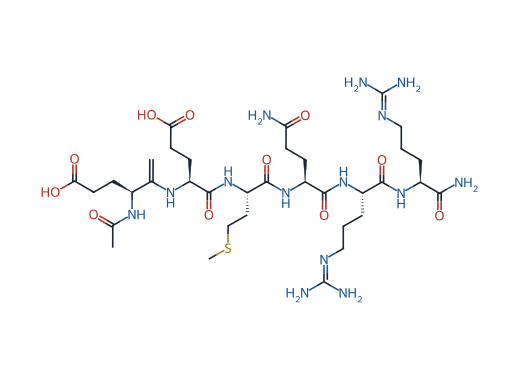
Also called acetyl hexapeptide-3, Argireline (ingredient trade name), Ac-EEMQRR-NH2, acetyl hexapeptide-8 amide, Botox in a jar
- US status
- Not approved as a drug
- DEA
- Not a controlled substance
- WADA
- Not named
- Class
- Cosmetic peptides (topical)
Jump to doses reported ↓ Dose math calculator
What it is
Acetyl hexapeptide-8, long sold as acetyl hexapeptide-3 and under the ingredient trade name Argireline, is a six-amino-acid peptide (Ac-Glu-Glu-Met-Gln-Arg-Arg-NH2) designed as a "Botox-like" cream ingredient for expression lines such as crow's feet and forehead lines S1S8. It is the best-known of the "neurotransmitter-inhibitor" cosmetic peptides. It is applied to skin; it is not an injection.
How it works
- Muscles move when nerves release acetylcholine. To release it, a nerve ending fuses tiny packets with its membrane using a protein machine called the SNARE complex. One of its parts is a protein called SNAP-25 S8.
- A decoy piece of SNAP-25. Acetyl hexapeptide-8 copies the front end of SNAP-25. It competes for SNAP-25's spot in the SNARE complex and destabilizes it, so less neurotransmitter is released S1S8S9.
- Much weaker than Botox. In lab tests it inhibited neurotransmitter release with a potency similar to botulinum toxin A but with much lower efficacy S1.
- The big catch: getting there. The target is the nerve-muscle junction, below the skin. In an FDA lab study of a 10% cream on human skin, most of the peptide washed off; 0.22% of the applied amount stayed in the outer dead-cell layer, 0.01% reached the epidermis, and none was found in the dermis S5. Reviewers say whether it reaches nerve-muscle junctions "remains uncertain" S7.
Legal status
- FDA: Not a drug. Cosmetic ingredients, other than color additives, "do not require FDA approval before they go on the market" S11.
- The claim decides the category. Products intended to affect the structure or any function of the body are drugs S11; a claim to relax muscles would fit that definition, while making lines look less noticeable is a cosmetic claim S12.
- Safety review: the Cosmetic Ingredient Review panel concluded it is "safe in cosmetics in the present practices of use at concentrations up to 0.005%," and that data are insufficient to call it safe above 0.005% S6. Several efficacy studies used far higher strengths, including 10% S1.
- DEA: Not a controlled substance.
- WADA: Not named on the 2026 List S14.
What the research actually shows
Evidence: C. A handful of small randomized studies show modest wrinkle improvements; the strongest early data came from the ingredient's developers. Reviewers note that clinical evidence for cosmetic peptides "is often weak" S13.
| Study | Design | People | Dose studied | Result |
|---|---|---|---|---|
| Blanes-Mira et al 2002 S1S8 | Placebo-controlled | 10 women (per Schagen) | 10% in an oil-in-water cream, twice daily for 30 days | Wrinkle depth reduced up to 30%; no oral toxicity or irritation at high doses in safety tests |
| Wang et al 2013 S2 | Randomized, placebo-controlled (3:1) | 60 Chinese adults | Twice daily on eye-area wrinkles for 4 weeks (strength not in the abstract) | Investigator-rated improvement 48.9% vs 0% with placebo; roughness measures fell only with the peptide |
| Raikou et al 2017 S3 | Randomized controlled, 4 groups | 24 healthy volunteers | Acetyl hexapeptide-3, tripeptide-10 citrulline, both, or neither for 60 days | Confirmed anti-wrinkle activity; best results with the combination |
| Lungu et al 2013 S4 | Randomized, double-blind, placebo-controlled pilot | 24 people with blepharospasm (eyelid spasm) getting Botox | Daily topical application (strength not in the abstract) | No significant adverse events; trend to longer Botox effect (3.7 vs 3.0 months), not significant |
| Kraeling et al 2015 S5 | FDA lab skin-penetration study | Human and guinea pig skin | 10% cream, 2 mg/cm² for 24 hours | Most washed off; none reached the dermis |
| Zhu et al 2026 S10 | Two clinical studies | 50 and 42 adults | Serum with this peptide plus four other actives, 12 weeks | Static wrinkles improved 35–69%, dynamic wrinkles 10–13% by clinical scoring. Multi-ingredient, so the peptide's share can't be separated |
What we don't know: whether the peptide does anything to muscles in people when applied to skin, whether the safe 0.005% level works at all (the positive studies mostly used higher or undisclosed strengths), and long-term effects of high-strength products.
Reported benefits
- In studies: modest reductions in wrinkle depth and roughness, mostly around the eyes S1S2S3.
- Marketed, not proven: "Botox in a jar." Botulinum toxin is injected into the muscle; this peptide is rubbed on the skin and barely gets past its outer layer S5S7.
Side effects
Common: none significant in the small trials; no primary irritation at high doses S1S4. Serious: none reported. Safety above 0.005% has not been established by the cosmetic safety panel S6.
Dangers and red flags
- Strength gap. Many products and studies use concentrations far above the 0.005% the safety panel endorsed S1S6.
- Overstated claims. It is not a substitute for botulinum toxin, and muscle-relaxing claims are drug-type claims S11.
- Injectable or "research" versions: no study supports injecting it, and no safety data exist for that use.
Doses reported
We don't recommend sh*t. These are the doses studies, labels and harm-reduction sources report. That's information, not advice. Talk to a licensed clinician.
This is a topical ingredient, so studies report concentration in the product.
| Source | Population | Dose | Route | Frequency and timing | Duration | Titration or escalation | Cite |
|---|---|---|---|---|---|---|---|
| Cosmetic Ingredient Review | Cosmetic products | Safe up to 0.005%; insufficient data above that | Topical | As used in products | Not applicable | Not applicable | S6 |
| Blanes-Mira et al 2002 | Healthy women | 10% in an oil-in-water emulsion | Topical, eye area | Twice daily (per Schagen) | 30 days | None | S1S8 |
| Wang et al 2013 | Chinese adults with eye-area wrinkles | Not stated in the abstract | Topical, eye area | Twice daily | 4 weeks | None | S2 |
| Raikou et al 2017 | Healthy volunteers | Not stated in the abstract | Topical | As directed in the trial | 60 days | None | S3 |
| Lungu et al 2013 | Adults with blepharospasm receiving Botox | Not stated in the abstract | Topical | Daily | Until symptoms returned (about 3–4 months) | None | S4 |
| Ingredient-maker data cited by Schagen 2017 | 43 women | 0.05%, alone or with 0.05% pentapeptide-18 | Topical cream | Not stated | Not stated | None | S8 |
The inline calculator is not shown on this page because reconstitution and injection math do not apply to a cream ingredient.
Monitoring a doctor would order
None. This is a cosmetic ingredient. Stop using a product that causes redness, itching or rash.
Bottom line
Acetyl hexapeptide-8 is a decoy piece of SNAP-25, a protein nerves need to release their signal, put in creams to soften expression lines. Small studies show modest wrinkle improvements, but an FDA skin study found almost none of it gets past the outer layer, the safety panel only endorses up to 0.005%, and many positive studies used far stronger or undisclosed amounts. It's a cosmetic, not "Botox in a jar."
Sources
- [S1] Blanes-Mira C, et al. A synthetic hexapeptide (Argireline) with antiwrinkle activity. Int J Cosmet Sci. 2002;24(5):303-10. PMID 18498523. (human-observational)
- [S2] Wang Y, et al. The anti-wrinkle efficacy of argireline, a synthetic hexapeptide, in Chinese subjects: a randomized, placebo-controlled study. Am J Clin Dermatol. 2013;14(2):147-53. PMID 23417317. (rct)
- [S3] Raikou V, et al. The efficacy study of the combination of tripeptide-10-citrulline and acetyl hexapeptide-3. A prospective, randomized controlled study. J Cosmet Dermatol. 2017;16(2):271-278. PMID 28150423. (rct)
- [S4] Lungu C, et al. Pilot study of topical acetyl hexapeptide-8 in the treatment for blepharospasm in patients receiving botulinum toxin therapy. Eur J Neurol. 2013;20(3):515-518. PMID 23146065. (rct)
- [S5] Kraeling ME, Zhou W, Wang P, Ogunsola OA. In vitro skin penetration of acetyl hexapeptide-8 from a cosmetic formulation. Cutan Ocul Toxicol. 2015;34(1):46-52. PMID 24754410. (in-vitro)
- [S6] Johnson W Jr, et al. Safety Assessment of Acetyl Hexapeptide-8 Amide as Used in Cosmetics. Int J Toxicol. 2025;44(2 suppl):54S-63S. PMID 40673537. (review)
- [S7] Zdrada-Nowak J, et al. Acetyl Hexapeptide-8 in Cosmeceuticals-A Review of Skin Permeability and Efficacy. Int J Mol Sci. 2025;26(12):5722. PMID 40565185. (review)
- [S8] Schagen SK. Topical Peptide Treatments with Effective Anti-Aging Results. Cosmetics. 2017;4(2):16. doi:10.3390/cosmetics4020016. (review)
- [S9] Errante F, et al. Cosmeceutical Peptides in the Framework of Sustainable Wellness Economy. Front Chem. 2020;8:572923. PMID 33195061. (review)
- [S10] Zhu M, et al. The effect of a serum containing acetyl hexapeptide-8, dipeptide diaminobutyroyl benzylamide diacetate and gluconolactone on skin biomarkers, wrinkles and skin texture: Ex vivo and clinical studies. Int J Cosmet Sci. 2026;48(5):913-925. PMID 41668671. (human-observational)
- [S11] FDA. Is It a Cosmetic, a Drug, or Both? (Or Is It Soap?). Content current as of 09/11/2024. (regulator)
- [S12] FDA. Wrinkle Treatments and Other Anti-aging Products. Content current as of 02/25/2022. (regulator)
- [S13] Pai VV, Bhandari P, Shukla P. Topical peptides as cosmeceuticals. Indian J Dermatol Venereol Leprol. 2017;83(1):9-18. PMID 27451932. (review)
- [S14] World Anti-Doping Agency. 2026 Prohibited List (cosmetic peptides not named). (regulator)