
SARMs & adjacent non-peptides
ACP-105
Also called ACP105, selective androgen receptor modulator
- US status
- Not approved
- DEA
- Not a federally scheduled controlled substance; sale as a dietary supplement is illegal and SARMs are widely banned at the state level and by trade rules
- WADA
- S1.2 Other anabolic agents (SARMs); prohibited at all times
- Class
- SARMs & adjacent non-peptides
Jump to doses reported ↓ Dose math calculator
What it is
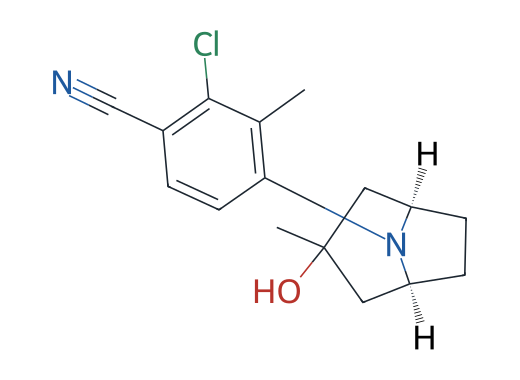
ACP-105 is a non-steroidal selective androgen receptor modulator: a small molecule that acts on the androgen receptor, the receptor testosterone uses, and was designed to favour muscle and bone over the prostate. It came out of pharmaceutical research and never reached approval anywhere. What makes ACP-105 unusual among the SARMs people buy is how little exists about it: searching the medical literature turns up essentially no pharmacology papers in people or in whole animals for muscle outcomes, and instead a run of papers on how to detect it in urine and hair for anti-doping purposes and computer-model predictions of what its toxicity might be S2S3S4S5. It is sold through the grey market as a "research chemical" or mislabeled as a supplement.
How it works
ACP-105 is a non-steroidal molecule that binds the androgen receptor, the same receptor testosterone acts on, and acts as a partial agonist: it switches the receptor on in muscle and bone while, by design, acting more weakly in tissues such as the prostate. Because it is not a steroid, it is not converted to estrogen or DHT, which is the basis of the claim that it builds muscle with fewer androgenic effects. For ACP-105 specifically that mechanism is inferred — from the SARM class and from laboratory and computer-model work on its metabolism and toxicity — rather than demonstrated, since there are essentially no published muscle-outcome studies in whole animals or people S3S4S5. Across SARMs as a class, the selectivity is relative, not absolute: human reports still show suppression of the body's own testosterone and liver injury S6.
Legal status
- FDA: Not approved for any use. FDA warns against SARM body-building products and has acted against sellers S1.
- Dietary-supplement status: SARMs are not lawful dietary ingredients; selling ACP-105 as a supplement is illegal S1.
- DEA: Not currently a federally scheduled controlled substance (any newer SARM scheduling legislation should be checked against current law).
- "Research use only" products: ACP-105 reaches buyers as research powder or liquid of unverified content. See our explainer.
- WADA: Prohibited at all times under S1.2 S8. Anti-doping laboratories include ACP-105 in routine SARM screening of urine and hair, and have mapped its human metabolites so that use can be proven S2S3.
- International (short): Not reviewed for this page yet.
What the research actually shows
Evidence: E. There is no published human efficacy trial and no published human safety study of ACP-105. The only work involving human samples is metabolite mapping for doping control, which tells you what the body turns ACP-105 into, not what it does for or to a person S3. The toxicity papers are computer predictions, not measurements in living tissue S4S5.
| Study | Design | Subject | What it studied | Result |
|---|---|---|---|---|
| Broberg 2023 S3 | Analytical chemistry, in vitro metabolites compared with human in vivo metabolites | Human samples and liver preparations | Which metabolites identify ACP-105 use | Maps the metabolites used to prove use in doping control |
| Gheddar 2021 S2 | Validated hair screening method for nine SARMs including ACP-105 | Human hair | Whether SARM use can be detected in hair | Method validated; demonstrates that use leaves a measurable record |
| Fijalkowska 2025 (toxicity) S4 | In silico prediction of toxicological endpoints | Computer models | Predicted toxicity of ACP-105 | Model-based predictions only; the authors frame the work as filling a gap left by the absence of real toxicity data |
| Fijalkowska 2025 (ADME) S5 | In silico absorption, distribution, metabolism, excretion profile | Computer models | Predicted pharmacokinetics | First assembled profile, built from models rather than measurements in people |
What we don't know: whether ACP-105 does anything useful in a human, at what dose, for how long it stays in the body, and what it does to the liver, cholesterol, or hormones. For this compound the honest summary is that the scientific record exists mainly so that laboratories can catch athletes using it.
Reported benefits
None are established, in people or in animals, in any study we could cite. What users report is user-reported, not tested. The muscle and bone rationale for this class comes from SARM pharmacology in general, not from published ACP-105 results S6.
Side effects
Common: no human side-effect data exist for ACP-105. Across the SARM class, the typical findings in people are suppression of the body's own testosterone and falls in HDL ("good") cholesterol S6. Serious: no ACP-105-specific human data. For SARMs as a group, drug-induced liver injury, sometimes severe, is the most serious documented harm S1S6. The computational toxicology work flags predicted concerns, but predictions are not findings S4S5.
Dangers and red flags
- A near-total absence of evidence. No human or whole-animal efficacy study, no human safety study, no measured pharmacokinetics S3S4S5.
- Liver injury across the class. SARM-associated liver injury is documented, and products often contain several SARMs at once S1S6S7.
- Hormone suppression. Expected of androgen receptor agonists, unmeasured for this one S6.
- What is in the bottle is unknown. When SARM products bought online were analyzed, most did not match their labels; some held other unapproved drugs and some held no active drug S7.
- Sport: prohibited at all times, and laboratories specifically screen for it in urine and hair S2S3S8.
Doses reported
We don't recommend sh*t. These are the doses studies, labels and harm-reduction sources report. That's information, not advice. Talk to a licensed clinician.
There is no citable dosing data for ACP-105 in humans. It has no FDA label (never approved), no human trial, and the published literature does not report a human dose. We will not fill that gap with forum or vendor numbers. ACP-105 is taken by mouth, so the reconstitution calculator does not apply.
Monitoring a doctor would order
No guideline, trial or monitoring standard exists. For anyone who has taken a SARM, the checks a clinician would reach for are liver enzymes and bilirubin, a lipid panel, and testosterone with LH and FSH S1S6.
Bottom line
ACP-105 is a never-approved SARM with one of the emptiest evidence files of any compound sold in this market: no human efficacy trial, no human safety study, no measured pharmacokinetics, and a published record consisting mostly of anti-doping detection methods and computer-model toxicity predictions. It is banned in sport at all times, screened for in urine and hair, and sold in products whose contents routinely do not match their labels.
Sources
- [S1] U.S. FDA. FDA Warns of Use of Selective Androgen Receptor Modulators (SARMs) Among Teens, Young Adults (consumer update). SARMs are unapproved drugs that cannot be legally marketed in the US as a dietary supplement or a drug; FDA has issued warning letters to sellers and pursued criminal actions, and lists liver injury and acute liver failure, heart attack or stroke risk, psychosis, sexual dysfunction, infertility and testicular shrinkage among reported harms. (regulator)
- [S2] Gheddar L, Raul JS, Kintz P. Development and validation of SARMs and metabolic modulators screening in hair using UHPLC-MS/MS: Application to a doping case and first identification of S23 in authentic human hair. J Chromatogr B. 2021;1187:123048. PMID 34814052. (ACP-105 is one of the nine SARMs covered by the method.) (review)
- [S3] Broberg MN, et al. A multivariate data analysis approach for the investigation of in vitro derived metabolites of ACP-105 in comparison with human in vivo metabolites. J Chromatogr B. 2023;1231:123927. PMID 37972465. (human-observational)
- [S4] Fijalkowska O, et al. Toxicity of ACP-105: a substance used as doping in sports: application of in silico methods for prediction of selected toxicological endpoints. Arch Toxicol. 2025;99(4):1485-1503. PMID 40064700. (in-vitro)
- [S5] Fijalkowska O, et al. First multifaceted ADME profile of ACP-105 (CAS: 1048998-11-3): a novel non-steroidal selective androgen receptor modulator used as doping in sports - integrative in silico toxicological studies for clinical and forensic toxicology purposes. Arch Toxicol. 2025;99(12):5047-5063. PMID 40928534. (in-vitro)
- [S6] Vignali JD, et al. Systematic Review of Safety of Selective Androgen Receptor Modulators in Healthy Adults: Implications for Recreational Users. J Xenobiot. 2023;13(2):218-236. PMID 37218811. (review)
- [S7] Van Wagoner RM, Eichner A, Bhasin S, Deuster PA, Eichner D. Chemical Composition and Labeling of Substances Marketed as Selective Androgen Receptor Modulators and Sold via the Internet. JAMA. 2017;318(20):2004-2010. PMID 29183075. (human-observational)
- [S8] World Anti-Doping Agency. 2026 Prohibited List, section S1.2 (other anabolic agents, SARMs). (regulator)