
Skin, tanning & sexual-health peptides
Afamelanotide (Scenesse; melanotan I)
Also called Scenesse, melanotan I, melanotan-1, MT-I, [Nle4-D-Phe7]-alpha-MSH, NDP-MSH
- US status
- Approved (Scenesse, 2019): more pain-free light exposure in adults with erythropoietic protoporphyria (EPP)
- DEA
- Not a controlled substance
- WADA
- Not named
- Class
- Skin, tanning & sexual-health peptides
Jump to doses reported ↓ Dose math calculator
What it is
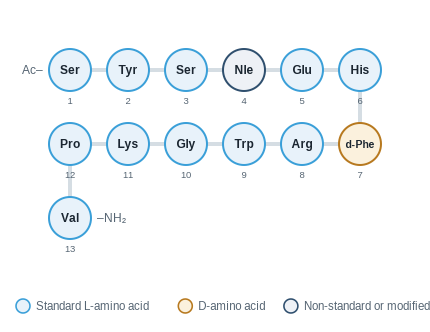
Afamelanotide is a lab-made, 13-amino-acid version of alpha-melanocyte-stimulating hormone (alpha-MSH), the body's own signal for making skin pigment S1. It was first studied in the 1990s under the name melanotan I S4. As Scenesse, it is FDA-approved for one rare disease: erythropoietic protoporphyria (EPP), in which light on the skin causes excruciating pain S2. A health care professional places a small implant under the skin every 2 months, and it raises pain-free time in light S1S2.
Online, "Melanotan I" is also sold as a powder vial for tanning. That is not Scenesse, and it is not approved for anything. Don't confuse it with the riskier melanotan II, a different molecule.
How it works
- Switches on the pigment receptor. Afamelanotide binds mainly to the melanocortin 1 receptor (MC1-R) on pigment cells S1.
- Makes dark pigment without sun. It increases eumelanin, the brown-black pigment, in the skin without any sun or UV exposure S1. In volunteers, forearm eumelanin roughly doubled one week after 10 daily injections S5.
- A souped-up hormone. Two amino-acid swaps (positions 4 and 7, as its chemical name [Nle4-D-Phe7]-alpha-MSH shows) make it what researchers called a "superpotent" alpha-MSH S5S6. From the controlled-release implant, its half-life is about 15 hours S1.
- Why it was tried in EPP. Researchers tested whether extra melanin protects skin from light. In fair-skinned volunteers it cut sunburn cells and UV DNA damage S7, and in EPP trials it lengthened pain-free time in light S2.
Legal status
- FDA: Approved in 2019 as Scenesse, a 16 mg implant, "to increase pain free light exposure in adult patients with a history of phototoxic reactions from erythropoietic protoporphyria (EPP)" S1. It must be implanted by a trained health care professional S1. It is not approved for tanning, vitiligo, or any cosmetic use.
- Compounding: afamelanotide does not appear on FDA's 503A category lists. Compounded or grey-market "Melanotan I" is not Scenesse.
- DEA: Not a controlled substance.
- "Research use only" vials: see our explainer.
- WADA: Not named on the 2026 List. Because afamelanotide is approved, the S0 catch-all for unapproved substances does not apply to it S8.
What the research actually shows
Evidence: A for EPP. Two randomized phase 3 trials led to approval. Tanning and photoprotection data come from small 1990s–2000s studies of daily injections.
| Study | Design | People | Dose studied | Result |
|---|---|---|---|---|
| Langendonk et al 2015, US trial S2 | Randomized, double-blind, placebo-controlled phase 3 | 94 adults with EPP | 16 mg implant every 60 days (3 implants) | Median pain-free time in direct sun 69.4 h vs 40.8 h (p = 0.04); quality of life improved |
| Langendonk et al 2015, EU trial S2 | Randomized, double-blind, placebo-controlled phase 3 | 74 adults with EPP | 16 mg implant every 60 days (5 implants) | Median pain-free time 6.0 h vs 0.8 h (p = 0.005); phototoxic reactions 77 vs 146 |
| Lim et al 2015 S3 | Randomized, multicenter | 55 adults with vitiligo | 16 mg implant monthly for 4 months, plus narrowband UV-B | Repigmentation 48.6% vs 33.3% with UV-B alone at day 168; faster on face and arms |
| Barnetson et al 2006 S7 | Randomized, placebo-controlled | 65 fair-skinned volunteers | 0.16 mg/kg a day injected under the skin, three 10-day courses over 3 months | Melanin up 41% in those who burn easily; sunburn cells down more than 50%; UV DNA damage (thymine dimers) down 59% |
| Dorr et al 2004 S6 | Three phase 1 trials | 24 volunteers in total | 0.08 or 0.16 mg/kg a day under the skin with UV-B or sunlight | Tanning with fewer sunburn cells; tan lasted longer with less sun; side effects minor (nausea, flushing) |
| Ugwu et al 1997 S4 | Randomized crossover | 3 men | 0.16 mg/kg IV or by mouth; 0.08–0.21 mg/kg under the skin; 10 doses over 2 weeks | Under-the-skin dose fully absorbed; nothing detectable in blood when swallowed; tan lasted 3+ weeks |
What we don't know: long-term effects of years of use on moles and skin cancer risk (carcinogenicity studies have not been done S1), and what grey-market "Melanotan I" vials contain.
Reported benefits
- Approved use: more time in light without pain and fewer painful reactions in EPP S1S2.
- In trials: faster repigmentation in vitiligo when added to UV-B S3; darker skin, fewer sunburn cells and less UV DNA damage in fair-skinned volunteers S7.
- Grey-market use: tanning without (or with less) sun. The 2000s studies tested this with daily injections S6S7; the approved product is not meant for it.
Side effects
Common (label, implant vs placebo): implant-site reactions 21% vs 10%, nausea 19% vs 14%, sore throat 7% vs 5%, cough 6% vs 3%, fatigue 6% vs 3%, skin darkening 4% vs 0%, dizziness 4% vs 3%, new or changing moles (melanocytic nevus) 4% vs 2% S1. Daily injection studies reported nausea and brief facial flushing S4S6. Serious: serious allergic reactions, including anaphylaxis, after approval S1. In the phase 3 trials, serious adverse events were not thought to be drug related S2.
Dangers and red flags
- Moles darken. The label warns it can darken skin overall and darken existing moles and freckles, and calls for a full-body skin exam twice a year S1. Darker moles are harder to judge for melanoma.
- Allergic reactions. Anaphylaxis has been reported; people who have had a severe reaction should not get it again S1.
- Grey-market vials are not Scenesse. Powder vials are not tested for identity, dose, sterility or endotoxin, and may contain something other than afamelanotide.
- Partial protection only. Volunteer studies showed fewer sunburn cells and less DNA damage, not complete protection from UV S7.
- Who should avoid it: there are no data in pregnancy, and safety in children has not been established S1.
Doses reported
We don't recommend sh*t. These are the doses studies, labels and harm-reduction sources report. That's information, not advice. Talk to a licensed clinician.
| Source | Population | Dose | Route | Frequency and timing | Duration | Titration or escalation | Cite |
|---|---|---|---|---|---|---|---|
| Scenesse label | Adults with EPP | One 16 mg implant | Implant under the skin, above the front of the hip bone, by a trained health care professional | Every 2 months | Ongoing as prescribed | None | S1 |
| Langendonk et al 2015 | Adults with EPP | 16 mg implant | Implant under the skin | Every 60 days | 3 implants (US) or 5 implants (EU) | None | S2 |
| Lim et al 2015 | Adults with vitiligo, plus UV-B | 16 mg implant | Implant under the skin | Monthly | 4 months | None | S3 |
| Barnetson et al 2006 | Fair-skinned adult volunteers | 0.16 mg/kg | Injection under the skin (abdomen) | Daily for 10 days, three times | 3 months | None | S7 |
| Dorr et al 2004 | Adult volunteers with UV-B or sun | 0.08 or 0.16 mg/kg | Injection under the skin | Daily (10 days) or 5 days a week | 10 days to 4 weeks | Higher dose in later study | S6 |
| Dorr et al 2000 | 7 adult volunteers | 0.16 mg/kg | Injection under the skin | Once daily, Monday–Friday | 2 weeks (10 doses) | None | S5 |
| Ugwu et al 1997 | 3 adult men | 0.08–0.21 mg/kg | Under the skin (also IV; by mouth was not absorbed) | 5 days a week | 2 weeks (10 doses) | Crossover between routes | S4 |
The research doses are per kilogram of body weight, so the total differs by person. The implant releases its 16 mg slowly over weeks and cannot be compared mg for mg with daily injections.
Open the dose math calculator →
Monitoring a doctor would order
Per the label: a full-body skin examination twice a year to check existing and new pigmented spots, and watching for allergic reactions S1.
Bottom line
Afamelanotide is a longer-lasting copy of the body's tanning hormone. As the Scenesse implant, it's a real, FDA-approved drug that gives people with a rare light-pain disease more pain-free time outdoors. Small older studies showed daily injections tan the skin and cut sunburn damage. Its main known downsides are nausea, implant-site reactions and darker moles that need twice-yearly skin checks. Grey-market "Melanotan I" vials are not the approved drug.
Sources
- [S1] SCENESSE (afamelanotide) implant, for subcutaneous use. Prescribing information (DailyMed set ID 94f53286-11dd-7fbb-e053-2a95a90a7c48). Initial U.S. approval 2019. (label)
- [S2] Langendonk JG, et al. Afamelanotide for Erythropoietic Protoporphyria. N Engl J Med. 2015;373(1):48-59. PMID 26132941. (rct)
- [S3] Lim HW, et al. Afamelanotide and narrowband UV-B phototherapy for the treatment of vitiligo: a randomized multicenter trial. JAMA Dermatol. 2015;151(1):42-50. PMID 25230094. (rct)
- [S4] Ugwu SO, et al. Skin pigmentation and pharmacokinetics of melanotan-I in humans. Biopharm Drug Dispos. 1997;18(3):259-69. PMID 9113347. (rct)
- [S5] Dorr RT, et al. Increased eumelanin expression and tanning is induced by a superpotent melanotropin [Nle4-D-Phe7]-alpha-MSH in humans. Photochem Photobiol. 2000;72(4):526-32. PMID 11045725. (human-case-series)
- [S6] Dorr RT, et al. Effects of a superpotent melanotropic peptide in combination with solar UV radiation on tanning of the skin in human volunteers. Arch Dermatol. 2004;140(7):827-35. PMID 15262693. (rct)
- [S7] Barnetson RS, et al. [Nle4-D-Phe7]-alpha-melanocyte-stimulating hormone significantly increased pigmentation and decreased UV damage in fair-skinned Caucasian volunteers. J Invest Dermatol. 2006;126(8):1869-78. PMID 16763547. (rct)
- [S8] World Anti-Doping Agency. 2026 Prohibited List (afamelanotide not named; S0 applies only to substances with no current government approval for human therapeutic use). (regulator)