
SARMs & adjacent non-peptides
AICAR (acadesine)
Also called acadesine, AICA riboside, 5-aminoimidazole-4-carboxamide ribonucleotide, ARA 100, GP 1 110
- US status
- Not approved
- DEA
- Not a federally scheduled controlled substance; it is an unapproved drug and is not a lawful dietary ingredient
- WADA
- S4.4.1 Metabolic modulators (AMPK activators; AICAR named); prohibited at all times
- Class
- SARMs & adjacent non-peptides
Jump to doses reported ↓ Dose math calculator
What it is
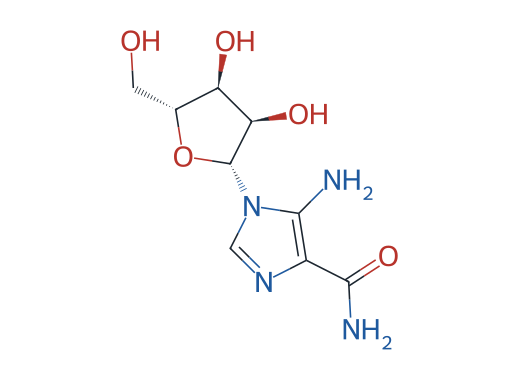
AICAR is a molecule the body already makes as an intermediate step in building purines, the raw material of DNA. It has two completely separate lives. In medicine, as acadesine, it was given by intravenous drip during heart bypass surgery to protect the heart muscle, and was tested in thousands of patients S2S3S4. In sport, it is bought as a powder for injection on the strength of a mouse experiment in which sedentary mice given AICAR for four weeks ran 44% further S1.
How it works
Inside a cell, AICAR is phosphorylated to ZMP, a molecule that mimics AMP — the chemical signal of low cellular energy. ZMP switches on AMPK, the enzyme that acts as the cell's fuel gauge: when AMPK goes on, the cell burns fat, takes up glucose, and turns on the genetic programme that builds mitochondria S1S6. That is the whole basis for selling it for endurance, and it is why anti-doping authorities class it as a metabolic modulator S8. The endurance claim itself rests on a mouse experiment, in which sedentary mice given AICAR for four weeks ran 44% further S1; no trial has shown the same in people. Its separate medical use as acadesine works through a different consequence of the same chemistry — regulating adenosine release in ischaemic tissue to protect heart muscle S5.
Legal status
- FDA: Not approved. Acadesine went through a large phase 3 cardiac-surgery trial that was stopped early for futility; there is no approved product and no approval for any use S2S5.
- Dietary-supplement status: AICAR is an unapproved drug and is not a lawful dietary ingredient; selling it as a supplement is illegal.
- DEA: Not a federally scheduled controlled substance.
- "Research use only" products: AICAR sold as a vial of powder for injection is research material of unverified content, and illicitly distributed AICAR products have been seized by authorities S6. See our explainer.
- WADA: Prohibited at all times. AICAR is named on the Prohibited List and has been since 2009 S6S8.
- International (short): Not reviewed for this page yet.
What the research actually shows
Evidence: B. There is substantial randomized human evidence for AICAR, and it is all about intravenous use during heart surgery, not about exercise. The surgical story went from promising to negative: an early patient-level meta-analysis of five randomized trials found fewer heart attacks and deaths, while the much larger modern trial found nothing S2S3. The endurance claim rests on mice S1.
| Study | Design | People | Dose studied | Result |
|---|---|---|---|---|
| RED-CABG, Newman 2012 S2S7 | Randomized, double-blind, placebo-controlled phase 3, 300 sites in 7 countries | 3,080 intermediate- to high-risk patients having bypass surgery (target was 7,500) | Acadesine 0.1 mg/kg per minute intravenously for 7 hours, also added to the cardioplegia solution | Stopped early for futility. The primary outcome (death, nonfatal stroke, or mechanical support for severe heart dysfunction through day 28) occurred in 5.1% on acadesine versus 5.0% on placebo (odds ratio 1.01) |
| McSPI meta-analysis, Mangano 1997 S3 | Patient-level meta-analysis of 5 randomized, double-blind, placebo-controlled trials | 4,043 bypass surgery patients (2,012 on acadesine) | Acadesine 0.1 mg/kg per minute intravenously for 7 hours, plus cardioplegia solution | Perioperative heart attack reduced 27%, early cardiac death reduced 50%, combined outcome reduced 26%; stroke not significantly reduced; adverse events similar to placebo apart from a transient rise in uric acid |
| Mangano 2006 S4 | Long-term follow-up analysis of randomized data | Bypass surgery patients with post-reperfusion heart attack | Acadesine by intravenous infusion, as above | Reported better long-term survival among patients who had a post-reperfusion heart attack |
| Narkar 2008 S1 | Animal study | Mice | Four weeks of AICAR, dose not transferable to people | Sedentary mice given AICAR alone ran 44% further and switched on oxidative muscle genes: the origin of the "exercise in a pill" idea |
What we don't know, for the use it is sold for: everything. No human study has tested AICAR for endurance, body composition or fat loss, at any dose, by any route. The human doses that exist are hours-long intravenous infusions in an operating theatre, under anaesthesia, measured per kilogram per minute, which have no relationship to a self-administered injection.
Reported benefits
In surgery, the early randomized data suggested fewer heart attacks and deaths after bypass surgery, but the definitive modern trial found no benefit at all and was halted S2S3S4. In mice, markedly greater running endurance without training S1. For human performance, there is nothing: the endurance benefit is animal-tested and user-reported, never measured in a person.
Side effects
Common: in the randomized surgical trials, adverse events were similar to placebo, with the exception of a transient rise in serum uric acid S3. That makes mechanistic sense: AICAR is a purine-pathway molecule, and purine breakdown ends in uric acid. Serious: the large phase 3 trial found no difference in key safety outcomes between acadesine and placebo in surgical patients S2. There is no safety data at all for repeated subcutaneous or intramuscular dosing in healthy people, which is how grey-market AICAR is used.
Dangers and red flags
- The human data do not transfer. Safety shown for a 7-hour intravenous infusion under anaesthesia says nothing about repeated self-injection in a healthy person S2S3.
- Uric acid. The one consistent drug-related signal in trials was a transient uric acid rise, which matters for anyone with gout or kidney disease S3.
- AMPK is a master switch, not a muscle switch. It governs fuel handling in liver, muscle, fat and brain; pushing it pharmacologically in a healthy body has not been studied for safety over time S1S6.
- Illicit supply. Authorities have seized illegally distributed AICAR products; what is in a grey-market vial is unverified in identity, dose and sterility S6.
- Sport: named on the Prohibited List and prohibited at all times, with established detection methods S6S8.
Doses reported
We don't recommend sh*t. These are the doses studies, labels and harm-reduction sources report. That's information, not advice. Talk to a licensed clinician.
There is no FDA label (never approved), so there is no label dose. Every citable human dose below is an intravenous infusion given in hospital during heart surgery, expressed per kilogram per minute. There is no citable human dose for the endurance or fat-loss use, and we will not fill that gap with forum or vendor numbers.
| Source | Dose | Unit / route | Frequency | Timing | Duration | Titration / escalation | Context |
|---|---|---|---|---|---|---|---|
| S2S7 RED-CABG | 0.1 mg/kg per minute | mg/kg/min, intravenous infusion, plus addition to the cardioplegia solution | Single perioperative infusion | Started just before anaesthesia induction | 7 continuous hours | None | 3,080 patients having on-pump bypass surgery |
| S3 McSPI pooled trials | 0.1 mg/kg per minute | mg/kg/min, intravenous infusion, plus cardioplegia solution | Single perioperative infusion | Before and during surgery | 7 continuous hours | None | 4,043 bypass surgery patients across 5 randomized trials |
Open the dose math calculator →
Monitoring a doctor would order
No guideline exists for an unapproved drug used outside hospital. The trial-relevant check is serum uric acid, the one consistent drug-related laboratory change, along with kidney function S3. Beyond that, there is no monitoring standard for AICAR in healthy people because that use has never been studied.
Bottom line
AICAR (acadesine) has real randomized human evidence, and none of it is about exercise: thousands of patients received it as a 7-hour intravenous infusion during heart bypass surgery, where an early meta-analysis suggested benefit and a definitive 3,080-patient trial found none and was stopped. The endurance reputation comes from mice that ran 44% further. There is no human dose, efficacy result or safety record for self-injected AICAR, the one consistent trial side effect was a transient uric acid rise, and it is named on the Prohibited List as banned in sport at all times.
Sources
- [S1] Narkar VA, et al. AMPK and PPARdelta agonists are exercise mimetics. Cell. 2008;134(3):405-415. PMID 18674809. (animal)
- [S2] Newman MF, et al. Effect of adenosine-regulating agent acadesine on morbidity and mortality associated with coronary artery bypass grafting: the RED-CABG randomized controlled trial. JAMA. 2012;308(2):157-164. PMID 22782417. ClinicalTrials.gov NCT00872001. (rct)
- [S3] Mangano DT. Effects of acadesine on myocardial infarction, stroke, and death following surgery. A meta-analysis of the 5 international randomized trials. The Multicenter Study of Perioperative Ischemia (McSPI) Research Group. JAMA. 1997;277(4):325-332. PMID 9002496. (rct)
- [S4] Mangano DT, et al. Post-reperfusion myocardial infarction: long-term survival improvement using adenosine regulation with acadesine. J Am Coll Cardiol. 2006;48(1):206-214. PMID 16814669. (rct)
- [S5] Acadesine: AICA riboside, ARA 100, arasine, GP 1 110 (drug profile). Drugs R D. 2008;9(3):169-175. PMID 18457469. (review)
- [S6] Pokrywka A, et al. Metabolic modulators of the exercise response: doping control analysis of an agonist of the peroxisome proliferator-activated receptor delta (GW501516) and 5-aminoimidazole-4-carboxamide ribonucleotide (AICAR). J Physiol Pharmacol. 2014;65(4):469-476. PMID 25179079. (review)
- [S7] ClinicalTrials.gov. Reduction in Cardiovascular Events by Acadesine in Subjects Undergoing CABG Surgery (RED-CABG), NCT00872001. (regulator)
- [S8] World Anti-Doping Agency. 2026 Prohibited List, section S4.4.1 (metabolic modulators; AMPK activators, AICAR named). (regulator)