
AAS ancillaries & fertility drugs
Anastrozole
Also called Arimidex, aromatase inhibitor, AI
- US status
- Approved
- DEA
- Not a controlled substance
- WADA
- S4.1 Aromatase inhibitors; prohibited at all times (named)
- Class
- AAS ancillaries & fertility drugs
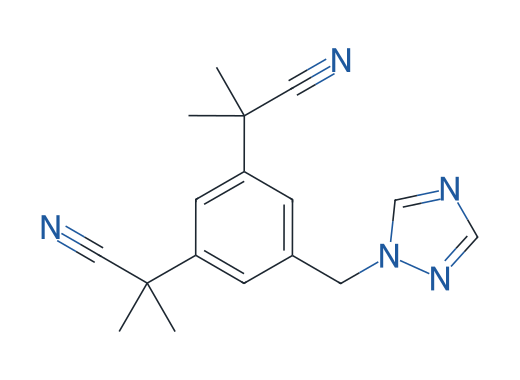
Jump to doses reported ↓ Dose math calculator
What it is
Anastrozole (Arimidex) is an aromatase inhibitor, an approved drug for breast cancer in postmenopausal women. It appears on this reference because anabolic-steroid users take it off-label to counter the estrogen-related effects (such as gynecomastia and fluid retention) of aromatizing steroids, a use it was never approved or studied for in that population.
How it works
Most estrogen in postmenopausal women, and a meaningful share in men, is made outside the ovaries by aromatase, the enzyme that converts androgens such as testosterone and androstenedione into estradiol and estrone, largely in fat tissue. Anastrozole is a non-steroidal, reversible inhibitor of that enzyme, so circulating estrogen falls while the androgen supply is untouched S1. In hormone-receptor-positive breast cancer, removing the estrogen that feeds the tumour is the point, and that is what the pivotal trial tested S2. The off-label use among steroid users leans on the same step: aromatizing steroids are converted to estradiol, and blocking aromatase lowers it. That use has no controlled evidence in that population, and estrogen is not a waste product — it carries bone, lipid and libido functions, so driving it down has consequences of its own S1.
Legal status
- FDA: Approved for breast cancer in postmenopausal women (adjuvant treatment and advanced disease). The off-label use to control estrogen in steroid users is not an approved indication S1.
- DEA: Not a controlled substance.
- Prescription drug: anastrozole is a prescription medicine; buying it from grey-market "research chemical" sellers means an unapproved product of unverified content.
- WADA: Named under S4.1 (aromatase inhibitors) and prohibited at all times in sport S3.
- International (short): Not reviewed for this page yet.
What the research actually shows
Evidence: A for its approved use. Anastrozole is supported by large, high-quality oncology trials. There is essentially no controlled evidence for its off-label use alongside anabolic steroids.
| Study | Design | People | Dose studied | Result |
|---|---|---|---|---|
| ATAC (Howell 2005) S2 | Randomized, double-blind, 5-year trial | 9,366 postmenopausal women with localized breast cancer | 1 mg/day oral | Anastrozole significantly prolonged disease-free survival and reduced recurrence versus tamoxifen |
| Label S1 | Approved indications | Postmenopausal women with breast cancer | 1 mg/day oral | Basis of approval for adjuvant and advanced breast cancer |
What we don't know: the safety and effect of anastrozole used off-label by (mostly younger, male) steroid users; driving estrogen too low carries its own harms (see below).
Reported benefits
In its approved use: better breast-cancer outcomes than tamoxifen in postmenopausal women S2. Steroid users take it to blunt estrogenic side effects of aromatizing steroids, but that benefit is unproven in that setting and comes with the risks of over-suppressing estrogen.
Side effects
Common: joint pain and stiffness, hot flushes, fatigue, and (from low estrogen) reduced libido and mood changes. Serious: estrogen is essential for bone and cardiovascular health, so lowering it reduces bone mineral density and raises fracture risk over time, and worsens cholesterol; in men, driving estrogen too low causes joint problems, low libido, and poor lipid and bone outcomes S1.
Dangers and red flags
- Over-suppressing estrogen is harmful. Too little estrogen damages bone, lipids, libido, and mood, a real risk in off-label steroid use.
- Bone loss. Anastrozole reduces bone density; this matters with long use S1.
- Grey-market product. "Research chemical" anastrozole is an unapproved product of unverified content.
- Sport: named and prohibited at all times S3.
- Who should use it: people with an approved indication under a clinician, not as a self-managed add-on to steroids.
Doses reported
We don't recommend sh*t. These are the doses studies, labels and harm-reduction sources report. That's information, not advice. Talk to a licensed clinician.
The row below is the FDA label dosing for the approved breast-cancer use, which is also the dose used in ATAC. There is no citable medical dosing for off-label use alongside steroids, so none is listed. Anastrozole is a tablet, so the reconstitution calculator does not apply.
| Source | Dose | Unit / route | Frequency | Timing | Duration | Titration / escalation | Context |
|---|---|---|---|---|---|---|---|
| S1S2 Label / ATAC | 1 mg | mg, oral | Once daily | Any time, with or without food | Adjuvant use typically 5 years; advanced disease until progression | Fixed dose; no titration | Breast cancer, postmenopausal women |
No citable medical dosing for off-label aromatase-inhibitor use by steroid users was found that we could cite; we will not fill that gap with forum or vendor numbers.
Monitoring a doctor would order
For the approved use, clinicians monitor bone mineral density (DXA), cholesterol, and symptoms, since estrogen suppression affects bone and lipids S1. Anyone taking it off-label to control estrogen would, if supervised, need estradiol, bone, and lipid monitoring to avoid over-suppression.
Bottom line
Anastrozole (Arimidex) is an approved aromatase inhibitor with strong evidence in postmenopausal breast cancer. Its off-label use to control estrogen in anabolic-steroid users is unstudied and risks over-suppressing estrogen, harming bone, lipids, libido, and mood. It is a prescription drug, named and banned in sport at all times.
Sources
- [S1] Anastrozole tablets. US prescribing information (DailyMed). Indicated for breast cancer in postmenopausal women; label dosing one 1 mg tablet once daily. Set ID da6ae05c-81e9-492a-a4c9-be3f1f367b59. (label)
- [S2] Howell A, et al. (ATAC Trialists' Group) Results of the ATAC (Arimidex, Tamoxifen, Alone or in Combination) trial after completion of 5 years' adjuvant treatment for breast cancer. Lancet. 2005;365:60-62. PMID 15639680. (rct)
- [S3] World Anti-Doping Agency. 2026 Prohibited List, section S4.1 (aromatase inhibitors; anastrozole named). (regulator)