
Growth hormone & GH-axis peptides
AOD-9604
Also called AOD9604, anti-obesity drug 9604, hGH fragment 176-191, AOD
- US status
- Not approved
- DEA
- Not a controlled substance
- WADA
- Not specifically named; a hGH fragment with no GH/IGF-1 effect, so not clearly prohibited, but athletes should assume anti-doping risk and check with their federation
- Class
- Growth hormone & GH-axis peptides
Jump to doses reported ↓ Dose math calculator
What it is
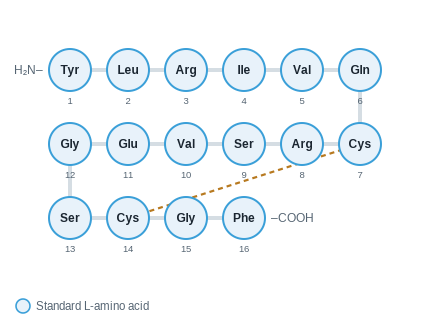
AOD-9604 ("anti-obesity drug 9604") is a short synthetic fragment of the tail end of human growth hormone (residues 176–191). It was developed as a weight-loss drug, failed to beat placebo in human obesity trials, and was never approved. It is now sold in the grey market for fat loss, and marketed by some for joint and cartilage repair, neither of which it is approved for.
How it works
Growth hormone has two broadly separable actions: growth and insulin resistance, which run through the GH receptor and IGF-1, and fat breakdown, which maps to the tail end of the molecule. AOD-9604 is that tail fragment (residues 176-191) with a tyrosine added, built to capture the fat-burning action alone S2. In mice, it reduced body fat and raised fat oxidation without raising IGF-1 or impairing glucose tolerance, and the effect persisted in beta-3-adrenergic-receptor knockout mice, so it does not simply act like a beta-3 agonist S2S3. That is where the mechanism stops being supported: in human obesity trials the compound did not beat placebo for weight loss S4, and the joint- and cartilage-repair marketing has no mechanistic or clinical basis S5. Because it is a peptide fragment, FDA also flags immunogenicity and impurity concerns for it as a compounding substance S1.
Legal status
- FDA: Not approved as a drug. Obesity development did not succeed. AOD-9604 is on the FDA compounding category 2 list, flagged for possible immunogenicity, peptide-related impurities and characterization complexity, with an adverse event noted (causality unclear) S1.
- Compounding / HHS list: its category 2 placement signals FDA safety concern; it is not in the October 2026 HHS enforcement-discretion peptide list.
- DEA: Not a controlled substance.
- "Research use only" powder: the usual way it is sold; that label means no one has checked it for human use. See our explainer.
- WADA: Not specifically named on the Prohibited List; because it is a GH fragment without GH or IGF-1 activity, it is not clearly captured, but the position is not settled, so athletes should assume risk and check with their federation.
- International (short): Not reviewed for this page yet.
What the research actually shows
Evidence: D. The published, peer-reviewed evidence is animal only. AOD-9604 reduced weight gain and increased fat breakdown in obese rodents. In humans, the company-sponsored obesity trials did not show weight loss beyond placebo, and those human results were not published as a peer-reviewed clinical trial; the only peer-reviewed human-facing references are a drug-development profile and a recent review.
| Study | Design | Subject | Dose studied | Result |
|---|---|---|---|---|
| Ng 2000 S2 | Animal | Obese Zucker rats | 500 mcg/kg oral daily, 19 days | Cut body-weight gain >50% vs control; raised fat-tissue lipolysis; no loss of insulin sensitivity |
| Heffernan 2001 S3 | Animal / mechanism | Obese mice and β3-AR knockout mice | Chronic IP dosing, 14 days | Reduced body weight/fat and raised β3-adrenergic receptor expression; effect lost in knockout mice |
| Wilding 2004 S4 | Development profile | — | — | Notes AOD-9604 was in phase 2 obesity trials at Metabolic Pharmaceuticals |
| Mendias 2026 S5 | Review | — | — | Groups AOD-9604 with unapproved peptides lacking rigorous human efficacy/safety data |
What we don't know: whether AOD-9604 produces any meaningful weight loss or joint benefit in people (the human obesity program did not succeed and was not published as a clinical trial), its long-term safety, and whether a grey-market vial contains the stated peptide.
Reported benefits
In rodents: reduced weight gain and increased fat breakdown without the glucose problems seen with full growth hormone S2S3. These effects have not been confirmed in humans, and the joint/cartilage-repair claims have no published clinical support S5.
Side effects
Common: not well characterized in humans; injection-site reactions are the usual expectation for an injected peptide. Serious: no distinctive serious signal is established, but there is essentially no human safety database. FDA's category 2 listing flags possible immunogenicity and notes an adverse event of unclear causality S1.
Dangers and red flags
- Human efficacy never shown. The obesity trials did not beat placebo and were not published as a peer-reviewed clinical trial; the real evidence is animal only S2S3S5.
- FDA safety flag. Category 2 compounding listing for immunogenicity and characterization concerns S1.
- Marketed for untested uses. Fat loss and joint repair in humans are unproven.
- Product quality. Sold as "research" powder of unverified identity, dose and sterility.
- Sport: not clearly prohibited, but unsettled; athletes should check with their federation.
Doses reported
We don't recommend sh*t. These are the doses studies, labels and harm-reduction sources report. That's information, not advice. Talk to a licensed clinician.
There is no FDA label (never approved) and no published human dosing data we can cite: the human obesity trials were not published as a peer-reviewed clinical study, so there is no trial arm to quote. The only peer-reviewed doses are from animal studies, listed below for transparency and clearly labeled as such; they do not translate to human use. We will not fill the human gap with forum or vendor numbers.
| Source | Dose | Unit / route | Frequency | Duration | Context |
|---|---|---|---|---|---|
| S2 Ng 2000 | 500 mcg/kg | mcg per kg, oral | Once daily | 19 days | Obese rats (animal) |
| S3 Heffernan 2001 | Chronic dosing (exact mg/kg not stated in abstract) | intraperitoneal | Daily | 14 days | Obese mice (animal) |
Open the dose math calculator →
Monitoring a doctor would order
There is no guideline for this unapproved drug and no human study base to draw one from. No AOD-9604-specific monitoring standard exists S5.
Bottom line
AOD-9604 is a never-approved growth-hormone fragment developed for weight loss. Its peer-reviewed evidence is animal only; the human obesity trials did not beat placebo and were never published as a clinical study, and the joint-repair claims are unproven. FDA lists it as a category 2 compounding safety risk, it is sold as grey-market "research" powder of unknown quality, and its anti-doping status, while not clearly prohibited, is unsettled.
Sources
- [S1] FDA. Certain Bulk Drug Substances for Use in Compounding that May Present Significant Safety Risks (AOD-9604: possible immunogenicity, peptide-related impurities and API characterization complexity; an adverse event noted, causality unclear). Content current as of 04/22/2026. (regulator)
- [S2] Ng FM, et al. Metabolic studies of a synthetic lipolytic domain (AOD9604) of human growth hormone. Horm Res. 2000;53:274-278. PMID 11146367. (animal)
- [S3] Heffernan M, et al. The effects of human GH and its lipolytic fragment (AOD9604) on lipid metabolism following chronic treatment in obese mice and beta(3)-AR knock-out mice. Endocrinology. 2001;142:5182-5189. PMID 11713213. (animal)
- [S4] Wilding J. AOD-9604 Metabolic. Curr Opin Investig Drugs. 2004;5:436-440. PMID 15134286 (drug-development profile noting obesity trials in progress). (review)
- [S5] Mendias CL, Awan TM. Safety and Efficacy of Approved and Unapproved Peptide Therapies for Musculoskeletal Injuries and Athletic Performance. Sports Med. 2026;56:1921-1935. PMID 41966639. (review)