
Healing / recovery research peptides
ARA-290 (cibinetide)
Also called cibinetide, ARA 290, ARA290
- US status
- Not approved
- DEA
- Not a controlled substance
- WADA
- Not named; it is an innate repair receptor agonist, a class prohibited at all times under S2.1.5
- Class
- Healing / recovery research peptides
Jump to doses reported ↓ Dose math calculator
What it is
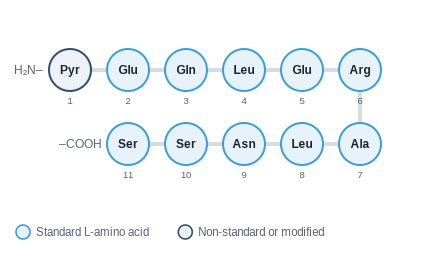
ARA-290, also called cibinetide, is a lab-made 11-amino-acid peptide designed from part of erythropoietin (EPO), the hormone that tells the body to make red blood cells S1S7. Unlike EPO, it does not raise red blood cell counts S1S5. It was developed to protect and repair small nerve fibers and was tested in small trials for nerve pain in sarcoidosis and type 2 diabetes S1S2S3. It was not approved. It is now sold online as a powder for injection.
How it works
- Borrowed from EPO. Besides making red blood cells, EPO protects tissues from injury. ARA-290 copies only the part of EPO linked to protection S1.
- One receptor, not the other. It acts on what researchers call the "innate repair receptor", which drives anti-inflammatory and tissue-repair responses, and not on the receptor that makes red blood cells S1S4.
- Nerve regrowth as a marker. In trials, researchers counted tiny nerve fibers in the cornea of the eye with a special microscope. More fibers after treatment was used as a sign the nerves were repairing S3.
Legal status
- FDA: Not approved for any use.
- Compounding: "Cibinetide (ARA-290)" is in 503A Category 3, substances nominated without adequate supporting information S8. Pharmacies get no enforcement discretion to compound with it. It is not in HHS's Oct 30 2026 draft enforcement-discretion policy.
- DEA: Not a controlled substance.
- "Research use only" vials: see our explainer.
- WADA: ARA-290 is not named, but WADA prohibits "innate repair receptor agonists" at all times under S2.1.5 S9, and its developers describe ARA-290 as exactly that S1S3. Athletes should treat it as banned.
What the research actually shows
Evidence: B. Small randomized trials, all 4 weeks long, found improvements in nerve-pain symptoms and corneal nerve fibers. No large trial has confirmed them, and most were run with the developer.
| Study | Design | People | Dose studied | Result |
|---|---|---|---|---|
| Heij et al 2012 S2 | Randomized, double-blind, placebo-controlled pilot | 22 people with sarcoidosis and small-fiber nerve symptoms | 2 mg IV three times a week for 4 weeks | Nerve-symptom score improved more than placebo (−11.5 vs −2.9); pain and fatigue improved equally in both groups; no safety concerns |
| Culver et al 2017 S3S4 | Randomized, placebo-controlled phase 2b | 64 people with sarcoidosis, nerve fiber loss and pain | 1, 4 or 8 mg a day under the skin for 28 days | Corneal nerve fiber area rose only at 4 mg (placebo-corrected +697 µm², p = 0.012); pain improved in all groups including placebo |
| Brines et al 2015 S1 | Placebo-controlled phase 2 | People with type 2 diabetes and painful neuropathy | 4 mg a day, self-injected under the skin for 28 days | HbA1c and lipids improved over 56 days; neuropathy symptoms improved; no safety issues |
| NCT06626971 S6 | Single-arm phase 2 | 9 people with diabetic macular edema | 4 mg a day under the skin for 12 weeks | Terminated; no results posted |
| NCT02070783 S7 | Randomized, placebo-controlled | 36 healthy volunteers | 2 mg IV, single dose | Emotional processing study; no results posted |
What we don't know: whether benefits last or hold up in larger trials, safety beyond 4 weeks of use, and whether it helps the injury healing or general "recovery" it is sold for. No trial has tested those.
Reported benefits
- In trials: less nerve pain and other small-fiber nerve symptoms in sarcoidosis S2S5; more corneal nerve fibers at 4 mg S3; better HbA1c and lipids in type 2 diabetes over a short trial S1.
- User-reported, not tested: injury recovery, inflammation, general healing.
Side effects
Common: trial reports describe no safety concerns or issues in clinical or laboratory checks S1S2. A review called the safety profile "excellent" in the small trials to date S5. Serious: none reported in the published trials. These trials were small and short.
Dangers and red flags
- Short, small trials. Fewer than 100 people per trial, treated for 4 weeks.
- EPO family. ARA-290 is designed not to raise red blood cells S1, but it is derived from a powerful hormone and its long-term safety has not been studied.
- Product quality. Grey-market vials are not tested for identity, dose, sterility or endotoxin.
- Sport: banned at all times under S2.1.5 S9.
- Who should avoid it: there is no evidence base for use in pregnancy, breastfeeding, children, or anyone with a current cancer.
Doses reported
We don't recommend sh*t. These are the doses studies, labels and harm-reduction sources report. That's information, not advice. Talk to a licensed clinician.
There is no FDA label. Every row below comes from a supervised clinical trial.
| Source | Population | Dose | Route | Frequency and timing | Duration | Titration or escalation | Cite |
|---|---|---|---|---|---|---|---|
| Heij et al 2012 | Adults with sarcoidosis and small-fiber neuropathy | 2 mg | IV | Three times a week | 4 weeks | None | S2 |
| Culver et al 2017 (NCT02039687) | Adults with sarcoidosis-related nerve fiber loss and pain | 1, 4 or 8 mg | Under the skin | Once daily | 28 days | None (parallel dose groups); only 4 mg met the nerve-fiber endpoint | S3S4 |
| Brines et al 2015 | Adults with type 2 diabetes and painful neuropathy | 4 mg | Under the skin, self-injected | Once daily | 28 days, then 28 days of follow-up | None | S1 |
| NCT06626971 | Adults with diabetic macular edema | 4 mg | Under the skin | Once daily | 12 weeks (trial terminated) | None | S6 |
| NCT02070783 | Healthy adults | 2 mg | IV | Single dose | 1 dose | None | S7 |
Open the dose math calculator →
Monitoring a doctor would order
No guideline exists. The trials ran clinical and laboratory safety checks S1S2; we found no source naming a specific monitoring schedule outside a trial.
Bottom line
ARA-290 is an EPO-derived peptide built to switch on tissue repair without making red blood cells. Small 4-week trials found less nerve pain and more corneal nerve fibers in sarcoidosis and better blood-sugar markers in diabetes, with no safety problems seen. It was never approved, compounders can't use it, and athletes should treat it as banned. Nothing supports its use for general injury recovery.
Sources
- [S1] Brines M, et al. ARA 290, a nonerythropoietic peptide engineered from erythropoietin, improves metabolic control and neuropathic symptoms in patients with type 2 diabetes. Mol Med. 2015;20(1):658-66. PMID 25387363. (rct)
- [S2] Heij L, et al. Safety and efficacy of ARA 290 in sarcoidosis patients with symptoms of small fiber neuropathy: a randomized, double-blind pilot study. Mol Med. 2012;18(1):1430-6. PMID 23168581. (rct)
- [S3] Culver DA, et al. Cibinetide Improves Corneal Nerve Fiber Abundance in Patients With Sarcoidosis-Associated Small Nerve Fiber Loss and Neuropathic Pain. Invest Ophthalmol Vis Sci. 2017;58(6):BIO52-BIO60. PMID 28475703. (rct)
- [S4] ClinicalTrials.gov NCT02039687. A double blind, placebo controlled phase 2 dose ranging study of the effects of ARA 290 on corneal nerve fiber density and neuropathic symptoms of subjects with sarcoidosis (n = 64). (rct)
- [S5] van Velzen M, et al. ARA 290 for treatment of small fiber neuropathy in sarcoidosis. Expert Opin Investig Drugs. 2014;23(4):541-50. PMID 24555851. (review)
- [S6] ClinicalTrials.gov NCT06626971. A phase II clinical trial on the use of ARA 290 for the treatment of diabetic macular oedema (terminated; n = 9). (human-case-series)
- [S7] ClinicalTrials.gov NCT02070783. The effects of ARA290 on the cognitive and neural processing of emotions in healthy volunteers (n = 36). (rct)
- [S8] FDA. Bulk Drug Substances Nominated for Use in Compounding Under Section 503A of the FD&C Act (Category 3: Cibinetide (ARA-290)). Updated May 14, 2026. (regulator)
- [S9] World Anti-Doping Agency. 2026 Prohibited List, S2.1.5 (innate repair receptor agonists, e.g. asialo EPO; carbamylated EPO). (regulator)