
Other approved peptide drugs
Bivalirudin
Also called Angiomax, Angiox, direct thrombin inhibitor, hirudin analog
- US status
- Approved
- DEA
- Not a controlled substance
- WADA
- Not listed as prohibited
- Class
- Other approved peptide drugs
Jump to doses reported ↓ Dose math calculator
What it is
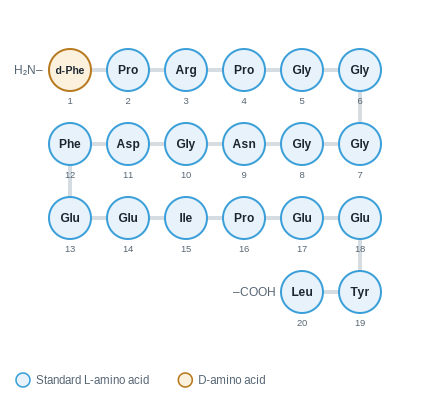
Bivalirudin is a 20-amino-acid peptide anticoagulant. It is an approved prescription drug (Angiomax) given by IV during procedures to open blocked heart arteries (percutaneous coronary intervention, PCI), including in people who cannot use heparin because of heparin-induced thrombocytopenia S1.
How it works
Thrombin is the enzyme at the end of the clotting cascade: it converts fibrinogen into fibrin and activates platelets. Bivalirudin binds thrombin directly and at two points at once — the active site and the substrate-recognition (exosite 1) groove — so it blocks both free thrombin and thrombin already bound inside a clot, which heparin cannot do S1. It needs no antithrombin to work, which is why it can be used in heparin-induced thrombocytopenia S1. The binding is reversible and short-lived: thrombin slowly cleaves the peptide, and with normal kidney function the anticoagulant effect fades within about an hour of stopping the infusion, so it is titrated as a drip during a procedure rather than dosed in advance S1.
Legal status
- FDA: Approved for use in patients undergoing PCI, and in those with or at risk of heparin-induced thrombocytopenia undergoing PCI S1.
- Compounding: an approved drug substance handled as a hospital injectable.
- DEA: Not a controlled substance.
- "Research use only" labels: not relevant; this is a hospital prescription drug.
- WADA (sport): Not listed as prohibited.
- International (short): marketed as Angiox in some regions.
What the research actually shows
Evidence: A. Bivalirudin is approved, with large randomized trials in PCI.
| Study | Design | People | Dose studied | Result |
|---|---|---|---|---|
| HORIZONS-AMI S2 | Randomized | 3,602 patients with heart attack undergoing PCI | IV bolus + infusion | Less major bleeding and lower cardiac mortality than heparin plus a GP IIb/IIIa inhibitor, with more early stent thrombosis |
| REPLACE-2 S3 | Randomized | 6,010 patients undergoing PCI | IV bolus + infusion | Similar ischemic outcomes to heparin plus GP IIb/IIIa inhibitor, with less bleeding |
What we don't know for this page: nothing unusual; its role versus heparin varies with the clinical situation and other drugs used.
Reported benefits
Effective anticoagulation during PCI with generally less bleeding than heparin-plus-GP IIb/IIIa regimens S2S3.
Side effects
Common: bleeding and low blood pressure S1. Serious: major bleeding; in heart-attack PCI, a signal of more acute stent thrombosis early after the procedure S1S2.
Dangers and red flags
- Bleeding. The main risk of any anticoagulant S1.
- Acute stent thrombosis seen early in heart-attack PCI S2.
- Hospital-only drug. Dosed and monitored by the procedural team S1.
Doses reported
We don't recommend sh*t. These are the doses studies, labels and harm-reduction sources report. That's information, not advice. Talk to a licensed clinician.
Bivalirudin is given by IV by the procedural team; there is no self-administered reconstitution, so the inline calculator does not apply.
| Source | Dose | Unit / route | Frequency | Timing | Duration | Titration / escalation | Context |
|---|---|---|---|---|---|---|---|
| S1 Label | 0.75 mg/kg bolus, then 1.75 mg/kg/h | mg/kg, IV | Bolus + infusion | During PCI | For the procedure (± after) | Adjusted in kidney impairment | PCI anticoagulation |
| S2S3 Trials | Same bolus + infusion | mg/kg, IV | Bolus + infusion | — | Procedure duration | Weight-based | PCI trials |
Monitoring a doctor would order
Signs of bleeding, blood counts, kidney function (clearance affects dosing), and clotting parameters as needed during the procedure S1.
Bottom line
Bivalirudin is an approved IV direct thrombin inhibitor used during coronary procedures, with large trials showing effective anticoagulation and generally less bleeding than heparin-based regimens, though with an early stent-thrombosis signal in heart attack. It is a hospital drug given and monitored by the procedural team. It is a prescription medicine.
Sources
- [S1] Bivalirudin for injection. US prescribing information (DailyMed). (label)
- [S2] Stone GW, et al. Bivalirudin during primary PCI in acute myocardial infarction (HORIZONS-AMI). N Engl J Med. 2008;358:2218-30. PMID 18499566. (rct)
- [S3] Lincoff AM, et al. Bivalirudin and provisional glycoprotein IIb/IIIa blockade compared with heparin (REPLACE-2). JAMA. 2003;289:853-63. PMID 12588269. (rct)