
Healing / recovery research peptides
BPC-157
Also called Body Protection Compound-157, pentadecapeptide BPC 157, PL 14736, PL-10, bepecin, BPC
- US status
- Not approved
- DEA
- Not a controlled substance
- WADA
- S0 Non-approved substances (named example); prohibited at all times
- Class
- Healing / recovery research peptides
Jump to doses reported ↓ Dose math calculator
What it is
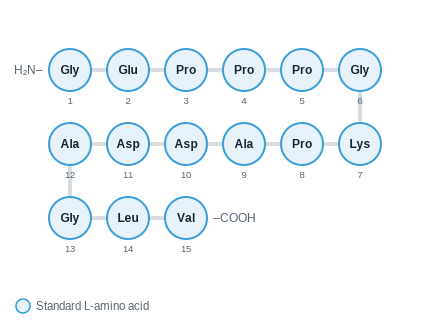
BPC-157 is a lab-made chain of 15 amino acids based on a fragment of a protein found in human gastric juice. Almost all of the research comes from rat and lab studies showing faster healing of tendon, gut and other tissue S8S12S14. People use it, usually as a small under-the-skin injection, in the hope of healing tendon, ligament, muscle and gut problems S11. No product has been approved anywhere we checked.
How it works
BPC-157 is a 15-amino-acid sequence taken from a protein found in human gastric juice; no receptor for it has been identified, so its mechanism is entirely inferred from animal and cell work rather than human pharmacology S14. The most consistently reported action is angiogenesis — new blood vessel growth. In laboratory work it activated and increased VEGFR2, the main receptor for vascular endothelial growth factor, which in turn signals through the nitric-oxide pathway to sprout vessels into injured tissue S13. In rats with a cut Achilles tendon it sped healing, and in cell culture it made tendon cells (tendocytes) spread, migrate and multiply faster S12. The working idea is that better blood supply plus faster fibroblast and tendocyte activity accelerates repair. What has not been established is whether any of this happens in people, at what exposure, or whether an injected peptide survives to reach the tissue; systematic reviews of the human literature find only small, low-quality studies S8S9S14.
Legal status
- FDA: Not approved for any use.
- Compounding: FDA put BPC-157 in Category 2 (substances that may pose significant safety risks), citing possible immune reactions (immunogenicity) for some routes, peptide impurities, and "no, or only limited, safety-related information" S1. FDA's page now lists it among substances whose nominations were withdrawn, so it is no longer in Category 2 S1. On Jul 23–24 2026 FDA's Pharmacy Compounding Advisory Committee voted to recommend adding it to the 503A bulks list (8–6 per a secondary summary) S3. On Oct 30 2026 HHS published a draft policy saying it does not intend to take enforcement action against state-licensed pharmacies or physicians compounding listed peptides while rulemaking proceeds S2. That is a draft enforcement stance, not an approval, and HHS says it can revisit it if a safety or quality signal appears S2.
- DEA: Not a controlled substance.
- "Research use only" vials: most BPC-157 people use comes from research-chemical vendors (90.9% of users who named a source in one analysis) S11. That label means no one has checked the product for human use. See our explainer.
- WADA: Named as an example under S0, non-approved substances, banned in and out of competition S4.
- International (short): Australia's TGA warned in May 2026 that poorly labeled imported peptide vials will be seized and destroyed at the border S15.
What the research actually shows
Evidence: C. Only three human studies exist, with 30 people in total and no control groups S9.
| Study | Design | People | Dose studied | Result |
|---|---|---|---|---|
| Lee & Padgett 2021 S5 | Retrospective chart review, phone follow-up | 16 adults with knee pain of various causes | Intra-articular BPC-157 (reported as 4 mg S10); 4 also got thymosin β4 | 14 of 16 reported relief; no validated outcome scale, no controls |
| Lee et al 2024 S6 | Uncontrolled pilot | 12 women with interstitial cystitis | 10 mg total, injected into the bladder wall during one cystoscopy | 10 of 12 reported complete resolution; no adverse events reported |
| Lee & Burgess 2025 S7 | Safety pilot | 2 adults who had used IV BPC-157 before | 10 mg IV (day 1), 20 mg IV (day 2) | No changes in heart, liver, kidney, thyroid or glucose markers; no side effects reported |
| Systematic review, 2025 S8 | 36 studies | 35 preclinical, 1 clinical | — | Animal benefits on muscle, tendon, ligament and bone; half-life under 30 minutes; "no clinical safety data" |
| Systematic review, 2026 S9 | 3 human studies, n = 30 | — | — | Certainty "very low"; authors say it should not be used clinically outside approved trials |
What we don't know: whether it works in people, what dose would be right, what it does over months, and whether vendor vials contain BPC-157 at the stated amount.
Reported benefits
- In animal studies: faster tendon, ligament, muscle, bone and gut healing S8S12.
- In the 3 small human reports: self-reported pain relief (knee) and symptom relief (interstitial cystitis), with no controls S5S6.
- User-reported, not tested: 79.3% of Reddit users who described an outcome said they improved, many while also doing physical therapy (36.6%) S11. Without a comparison group this can't separate the drug from healing time, therapy or expectation.
Side effects
Common: none established. The three pilots reported none S5S6S7. User-reported (not tested, preprint): 27.2% of users described at least one side effect, most often fatigue, anxiety, anhedonia (loss of pleasure), insomnia and injection-site pain. Anhedonia was reported far more often than by users of other peptides in the same communities (10.2% vs 1.3% of those with side effects) S11. Serious: unknown. There are no controlled human safety data S8.
Dangers and red flags
- Unknown product quality. FDA flagged peptide-related impurities and immune-reaction risk S1. Grey-market vials are not tested for identity, dose or sterility.
- Blood-vessel growth. BPC-157 promotes new blood vessel growth via VEGFR2 in animal studies S13. That's part of how it may help healing; whether it matters for people with cancer is unknown. This is a theoretical concern, not a documented harm.
- Sport: banned at all times S4.
- Who should avoid it: with no human safety data, there is no evidence base for use in pregnancy, breastfeeding, children, or people with active cancer.
- Rising doses: in one analysis, median new-user doses rose from 300 µg in 2024 to 500 µg in 2025 S11.
Doses reported
We don't recommend sh*t. These are the doses studies, labels and harm-reduction sources report. That's information, not advice. Talk to a licensed clinician.
| Source | Dose | Frequency | Duration | Context |
|---|---|---|---|---|
| S5S10 Lee & Padgett 2021 | 4 mg (2 mL of 2,000 µg/mL), intra-articular | Single injection (some patients also got TB4) | Follow-up 6–12 months | Clinic chart review, knee pain, n = 16 |
| S6 Lee et al 2024 | 10 mg total, injected into the bladder wall | Once, during cystoscopy | Single procedure | Interstitial cystitis, n = 12 |
| S7 Lee & Burgess 2025 | 10 mg IV, then 20 mg IV | One infusion per day | 2 days | Safety pilot, n = 2 |
| S11 Cassinat et al 2026 (preprint) | Median 366 µg per injection (IQR 250–500 µg); mostly subcutaneous | Not reported in the sections we read | Not reported in the sections we read | Self-reported by Reddit users, 2021–2026 |
| S11 Cassinat et al 2026 (preprint) | 10 µg/kg in rat tendon/ligament studies; ~1.6 µg/kg human-equivalent by body-surface conversion (~140 µg at 85 kg) | — | — | The authors say this conversion "does not identify a safe or effective dose" |
There are no FDA-labeled doses because there is no approved product.
Open the dose math calculator →
Monitoring a doctor would order
There is no guideline. A clinician seeing someone who uses BPC-157 would typically ask about the source, check the injection site, and look for signs of infection. We found no source naming specific BPC-157 lab monitoring, so we don't list any.
Bottom line
BPC-157 looks interesting in rats and has almost no human evidence: three tiny uncontrolled reports totaling 30 people. Its US compounding status is changing (FDA advisory vote in July 2026, HHS draft policy in October 2026), but it is still not an approved drug, and most supply comes from untested research-chemical vials. It is banned in sport at all times.
Sources
- [S1] FDA. Certain Bulk Drug Substances for Use in Compounding that May Present Significant Safety Risks (BPC-157 entry). Content current as of 04/22/2026. (regulator)
- [S2] HHS. Enforcement Discretion Policy Regarding 503A Compounding Using Certain Peptide Bulk Drug Substances (draft). Federal Register FR Doc 2026-22192, Oct 30 2026; Docket HHS-OASH-2026-0496. (regulator)
- [S3] FDA. July 23-24, 2026: Meeting of the Pharmacy Compounding Advisory Committee (meeting page). Vote tallies as summarized by SSRP Institute, 'PCAC Meeting Vote Summary' (secondary source). (regulator)
- [S4] World Anti-Doping Agency. 2026 Prohibited List, section S0. (regulator)
- [S5] Lee E, Padgett B. Intra-Articular Injection of BPC 157 for Multiple Types of Knee Pain. Altern Ther Health Med. 2021;27(4):8-13. PMID 34324435. (human-case-series)
- [S6] Lee E, Walker C, Ayadi B. Effect of BPC-157 on Symptoms in Patients with Interstitial Cystitis: A Pilot Study. Altern Ther Health Med. 2024;30(10):12-17. PMID 39325560. (human-case-series)
- [S7] Lee E, Burgess K. Safety of Intravenous Infusion of BPC157 in Humans: A Pilot Study. Altern Ther Health Med. 2025;31(5):20-24. PMID 40131143. (human-case-series)
- [S8] Vasireddi N, et al. Emerging Use of BPC-157 in Orthopaedic Sports Medicine: A Systematic Review. HSS J. 2025;21(4):485-495. PMID 40756949. (review)
- [S9] Poolton JT, Minett J, Kazmi A. Human evidence for BPC-157 in orthopaedic and regenerative medicine: a systematic review of efficacy and safety. Acta Orthop Belg. 2026;92(3). PMID 42885452. (review)
- [S10] Tewari K, et al. Peptide Supplements and Their Therapeutic Applications in Sports Medicine. Am J Sports Med. 2026. PMID 42578445. (Reports the Lee & Padgett knee dose as 4 mg, 2 mL of 2000 µg/mL.) (review)
- [S11] Cassinat J, Callan C, Liggett C, Wright V. Real-World Use, Dosing, and Reported Side Effects of BPC-157 and TB-500 for Musculoskeletal Injury: An Analysis of Online Communities. medRxiv preprint, Nov 2026. doi:10.64898/2026.11.04.26367022. NOT PEER REVIEWED. (preprint)
- [S12] Staresinic M, et al. Gastric pentadecapeptide BPC 157 accelerates healing of transected rat Achilles tendon and in vitro stimulates tendocytes growth. J Orthop Res. 2003;21:976-83. PMID 14554208. (animal)
- [S13] Hsieh MJ, et al. Therapeutic potential of pro-angiogenic BPC157 is associated with VEGFR2 activation and up-regulation. J Mol Med (Berl). 2017;95:323-333. PMID 27847966. (animal)
- [S14] McGuire FP, et al. Regeneration or Risk? A Narrative Review of BPC-157 for Musculoskeletal Healing. Curr Rev Musculoskelet Med. 2025;18(12):611-619. PMID 40789979. (review)
- [S15] Therapeutic Goods Administration (Australia). TGA warning on the risks of importing unapproved peptide products. Published 7 May 2026. (regulator)