
Skin, tanning & sexual-health peptides
Bremelanotide (PT-141)
Also called Vyleesi, PT-141, PT 141
- US status
- Approved (Vyleesi, 2019): acquired, generalized HSDD in premenopausal women
- DEA
- Not a controlled substance
- WADA
- Not named
- Class
- Skin, tanning & sexual-health peptides
Jump to doses reported ↓ Dose math calculator
What it is
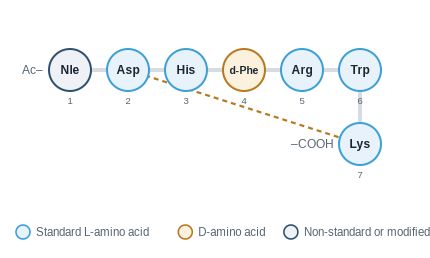
Bremelanotide is a lab-made melanocortin receptor agonist peptide S1. It is a close relative of melanotan II S8. The approved product, Vyleesi, is a single-use autoinjector holding 1.75 mg in 0.3 mL, injected under the skin of the abdomen or thigh as needed before sex S1. Online, "PT-141" is also sold as a grey-market powder or nasal spray; those products are not Vyleesi and have not been checked by anyone S7.
How it works
Sexual desire is shaped in the brain, not the genitals, and the melanocortin system is one of its regulators. Bremelanotide is a non-selective agonist at melanocortin receptors, with the strongest activity at MC1R and MC4R; MC4R activation in the hypothalamus is the action believed to account for its effect on desire S1. The label is explicit that the mechanism by which it treats hypoactive sexual desire disorder is not known, and that it does not act on blood flow the way erectile-dysfunction drugs do S1. It is taken as needed rather than continuously, with a half-life of about 2.7 hours S1. Two consequences follow from its receptor profile: MC1R activation causes the skin darkening seen with this class, and the same receptors in blood vessels produce a transient rise in blood pressure and fall in heart rate after each dose S1S5.
Legal status
- FDA: Approved Jun 21 2019 S2 for premenopausal women with acquired, generalized hypoactive sexual desire disorder (HSDD): low desire that causes marked distress and is not due to another medical or psychiatric condition, relationship problems, or a drug S1. The label says it is not indicated for HSDD in postmenopausal women or in men, and "not indicated to enhance sexual performance" S1.
- Compounding: bremelanotide is the active ingredient of an approved drug. We did not find an FDA compounding category entry for it, and we did not look further.
- DEA: Not a controlled substance.
- Grey-market "PT-141": sold as "research use only." See our explainer. Use outside the label, by men, or from a non-pharmacy source is outside anything FDA reviewed.
- WADA: Not named on the 2026 List S6. As an approved drug it is outside S0, which covers only substances with no government approval S6.
What the research actually shows
Evidence: A for the labeled use. Two identical phase 3 trials (RECONNECT) in about 1,250 premenopausal women, plus a phase 2b dose-finding trial S1S3S4. The benefit is real but modest.
| Study | Design | People | Dose studied | Result |
|---|---|---|---|---|
| RECONNECT 301 and 302, Kingsberg et al 2019 S3; label S1 | Two randomized, double-blind, placebo-controlled phase 3 trials, 24 weeks, then 52-week open-label extension | 1,267 randomized premenopausal women with HSDD (1,247 in safety analysis); mean age 39 | 1.75 mg subcutaneous as needed, about 45 minutes before expected sexual activity; no more than 1 dose in 24 hours and no more than 12 per month in the trials | Desire score (FSFI desire domain, 1.2–6 scale) rose 0.30 and 0.42 points more than placebo (pooled 0.35); distress about low desire fell 0.33 points more than placebo (pooled) |
| Clayton et al 2016 S4 | Randomized, placebo-controlled phase 2b dose-finding, 12 weeks | 327 premenopausal women with female sexual dysfunction (efficacy set) | 0.75, 1.25 or 1.75 mg subcutaneous as desired | Pooled 1.25/1.75 mg: +0.7 satisfying sexual events per month vs +0.2 on placebo |
| Clayton et al 2022 S5 | Review of the whole development program | 3,500 subjects in 43 studies | Various | Most adverse events mild to moderate; focal hyperpigmentation in more than a third with up to 16 consecutive daily doses |
What we don't know: whether it helps men or postmenopausal women (not approved for either S1), and how long each dose works: the label says "the duration of efficacy after each dose is unknown" S1.
Reported benefits
- In phase 3 trials: small increases in sexual desire and reductions in related distress versus placebo S3.
- Satisfying sexual events: a small increase in the phase 2b trial S4.
- Men, performance, tanning: not established and not approved S1.
Side effects
Common (Vyleesi vs placebo, phase 3, label Table 1): nausea 40.0% vs 1.3%; flushing 20.3% vs 0.3%; injection-site reactions 13.2% vs 8.4%; headache 11.3% vs 1.9%; vomiting 4.8% vs 0.2%; cough 3.3%; fatigue 3.2%; hot flush 2.7%; tingling (paresthesia) 2.6%; dizziness 2.2%; nasal congestion 2.1% S1. - Nausea was worst after the first dose (21%), then about 3% after later doses; 13% needed anti-nausea medicine and 8% stopped because of it S1. - 18% of Vyleesi users stopped the trials because of side effects vs 2% on placebo S1.
Serious: - Blood pressure and heart rate: each dose raises blood pressure (up to 6 mmHg systolic and 3 mmHg diastolic, peaking 2–4 hours after) and lowers heart rate by up to 5 beats per minute, usually back to baseline within 12 hours S1. - Focal hyperpigmentation: darkening of the face, gums or breasts in 1% at up to 8 doses a month, but 38% after 8 consecutive daily doses; not always reversible S1. - Serious adverse reactions overall: 1.1% vs 0.5% on placebo S1.
Dangers and red flags
- Contraindicated in uncontrolled high blood pressure or known cardiovascular disease, and not recommended for people at high cardiovascular risk S1.
- More is not better. Daily dosing sharply raises the risk of skin darkening S1.
- Interactions: may slow stomach emptying and reduce absorption of oral drugs; avoid with oral naltrexone used for alcohol or opioid addiction, because it can significantly lower naltrexone levels S1.
- Grey-market products: black-market bremelanotide and melanotan II samples have turned up in police seizures alongside steroids S7. Content and dose are unverifiable, and a mix-up with melanotan II matters: a 6 mg melanotan II injection caused rhabdomyolysis in one case S8.
- Sport: not named on the 2026 List S6.
Doses reported
We don't recommend sh*t. These are the doses studies, labels and harm-reduction sources report. That's information, not advice. Talk to a licensed clinician.
FDA label (Vyleesi), quoted as written S1: 1.75 mg injected under the skin of the abdomen or thigh with the autoinjector, as needed, at least 45 minutes before anticipated sexual activity. Do not give more than one dose within 24 hours. More than 8 doses per month is not advised by the label. Stop after 8 weeks if there is no improvement. There is no titration and no dose adjustment table.
| Source | Population | Dose | Route | Frequency and timing | Duration | Titration or escalation | Cite |
|---|---|---|---|---|---|---|---|
| FDA label (Vyleesi) | Premenopausal women with acquired, generalized HSDD | 1.75 mg (1.75 mg/0.3 mL autoinjector) | Subcutaneous, abdomen or thigh | As needed, at least 45 minutes before anticipated sexual activity; max 1 dose per 24 hours; label advises against more than 8 per month | Stop after 8 weeks if no improvement | None; single fixed strength | S1 |
| RECONNECT phase 3 trials | 1,247 premenopausal women with HSDD | 1.75 mg | Subcutaneous autoinjector | As needed, about 45 minutes before; max 1 per 24 hours and 12 per month; most used it 2–3 times a month, no more than weekly; median 10 injections in 24 weeks | 24 weeks double-blind, then 52-week open-label | None | S1S3 |
| Phase 2b dose-finding | 327 premenopausal women with female sexual dysfunction | 0.75 mg, 1.25 mg or 1.75 mg | Subcutaneous | As desired | 12 weeks | Parallel dose arms, not escalation | S4 |
| Hyperpigmentation study (label) | Participants in a separate clinical study | 1.75 mg | Subcutaneous | Daily | 8 consecutive days, then 8 more in some | None; 38% developed focal hyperpigmentation after 8 days, plus 14% more after 16 | S1 |
No dose for men, nasal use or grey-market vials comes from any approved or published source we checked.
Open the dose math calculator →
Monitoring a doctor would order
Per the label: check cardiovascular risk and make sure blood pressure is well controlled before starting and periodically during treatment; consider stopping if hyperpigmentation develops; reassess at 8 weeks S1.
Bottom line
Bremelanotide is a real, FDA-approved drug for one narrow use: distressing low sexual desire in premenopausal women. In phase 3 trials it raised desire scores modestly over placebo, and 40% of users got nausea. It briefly raises blood pressure, and frequent use can darken skin, sometimes for good. Grey-market "PT-141" is not Vyleesi, and men are outside the label.
Sources
- [S1] VYLEESI (bremelanotide injection) prescribing information, label effective Nov 2026 (DailyMed set ID f1d0c1b5-2f39-4bad-a6a4-0066e3ad5dcf). (label)
- [S2] FDA. Drugs@FDA: NDA 210557, Vyleesi (original approval Jun 21, 2019; new molecular entity). (regulator)
- [S3] Kingsberg SA, et al. Bremelanotide for the Treatment of Hypoactive Sexual Desire Disorder: Two Randomized Phase 3 Trials. Obstet Gynecol. 2019;134(5):899-908. PMID 31599840. (rct)
- [S4] Clayton AH, et al. Bremelanotide for female sexual dysfunctions in premenopausal women: a randomized, placebo-controlled dose-finding trial. Womens Health (Lond). 2016;12(3):325-37. PMID 27181790. (rct)
- [S5] Clayton AH, et al. Safety Profile of Bremelanotide Across the Clinical Development Program. J Womens Health (Larchmt). 2022;31(2):171-182. PMID 35147466. (review)
- [S6] World Anti-Doping Agency. 2026 Prohibited List. (regulator)
- [S7] Mestria S, et al. LC-HRMS characterization of the skin pigmentation and sexual enhancers melanotan II and bremelanotide sold on the black market of performance and image enhancing drugs. Drug Test Anal. 2021;13(4):876-882. PMID 33245851. (in-vitro)
- [S8] Nelson ME, et al. Melanotan II injection resulting in systemic toxicity and rhabdomyolysis. Clin Toxicol (Phila). 2012;50(10):1169-73. PMID 23121206. (human-case-series)