
AAS ancillaries & fertility drugs
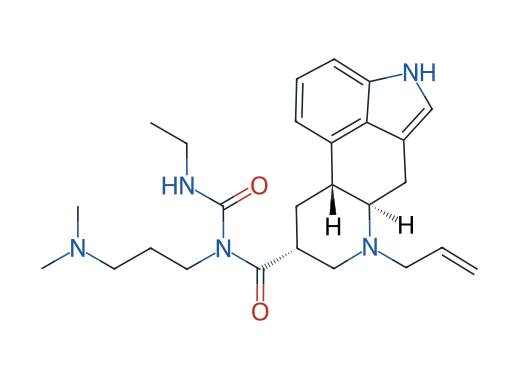
Cabergoline
Also called Dostinex (original brand), cabergoline tablets, dopamine agonist, caber
- US status
- Approved
- DEA
- Not a controlled substance
- WADA
- Not listed on the 2026 Prohibited List
- Class
- AAS ancillaries & fertility drugs
Jump to doses reported ↓ Dose math calculator
What it is
Cabergoline is a prescription tablet that lowers prolactin, the pituitary hormone that drives milk production. It is the usual first-choice drug for prolactin-secreting pituitary tumors (prolactinomas) and other causes of high prolactin S1S3. It shows up on this reference because anabolic-steroid users take it off-label, mostly alongside 19-nor steroids such as nandrolone and trenbolone, to counter prolactin-related problems like low libido or nipple discharge. That use has no controlled evidence behind it.
How it works
Cabergoline is an ergot-derived dopamine D2-receptor agonist. Dopamine from the hypothalamus is the brake on prolactin release; cabergoline mimics that brake directly on the prolactin-making cells (lactotrophs) of the pituitary, so prolactin falls S1. It binds D2 receptors strongly and D1, adrenergic and most serotonin receptors weakly S1. Its half-life is long, about 63 to 69 hours in healthy people, which is why it is taken only twice a week S1. The ergot structure also matters for safety: ergot dopamine agonists have been tied to scarring (fibrosis) of heart valves and other tissues, mainly at the high doses once used for Parkinson's disease S1S4S5.
Legal status
- FDA: Approved for hyperprolactinemic disorders (idiopathic or due to pituitary adenomas) in adults. The label says to avoid using it to suppress milk production after childbirth, because a related drug (bromocriptine) used that way was linked to high blood pressure, stroke, heart attack, seizures and death S1. The original brand (Dostinex) is no longer the main US product; generics are.
- DEA: Not a controlled substance.
- Prescription drug: cabergoline needs a prescription. Grey-market "research" cabergoline is an unapproved product of unknown content.
- WADA: Not named on the 2026 Prohibited List S7.
- International (short): Not reviewed for this page yet.
What the research actually shows
Evidence: A for its approved use. Cabergoline has randomized trials in high prolactin and a clear safety literature on heart valves. There are no controlled studies of its use by anabolic-steroid users.
| Study | Design | People | Dose studied | Result |
|---|---|---|---|---|
| Label Study 1 S1 | 4-week randomized, placebo-controlled dose-response trial | 188 women with high prolactin | Placebo, or 0.125 / 0.5 / 0.75 / 1 mg twice weekly (lower first week) | Normal prolactin at 4 weeks in 0% (placebo), 76%, 74% and 95% (0.5, 0.75, 1 mg groups); the 0.125 mg dose was not effective |
| Webster 1994 S2 | 8-week double-blind RCT, then 16 weeks open | 459 women with high-prolactin amenorrhea | Cabergoline 0.5–1.0 mg twice weekly vs bromocriptine 2.5–5.0 mg twice daily | Stable normal prolactin 83% vs 59%; ovulation or pregnancy 72% vs 52%; stopped for intolerance 3% vs 12% |
| Schade 2007 S4 | UK nested case-control study | 11,417 people on Parkinson's drugs | Parkinson's doses | New heart-valve leakage: incidence-rate ratio 4.9 with cabergoline, 7.1 with pergolide; no rise with non-ergot agonists |
| Zanettini 2007 S5 | Echocardiography prevalence study | 155 Parkinson's patients on dopamine agonists, 90 controls | Parkinson's doses | Moderate-to-severe valve leakage in 28.6% on cabergoline vs 5.6% of controls; worse with higher cumulative dose |
| Stiles 2018 S6 | Meta-analysis of 13 case-control studies | People on ≥6 months of cabergoline for high prolactin | Low (prolactin) doses | More tricuspid valve leakage (OR 3.74), none diagnosed from symptoms; no rise in other valve disease; clinical meaning unclear |
What we don't know: whether cabergoline helps, or is safe, when taken by people using anabolic steroids; whether low-prolactin-dose valve changes progress over decades. The label notes that benefit beyond 24 months of therapy has not been established S1.
Reported benefits
In its approved use, cabergoline normalizes prolactin in most patients, restores menstruation and ovulation in many women with high prolactin, and is better tolerated than bromocriptine S1S2. Steroid users take it to lower prolactin and relieve prolactin-type symptoms; that benefit is assumed from the mechanism, not shown in any study of that group.
Side effects
Common (label, placebo-controlled trial): nausea (27%), headache (26%), dizziness (15%), constipation (10%), fatigue (7%), and drop in blood pressure on standing (4% vs 0% on placebo) S1. Serious (label): heart-valve disease and pericardial fibrosis; fibrosis of the lining of the lungs, the lungs themselves, or the area behind the abdomen (retroperitoneal); orthostatic hypotension; and impulse-control problems such as new gambling, spending, sexual or eating urges S1. Post-marketing reports also include psychosis, aggression and hair loss S1.
Dangers and red flags
- Heart valves. Ergot dopamine agonists can thicken and stiffen heart valves. The risk is clearest at high Parkinson's doses (over 2 mg a day), but valve cases have also been reported at prolactin doses S1S4S5S6. The label requires an echocardiogram before starting and contraindicates it in anyone with existing valve disease S1.
- Fibrosis elsewhere. Lung, pleural and retroperitoneal scarring have been reported; watch for shortness of breath, persistent cough, chest pain, flank pain or leg swelling S1.
- Impulse-control changes. People may not notice new compulsions themselves; the label asks prescribers to ask directly S1.
- Long half-life. Effects and side effects linger for days after a dose S1.
- Grey-market product. Unapproved "research" cabergoline has unknown identity and strength.
- Who should not use it (label contraindications): uncontrolled high blood pressure, allergy to ergot drugs, any history of heart-valve disease or pericardial fibrosis, or of lung, pleural or retroperitoneal fibrosis S1.
Doses reported
We don't recommend sh*t. These are the doses studies, labels and harm-reduction sources report. That's information, not advice. Talk to a licensed clinician.
The rows below are the FDA label dosing for high prolactin and the doses used in the trials above, all oral. Note the units: cabergoline is dosed in milligrams twice a week, not daily. There is no citable medical dosing for off-label use by steroid users, so none is listed. Cabergoline is a tablet (0.5 mg, scored), so the reconstitution calculator does not apply.
| Source | Dose | Unit / route | Frequency | Timing | Duration | Titration / escalation | Context |
|---|---|---|---|---|---|---|---|
| S1 Label (start) | 0.25 mg | mg, oral | Twice weekly | With or without food | Until prolactin is normal; recheck prolactin periodically if stopped | Raise by 0.25 mg twice weekly, no sooner than every 4 weeks | High prolactin (idiopathic or pituitary adenoma), adults |
| S1 Label (maximum) | 1 mg | mg, oral | Twice weekly | With or without food | As above | Ceiling of the label range | High prolactin, adults |
| S1 Label Study 1 | 0.5 / 0.75 / 1 mg (half dose in week 1) | mg, oral | Twice weekly | — | 4 weeks | Fixed arms | Dose-response trial, women with high prolactin |
| S2 Webster 1994 | 0.5–1.0 mg | mg, oral | Twice weekly | — | 8 weeks blinded + 16 weeks open | Adjusted by prolactin response | Women with high-prolactin amenorrhea |
| S1S4S5 Parkinson's use | Over 2 mg | mg per day, oral | Daily | — | Long-term | — | Not an approved use. Listed only because these high doses are where valve disease was most clearly seen |
No citable medical dosing for cabergoline use by anabolic-steroid users was found; we will not fill that gap with forum or vendor numbers.
Open the dose math calculator →
Monitoring a doctor would order
- Before starting: a cardiovascular evaluation including an echocardiogram; do not start if valve disease is found S1. Blood pressure at baseline S1. Prolactin level and a work-up for the cause of high prolactin S3.
- On treatment: repeat echocardiogram every 6 to 12 months or when new swelling, murmur, shortness of breath or heart-failure signs appear S1. Consider ESR, serum creatinine and chest X-ray for fibrosis as clinically needed S1. Blood pressure, including standing S1. Prolactin to guide dose changes S1.
- Ask about new gambling, spending, sexual or eating urges S1.
- After stopping: recheck prolactin periodically to see whether treatment is still needed S1.
Bottom line
Cabergoline is an approved, effective, twice-weekly dopamine agonist that lowers prolactin by acting directly on the pituitary, and it beats bromocriptine on both results and tolerability in high-prolactin women. Its signature risk is heart-valve and other fibrosis, clearest at high Parkinson's doses but reported at prolactin doses too, so the label requires echocardiograms before and during treatment. Its off-label use by steroid users to manage prolactin is unstudied. It is not a controlled substance and is not on the WADA list.
Sources
- [S1] Cabergoline tablets. US prescribing information (DailyMed), Mylan Pharmaceuticals; label revised June 2026. Indications, dosing (0.25 mg twice weekly start; 1 mg twice weekly maximum), warnings on valvulopathy and fibrosis, clinical studies. Set ID e497366b-a124-4d7f-bd45-a883c392d4bb. (label)
- [S2] Webster J, et al. A comparison of cabergoline and bromocriptine in the treatment of hyperprolactinemic amenorrhea. N Engl J Med. 1994;331:904-9. PMID 7915824. (rct)
- [S3] Melmed S, et al. Diagnosis and treatment of hyperprolactinemia: an Endocrine Society clinical practice guideline. J Clin Endocrinol Metab. 2011;96:273-88. PMID 21296991. (review)
- [S4] Schade R, et al. Dopamine agonists and the risk of cardiac-valve regurgitation. N Engl J Med. 2007;356:29-38. PMID 17202453. (human-observational)
- [S5] Zanettini R, et al. Valvular heart disease and the use of dopamine agonists for Parkinson's disease. N Engl J Med. 2007;356:39-46. PMID 17202454. (human-observational)
- [S6] Stiles CE, et al. A meta-analysis of the prevalence of cardiac valvulopathy in hyperprolactinemic patients treated with cabergoline. J Clin Endocrinol Metab. 2018 (published online ahead of print). PMID 30215804. doi:10.1210/jc.2018-01071. (review)
- [S7] World Anti-Doping Agency. 2026 Prohibited List (cabergoline is not named in any section). (regulator)