
SARMs & adjacent non-peptides
Cardarine (GW501516)
Also called GW501516, GW-501516, GW1516, endurobol, cardarine
- US status
- Not approved
- DEA
- Not a federally scheduled controlled substance; it is an unapproved drug and is not a lawful dietary ingredient
- WADA
- S4.4 Metabolic modulators (PPAR-delta agonists; GW1516 named); prohibited at all times
- Class
- SARMs & adjacent non-peptides
Jump to doses reported ↓ Dose math calculator
What it is
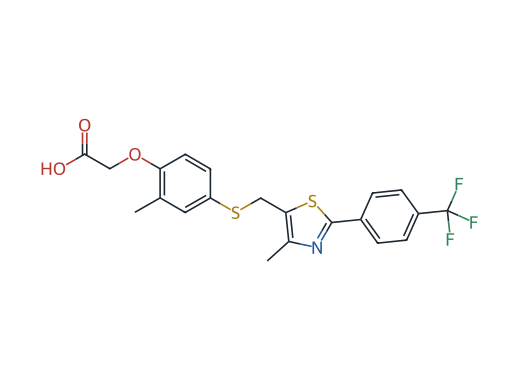
Cardarine, properly GW501516 or GW1516, is not a SARM, despite being sold beside them. It is a PPAR-delta agonist. It was developed by a pharmaceutical company as a treatment for abnormal cholesterol, and in short human studies it did what it was designed to do to blood lipids S1S2S3S4. Its fame in sport came from a separate line of animal work, where it increased running endurance in mice, especially alongside training S5. Clinical development was stopped and the investigational application with FDA withdrawn after long-term animal studies produced tumors in several organs S7S8. It is taken by mouth and reaches people only through the grey market.
How it works
PPAR-delta is a nuclear hormone receptor — a receptor that sits inside the cell and, once switched on, binds DNA and changes which genes are read. Cardarine activates it, and the gene programme that follows pushes muscle and other tissue to burn fat rather than glucose: more fat oxidation, more reverse cholesterol transport, less reliance on sugar S1S2S3. In short human studies that is exactly what it did to blood lipids — triglycerides fell, HDL rose, and tracer work showed the change came from altered handling of lipoproteins rather than from weight loss S1S3S4. The endurance claim comes from mice, in which PPAR-delta activation plus training shifted muscle toward oxidative fibres and increased running distance S5. The same gene-level mechanism cuts the other way: PPAR-delta activation also drives cell proliferation in tissue such as colon epithelium S6, and long-term animal studies produced tumours in multiple organs, which ended its development S7S8.
Legal status
- FDA: Not approved for any use. Development was halted and the investigational new drug application withdrawn; no human study has been run since S7S8.
- Dietary-supplement status: GW501516 is an unapproved drug and is not a lawful dietary ingredient; selling it as a supplement is illegal.
- DEA: Not a federally scheduled controlled substance.
- "Research use only" products: cardarine is sold as research powder, capsules or liquid of unverified content. See our explainer.
- WADA: Prohibited at all times. It has been on the Prohibited List since 2009, first in the gene-doping category and then under metabolic modulators S7S9S10. WADA took the rare step of issuing a public health warning to athletes about it, and USADA tells athletes plainly that it was pulled from development after it was found to cause cancer in animals S8.
- International (short): Not reviewed for this page yet.
What the research actually shows
Evidence: B. Real randomized human trials exist, but every one of them measured blood lipids over two to twelve weeks, at doses up to 10 mg a day. Not one measured endurance, fat loss or body composition as a main outcome. The endurance story is entirely from mice. Against that sits the reason the drug does not exist: long-term rodent studies at high doses produced tumors across multiple organs, which is why development stopped and no further human research was done S7S8.
| Study | Design | People | Dose studied | Result |
|---|---|---|---|---|
| Sprecher 2007 S1 | Randomized, placebo-controlled, inpatient and sedentary; first report of a PPAR-delta agonist given to humans | 24 healthy volunteers (placebo n=6; 2.5 mg n=9; 10 mg n=9) | 2.5 mg or 10 mg once daily by mouth | HDL cholesterol rose in both drug groups while falling 11.5% on placebo; triglyceride clearance after a fat meal improved; fasting triglycerides only trended down |
| Riserus 2008 S2 | Randomized, double-blind, three-group, 2 weeks | 18 moderately overweight men (6 per group) | 10 mg once daily by mouth | Fasting triglycerides -30%, apolipoprotein B -26%, LDL cholesterol -23%, insulin -11%, liver fat -20%; HDL unchanged; a marker of oxidative stress fell 30% |
| Ooi 2011 S3 | Randomized, double-blind crossover, 6-week periods | 13 men with dyslipidemia and central obesity | 2.5 mg per day by mouth | Lowered triglycerides, fatty acids and apolipoprotein B-100; raised HDL cholesterol; traced the changes to faster clearance of VLDL particles |
| Olson 2012 S4 | Randomized, placebo-controlled, 12 weeks | 268 patients with low HDL cholesterol (plus a 37-person exploratory study) | 2.5, 5.0 or 10.0 mg per day by mouth | HDL cholesterol up to +16.9% (10 mg), apoA-I +6.6%, LDL -7.3%, triglycerides -16.9%, apoB -14.9%, free fatty acids -19.4% |
| Narkar 2008 S5 | Animal study | Mice | Not a human dose | A PPAR-delta agonist plus training increased oxidative muscle fibres and running endurance; this is the source of the "exercise in a pill" claim |
| Gupta 2004 S6 | Animal study | Apc-min mice, prone to intestinal polyps | Not a human dose | GW501516 significantly increased the number and size of intestinal polyps, with a fivefold rise in polyps larger than 2 mm |
| Pokrywka 2014 S7 | Review covering the doping context and the toxicology | — | — | Summarizes the 104-week rodent carcinogenicity studies behind the discontinuation: tumors in multiple tissues in rats and mice, and reduced survival in mice |
What we don't know: whether cardarine does anything for human endurance or body composition, because no human trial has ever measured those; and what long-term use does to a person, because the longest human exposure in the published record is 12 weeks and development stopped before anyone found out S4S7.
Reported benefits
In trials: a consistent, measurable improvement in the cholesterol and triglyceride profile, over 2 to 12 weeks, with lower liver fat in one small study S1S2S3S4. In mice: greater running endurance, mostly in combination with training S5. The endurance and fat-loss effects that cardarine is actually bought for are user-reported in humans and animal-tested only; no human trial measured them.
Side effects
Common: the published human trials, which were short and at doses up to 10 mg a day, did not report significant adverse effects, which the review attributes to the low doses and short duration rather than to established safety S7. Serious: the serious concern is not a side effect seen in trials, it is the cancer signal from long-term animal dosing that ended development: tumors in multiple organs in rats and mice in two-year studies, decreased survival in mice, and faster growth of intestinal polyps in a mouse model predisposed to them S6S7S8.
Dangers and red flags
- A cancer signal is why this drug does not exist. Long-term high-dose rodent studies produced tumors across several organs, development was terminated and the FDA application withdrawn; the long-term human risk is unknown because nobody was allowed to find out S7S8.
- The human trials are not the use case. Every human study was a short lipid study; none tested endurance, fat loss or long-term safety S1S2S3S4.
- Sold as "research" material of unknown content. It is an unapproved drug bought from research-chemical sellers with no identity or purity standard behind it.
- Sport: prohibited at all times, with a rare WADA health warning attached, and detectable in urine and in hair S8S9S10.
- Who should avoid it: anyone, on the published evidence; there is no legitimate medical use and no approved product anywhere.
Doses reported
We don't recommend sh*t. These are the doses studies, labels and harm-reduction sources report. That's information, not advice. Talk to a licensed clinician.
There is no FDA label (never approved), so there is no label dose. The rows below are the oral doses used in the published human lipid trials, plus the misuse dosing described in a peer-reviewed forensic toxicology paper, reported as that paper reports it. Cardarine is taken by mouth, so the reconstitution calculator does not apply.
| Source | Dose | Unit / route | Frequency | Timing | Duration | Titration / escalation | Context |
|---|---|---|---|---|---|---|---|
| S1 Sprecher 2007 | 2.5 mg or 10 mg | mg, oral | Once daily | — | 2 weeks | Fixed dose groups | Healthy volunteers, hospitalized and sedentary |
| S2 Riserus 2008 | 10 mg | mg, oral | Once daily | — | 2 weeks | Fixed dose | Moderately overweight men |
| S3 Ooi 2011 | 2.5 mg | mg, oral | Daily | — | 6-week treatment periods, crossover | Fixed dose | Men with dyslipidemia and central obesity |
| S4 Olson 2012 | 2.5 mg, 5.0 mg or 10.0 mg | mg, oral | Daily | — | 12 weeks | Fixed dose groups | Patients with low HDL cholesterol |
| S9 Kintz 2020 (reported misuse) | 10 to 20 mg per day | mg, oral | Daily | — | 6 to 8 weeks | Not applicable | What the forensic literature describes as performance-enhancing misuse dosing; not a studied or safe dose, and above the trial range |
Monitoring a doctor would order
There is no guideline for an unapproved, discontinued drug. The human trials followed a fasting lipid panel and markers of liver fat and glucose handling S2S4. Given why development stopped, the honest statement is that no blood test monitors for the risk that ended this drug, and no screening regime has been established for people taking it S7S8.
Bottom line
Cardarine (GW501516) is a PPAR-delta agonist, not a SARM, with genuine randomized human evidence that it improves blood lipids over 2 to 12 weeks at up to 10 mg a day. Its reputation as an endurance drug comes from mice, not people. Development stopped and the FDA application was withdrawn after long-term rodent studies produced tumors in multiple organs, so the long-term human risk has never been characterized and never will be from clinical data. It is prohibited in sport at all times, carries a rare WADA health warning, and is bought as unapproved research material of unknown content.
Sources
- [S1] Sprecher DL, et al. Triglyceride:high-density lipoprotein cholesterol effects in healthy subjects administered a peroxisome proliferator activated receptor delta agonist. Arterioscler Thromb Vasc Biol. 2007;27(2):359-365. PMID 17110604. (rct)
- [S2] Riserus U, et al. Activation of peroxisome proliferator-activated receptor (PPAR)delta promotes reversal of multiple metabolic abnormalities, reduces oxidative stress, and increases fatty acid oxidation in moderately obese men. Diabetes. 2008;57(2):332-339. PMID 18024853. (rct)
- [S3] Ooi EM, Watts GF, Sprecher DL, Chan DC, Barrett PH. Mechanism of action of a peroxisome proliferator-activated receptor (PPAR)-delta agonist on lipoprotein metabolism in dyslipidemic subjects with central obesity. J Clin Endocrinol Metab. 2011;96(10):E1568-E1576. PMID 21816786. (rct)
- [S4] Olson EJ, Pearce GL, Jones NP, Sprecher DL. Lipid effects of peroxisome proliferator-activated receptor-delta agonist GW501516 in subjects with low high-density lipoprotein cholesterol: characteristics of metabolic syndrome. Arterioscler Thromb Vasc Biol. 2012;32(9):2289-2294. PMID 22814748. (rct)
- [S5] Narkar VA, et al. AMPK and PPARdelta agonists are exercise mimetics. Cell. 2008;134(3):405-415. PMID 18674809. (animal)
- [S6] Gupta RA, Wang D, Katkuri S, Wang H, Dey SK, DuBois RN. Activation of nuclear hormone receptor peroxisome proliferator-activated receptor-delta accelerates intestinal adenoma growth. Nat Med. 2004;10(3):245-247. PMID 14758356. (animal)
- [S7] Pokrywka A, et al. Metabolic modulators of the exercise response: doping control analysis of an agonist of the peroxisome proliferator-activated receptor delta (GW501516) and 5-aminoimidazole-4-carboxamide ribonucleotide (AICAR). J Physiol Pharmacol. 2014;65(4):469-476. PMID 25179079. (review)
- [S8] U.S. Anti-Doping Agency. What Should Tested Athletes Know About GW1516? (regulator)
- [S9] Kintz P, Ameline A, Gheddar L, Raul JS. Testing for GW501516 (cardarine) in human hair using LC/MS-MS and confirmation by LC/HRMS. Drug Test Anal. 2020;12(7):980-986. PMID 32298044. (human-case-series)
- [S10] World Anti-Doping Agency. 2026 Prohibited List, section S4.4 (metabolic modulators; PPAR-delta agonists, GW 1516 named). (regulator)