
Reproductive & hormonal peptides (approved)
Cetrorelix
Also called Cetrotide, cetrorelix acetate for injection, generic cetrorelix kits
- US status
- Approved
- DEA
- Not a controlled substance
- WADA
- Not named on the 2026 Prohibited List
- Class
- Reproductive & hormonal peptides (approved)
Jump to doses reported ↓ Dose math calculator
What it is
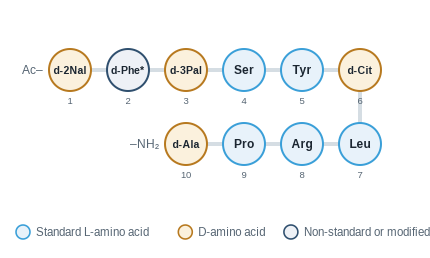
Cetrorelix (Cetrotide, and generic versions) is a synthetic ten-amino-acid peptide that blocks the receptor for gonadotropin-releasing hormone (GnRH) on the pituitary gland S1. It is an approved prescription fertility drug. During IVF, women take daily hormone injections to grow several eggs at once; cetrorelix is added partway through to stop the body from releasing those eggs too early. It is a small daily injection under the skin of the lower belly that patients can give themselves after instruction S1.
How it works
Ovulation is triggered by a sudden surge of LH from the pituitary. In IVF that natural surge is a problem: if it happens before the eggs are collected, they are released and lost. Cetrorelix competes with the body's own GnRH for the pituitary receptor, so the pituitary cannot launch the LH surge S1. Because it blocks rather than stimulates the receptor, it works within about two hours at the 0.25 mg dose, with no initial hormone surge, and its effect wears off after it is stopped S1. Its effect on LH is stronger than on FSH, so the fertility drugs keep growing the follicles S1. When the eggs are ready, the doctor gives an hCG "trigger" injection to finish maturing them.
Legal status
- FDA: Approved for inhibiting premature LH surges in women undergoing controlled ovarian stimulation S1. The 0.25 mg vial is marketed; the 3 mg strength is listed as discontinued S2.
- Who prescribes it: the label says it should be prescribed by physicians experienced in fertility treatment S1.
- DEA: Not a controlled substance.
- WADA: GnRH antagonists are not named on the 2026 Prohibited List S4.
- International (short): Not reviewed for this page.
What the research actually shows
Evidence: A. Approved on five clinical trials (732 women), with later meta-analysis of antagonists as a class.
| Study / source | Design | People | Dose studied | Result |
|---|---|---|---|---|
| Phase 2 dose-finding S1 | Two dose-finding trials | Women in ovarian stimulation | Single and multiple doses | 3 mg single dose and 0.25 mg daily were the minimal effective doses for blocking premature LH surges |
| Phase 3, multiple dose, active comparator S1 | Controlled trial | 159 women | 0.25 mg daily from stimulation day 5 or 6 | LH surge after starting in 1.9%; egg retrieval in 94.3% |
| Phase 3, multiple dose, non-comparative S1 | Single-arm | 303 women | 0.25 mg daily | LH surge in 1.0%; egg retrieval in 93.1% |
| Phase 3, single dose S1 | Controlled trial | 115 women | 3 mg once (strength now discontinued) | No LH surges after dosing; egg retrieval in 98.3% |
| Al-Inany 2016, Cochrane S3 | Meta-analysis of 73 randomized trials | 12,212 women; GnRH antagonists vs long-course agonists | Antagonist regimens including 0.25 mg daily | No clear difference in live birth (OR 1.02); less ovarian hyperstimulation syndrome (OR 0.61) |
What we don't know for this page: the Cochrane result is for GnRH antagonists as a class (cetrorelix and ganirelix), not cetrorelix alone S3.
Reported benefits
Prevents the early LH surge that would ruin an IVF attempt, with a short course of daily injections, no initial flare, and, as a class, a lower risk of ovarian hyperstimulation syndrome than the older long agonist approach, without lowering live-birth rates S1S3.
Side effects
Common (949 women in trials): moderate or severe ovarian hyperstimulation syndrome 3.5% (events counted regardless of cause, during the whole stimulation treatment); nausea 1.3%; headache 1.1%; mild, brief injection-site redness, bruising, itching or swelling S1. Serious: allergic reactions, including anaphylactoid reactions with the first dose, reported after marketing; one severe anaphylactic reaction occurred after seven months at 10 mg/day in a non-fertility study S1. Liver enzymes rose up to three times normal in 1 to 2% of women; the meaning is unclear S1. Pregnancy outcomes: two stillbirths in phase 3 studies; in follow-up of 316 newborns, a small number of birth defects were recorded, and the label says a causal link is unknown because IVF itself and other factors make cause hard to study S1.
Dangers and red flags
- Pregnancy must be excluded first. It is contraindicated in known or suspected pregnancy and in breastfeeding; animal studies showed total pregnancy loss at higher doses S1.
- Allergy. Use is not advised in women with severe allergic conditions S1.
- Kidneys. Contraindicated in severe kidney impairment S1.
- Over-response. hCG should not be given if the ovaries over-respond, to lower the chance of ovarian hyperstimulation syndrome S1.
- Who should avoid it: anyone allergic to cetrorelix, other peptide hormones, mannitol, GnRH or GnRH analogs S1.
Doses reported
We don't recommend sh*t. These are the doses studies, labels and harm-reduction sources report. That's information, not advice. Talk to a licensed clinician.
The 0.25 mg vial is mixed with its own 1 mL prefilled syringe of sterile water and the whole contents injected S1. The calculator below is prefilled with that label presentation (0.25 mg in 1 mL) only.
| Source | Population | Dose | Route | Frequency and timing | Duration | Titration or escalation | Cite |
|---|---|---|---|---|---|---|---|
| Cetrotide label | Women in controlled ovarian stimulation | 0.25 mg (whole vial, mixed with 1 mL sterile water) | Subcutaneous, lower belly | Once daily, starting stimulation day 5 (morning or evening) or day 6 (morning) | Until the day of the hCG injection | None | S1 |
| Cetrotide phase 3 single-dose trial | Women in controlled ovarian stimulation | 3 mg once (strength now discontinued in the US) | Subcutaneous | Once, usually around stimulation day 7; 0.25 mg daily added if hCG was not given within 4 days | Single dose | — | S1S2 |
| Al-Inany 2016 (regimens described) | IVF | 0.25 mg daily from stimulation day 6 to 7 (fixed) or when the lead follicle reached 14 to 15 mm (flexible); or a single 3 mg dose on day 7 to 8 | Subcutaneous | As described | — | — | S3 |
There is no known non-medical use with published dosing, so we report no community doses.
Open the dose math calculator →
Monitoring a doctor would order
Ultrasound of follicle growth and estradiol levels during stimulation; pregnancy test before starting; watching for signs of ovarian hyperstimulation and allergic reactions S1.
Bottom line
Cetrorelix is a GnRH blocker used for a few days during IVF to stop eggs from being released before they can be collected. It works within hours, causes no initial surge, and as a class lowers the risk of ovarian hyperstimulation compared with older agonist approaches without lowering live-birth rates. Side effects are usually mild; rare allergic reactions, including at the first dose, are the main safety concern.
Sources
- [S1] CETROTIDE (cetrorelix acetate for injection) 0.25 mg. US prescribing information (DailyMed), EMD Serono. Indication, pharmacology, clinical studies, contraindications, precautions, adverse events, dosage and administration, how supplied. Set ID aca7768e-28a7-4027-b1d8-e66247665f79. (label)
- [S2] U.S. FDA, Drugs@FDA. CETROTIDE (cetrorelix acetate), NDA 021197: 0.25 mg vial marketed (prescription); 3 mg vial discontinued. (regulator)
- [S3] Al-Inany HG, et al. Gonadotrophin-releasing hormone antagonists for assisted reproductive technology. Cochrane Database Syst Rev. 2016;4:CD001750. PMID 27126581. (review)
- [S4] World Anti-Doping Agency. 2026 Prohibited List (S2.2.1 names GnRH and its agonist analogues; GnRH antagonists such as cetrorelix are not named). (regulator)