
Anabolic-androgenic steroids (AAS)
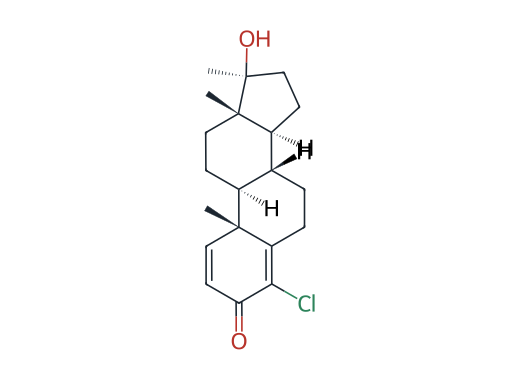
Chlorodehydromethyltestosterone
Also called Oral Turinabol, Tbol, T-bol, dehydrochloromethyltestosterone, 4-chlorodehydromethyltestosterone, chlorodehydromethyltestosterone
- US status
- Not approved. Never a medicine in the US.
- DEA
- Schedule III (21 CFR 1308.13(f), listed as dehydrochloromethyltestosterone)
- WADA
- S1.1 Anabolic androgenic steroids; prohibited at all times
- Class
- Anabolic-androgenic steroids (AAS)
Jump to doses reported ↓ Dose math calculator
What it is
Chlorodehydromethyltestosterone — "Oral Turinabol" ("Tbol") — is an oral anabolic-androgenic steroid, a 4-chloro, 17α-methylated derivative of methandrostenolone (Dianabol). It was created in East Germany and is best known as the main drug of the former German Democratic Republic's state doping program, which gave it to athletes — including minors — often without their knowledge S1. It has never been a medicine in the US and exists today only as grey-market and "designer" supply.
How it works
Like all anabolic-androgenic steroids, it binds the androgen receptor inside muscle and other tissue; the activated receptor then acts on DNA to raise muscle protein synthesis, producing gains in mass and strength S8. Three structural features shape how it behaves. The 17-alpha methyl group lets it survive first pass through the liver so it works as a tablet — and is the same feature that makes 17-alkylated orals hepatotoxic, with liver injury and, in reported cases, liver tumours S7. The 4-chloro substitution blocks aromatization, so it is not converted to estrogen; gains are "dry," with no estrogenic water retention, but also none of estrogen's protective effects on lipids. Its androgenic activity is low relative to its anabolic activity, which is why the GDR programme used it in women and girls, in whom it still produced irreversible virilization S1. Like any androgen taken from outside, it shuts down the body's own LH and testosterone output by pituitary feedback S8S9. Its long-lived metabolites are what made retrospective detection possible years later S2.
Legal status
- FDA: Never approved for any use S1.
- DEA: Schedule III anabolic steroid, listed by name as dehydrochloromethyltestosterone in 21 CFR 1308.13(f) S4. Possessing it without a valid prescription is a federal crime S5.
- "Designer" and supplement supply: it has turned up as a contaminant or undeclared ingredient in dietary supplements; a "supplement" label does not make it legal or safe S3.
- WADA: Prohibited at all times under S1.1; its long-term metabolites are a routine doping-test target that can be detected for months S2S6.
- International (short): Not reviewed for this page yet.
What the research actually shows
Evidence: E. There are no clinical trials of this drug — it was never developed as a legitimate medicine. The human record is historical and forensic: documentation of the GDR doping program and its harms S1, and analytical chemistry on how the drug and its metabolites are detected S2S3.
| Study | Design | Subjects | Dose studied | Result |
|---|---|---|---|---|
| Franke & Berendonk 1997 S1 | Historical / forensic review | GDR athletes, including minors | State-administered doses | Documented systematic administration and reported harms, including virilization in girls and women |
| Sobolevsky 2012 S2 | Analytical | Human urine | — | Identified long-term metabolites enabling detection for months after use |
| Geyer 2008 S3 | Analytical survey | Dietary supplements | — | Found doping steroids, including this class, as contaminants/undeclared ingredients |
What we don't know: anything about safe dosing in people — no trial has ever studied it. Its risks are inferred from the GDR record and from androgens as a class.
Reported benefits
No benefit has ever been shown in a clinical trial. In the GDR program it produced performance gains in athletes S1; users today report lean, "dry" gains — user-reported, not tested. Any effect comes with the androgenic and liver risks below.
Side effects
It is a 17α-alkylated oral, the class most strongly linked to liver injury S7: Common: suppression of the body's own testosterone, acne, and unfavorable cholesterol changes. Serious: virilization in women — the GDR record documents deepened voice, facial hair and other masculinizing effects in girls and women, some irreversible S1; liver strain and liver tumors are documented with 17α-alkylated androgens S7; cardiovascular effects seen across AAS also apply S8.
Dangers and red flags
- Documented harm in a real population. The GDR program showed serious virilization and other harms, including in minors dosed without consent S1.
- Liver injury. As a 17α-alkylated oral, it stresses the liver; liver tumors are documented with this class S7.
- Controlled substance. Non-prescription possession is a federal crime S5.
- Hidden exposure. It has appeared undeclared in supplements, so people can be exposed without knowing S3.
- Cardiovascular (class). AAS use is linked to higher rates of heart disease S8.
- Grey-market quality. All current supply is underground product of unknown identity and dose; about half of AAS samples in cohort data did not match their label S9.
- Sport: prohibited at all times, with long detection windows S2S6.
Doses reported
We don't recommend sh*t. These are the doses studies, labels and harm-reduction sources report. That's information, not advice. Talk to a licensed clinician.
No medical dosing data exist — this drug was never a medicine, so there is no label and no trial dose. The only human-dose record is the state doping program documented by Franke & Berendonk, reported as evidence of abuse and harm, not as guidance S1. It is a tablet, so the reconstitution calculator does not apply. We do not list illicit physique doses, which have no citable medical source.
| Source | Dose | Unit / route | Frequency | Timing | Duration | Titration / escalation | Context |
|---|---|---|---|---|---|---|---|
| S1 Franke & Berendonk 1997 | State-administered doses to athletes (documented as abuse) | oral | Per program | — | Years, in some athletes | — | GDR doping program; linked to virilization and other harms |
Open the dose math calculator →
Monitoring a doctor would order
No medical monitoring standard exists for this drug. For any 17α-alkylated oral androgen, a clinician would check liver enzymes, a lipid panel, testosterone, hematocrit and blood pressure, and in women, signs of virilization S7S8. Tell the clinician what was actually used.
Bottom line
Chlorodehydromethyltestosterone ("Oral Turinabol") was never a medicine — it is the drug at the center of East Germany's state doping program, which documented serious harms including irreversible virilization in girls and women dosed without consent. There are no clinical trials, it is a 17α-alkylated oral with liver-tumor risk, it has turned up undeclared in supplements, and it is a Schedule III controlled substance whose non-prescription possession is a federal crime. It is banned in sport at all times, with long detection windows.
Sources
- [S1] Franke WW, Berendonk B. Hormonal doping and androgenization of athletes: a secret program of the German Democratic Republic government. Clin Chem. 1997;43(7):1262-79. PMID 9216474. (human-observational)
- [S2] Sobolevsky T, Rodchenkov G. Detection and mass spectrometric characterization of novel long-term dehydrochloromethyltestosterone metabolites in human urine. J Steroid Biochem Mol Biol. 2012;128(3-5):121-7. PMID 22142641. (in-vitro)
- [S3] Geyer H, et al. Nutritional supplements cross-contaminated and faked with doping substances. J Mass Spectrom. 2008;43(7):892-902. PMID 18563865. (survey)
- [S4] 21 CFR 1308.13(f), Schedule III anabolic steroids; dehydrochloromethyltestosterone (4-chloro-17β-hydroxy-17α-methyl-androst-1,4-dien-3-one) (eCFR). (regulator)
- [S5] 21 U.S.C. 844, Penalties for simple possession. (regulator)
- [S6] World Anti-Doping Agency. 2026 Prohibited List, section S1.1 (anabolic androgenic steroids). (regulator)
- [S7] Khalid S, et al. Development of Liver Cancers as an Unexpected Consequence of Anabolic Androgenic Steroid Use. Cureus. 2023;15(1):e34357. PMID 36874750. (review)
- [S8] Pope HG Jr, et al. Adverse health consequences of performance-enhancing drugs: an Endocrine Society scientific statement. Endocr Rev. 2014;35:341-75. PMID 24423981. (review)
- [S9] Smit DL, et al. Baseline characteristics of the HAARLEM study: 100 male amateur athletes using anabolic androgenic steroids. Scand J Med Sci Sports. 2020;30:531-539. PMID 31663164. (human-observational)