
Growth hormone & GH-axis peptides
CJC-1295 (with DAC)
Also called CJC-1295 DAC, DAC:GRF, drug affinity complex GRF, long-acting GHRH analog
- US status
- Not approved
- DEA
- Not a controlled substance
- WADA
- S2.2.4 Growth hormone releasing factors (GHRH analogues); prohibited at all times
- Class
- Growth hormone & GH-axis peptides
Jump to doses reported ↓ Dose math calculator
What it is
CJC-1295 with DAC (a "drug affinity complex") is a long-acting synthetic analog of growth-hormone-releasing hormone. It has never been approved for any use and is sold only as grey-market "research" powder. The version without DAC (also called Mod GRF 1-29) is a separate, much shorter-acting peptide, covered on its own page.
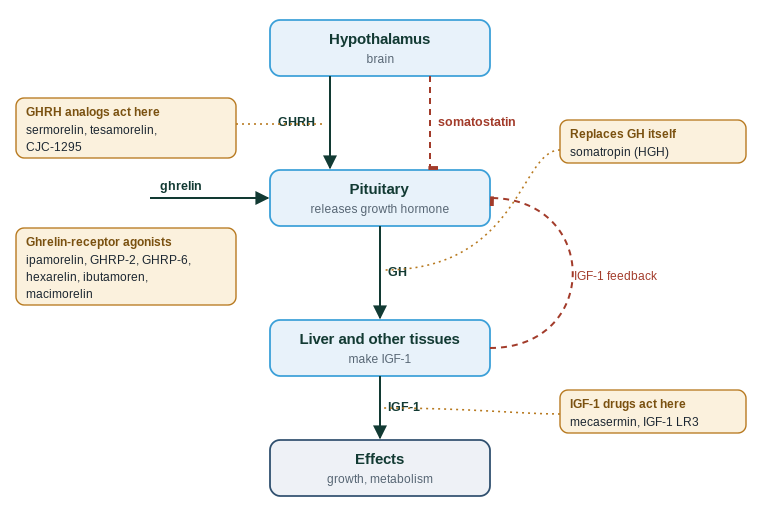
The growth-hormone axis, and where each drug class acts
How it works
Growth hormone is released by the pituitary when the hypothalamus sends growth-hormone-releasing hormone (GHRH). CJC-1295 is a modified GHRH(1-29) fragment that binds the same pituitary GHRH receptor, so it works by pushing the gland to release its own GH rather than supplying GH from outside S3. The DAC — a reactive chemical group — lets the peptide bond covalently to albumin in the blood, which shields it from breakdown and stretches its action from minutes to days S3. In the published human dose-finding study, single injections raised GH for up to about six days and IGF-1 for up to about 11 days, with half-lives of five to eight days S3. The pituitary's own pulsing was preserved rather than flattened S4. The consequence that matters is that the elevation cannot be withdrawn: once injected, the albumin-bound peptide keeps signalling for days, so IGF-1 stays raised whether or not that turns out to be wanted, and anti-doping rules name it directly S5.
Legal status
- FDA: Not approved for any use. On the FDA compounding list, CJC-1295 appears among substances nominated but withdrawn; FDA cites serious adverse events including increased heart rate and a systemic vasodilatory reaction, and says available clinical data are limited S1.
- Compounding: FDA's Pharmacy Compounding Advisory Committee voted against adding every CJC-1295 form (including both DAC forms) to the 503A bulks list on December 4, 2024 S2. CJC-1295 is not in the October 2026 HHS enforcement-discretion peptide list.
- DEA: Not a controlled substance.
- "Research use only" powder: this is essentially the only way CJC-1295 DAC is sold; that label means no one has checked it for human use. See our explainer.
- WADA: Named under S2.2.4 and prohibited at all times in sport S5.
- International (short): Not reviewed for this page yet.
What the research actually shows
Evidence: C. A small number of early-phase human pharmacology studies measured how CJC-1295 raises GH and IGF-1. There are no trials of clinical outcomes (body composition, strength, healing) and no long-term safety data.
| Study | Design | People | Dose studied | Result |
|---|---|---|---|---|
| Teichman 2006 S3 | Two randomized, placebo-controlled ascending-dose trials, 28 and 49 days | Healthy adults, ages 21–61 | Single doses, then weekly/biweekly | GH rose 2- to 10-fold for ≥6 days; IGF-1 rose 1.5- to 3-fold for 9–11 days; half-life 5.8–8.1 days; best tolerated at 30–60 mcg/kg |
| Ionescu 2006 S4 | Pharmacodynamic study | Healthy men 20–40 | Single 60 or 90 mcg/kg | GH secretion rose with preserved pulsatility; trough GH rose markedly; no difference between the two doses |
What we don't know: whether it does anything useful for the body-composition, recovery or anti-aging goals it is sold for; its long-term safety; and whether a grey-market vial contains real, sterile peptide at the stated amount. FDA has flagged increased heart rate and a vasodilatory reaction S1.
Reported benefits
In the early human studies: sustained increases in GH and IGF-1 blood levels S3S4. No study has shown that these level changes translate into the muscle, fat-loss, recovery or anti-aging benefits the peptide is marketed for.
Side effects
Common: injection-site reactions, flushing and headache are commonly reported with GHRH-analog dosing, though the formal studies were small S3. Serious: FDA has identified serious adverse events associated with CJC-1295 including increased heart rate and a systemic vasodilatory reaction (a drop in blood pressure with flushing) S1. Raising GH and IGF-1 carries the same theoretical concerns as growth hormone (glucose effects, tissue growth).
Dangers and red flags
- Regulators have said no. FDA cites specific adverse events, and its advisory committee voted against the whole CJC-1295 group for compounding S1S2.
- Long action cuts both ways. Because DAC keeps GH and IGF-1 up for days, a bad reaction or an overdose from a mislabeled vial cannot be quickly undone.
- Product quality. Sold almost entirely as "research" powder of unverified identity, dose and sterility.
- No human outcome data. The studies measured hormone levels, not health outcomes.
- Sport: prohibited at all times S5.
- Who should avoid it: with no approval and no safety database, there is no established safe use for anyone.
Doses reported
We don't recommend sh*t. These are the doses studies, labels and harm-reduction sources report. That's information, not advice. Talk to a licensed clinician.
There is no FDA-labeled dose because there is no approved product. The rows below are early-phase study doses only, all subcutaneous, measured for their effect on GH/IGF-1 levels, not for any health outcome.
| Source | Dose | Unit / route | Frequency | Duration | Context |
|---|---|---|---|---|---|
| S3 Teichman 2006 | Single ascending doses; multiple weekly/biweekly doses; best tolerated 30–60 mcg/kg | mcg per kg, subcutaneous | Single, then weekly or every 2 weeks | 28 and 49 days | Healthy adults, pharmacology |
| S4 Ionescu 2006 | 60 or 90 mcg/kg | mcg per kg, subcutaneous | Single injection | One week of sampling | Healthy men, pharmacodynamics |
No validated survey or harm-reduction source with citable numbers specific to non-pharmacy CJC-1295 DAC use was found that we could cite.
Open the dose math calculator →
Monitoring a doctor would order
There is no guideline for this unapproved drug. By analogy to other GH-axis drugs, a clinician would watch IGF-1, glucose, heart rate and blood pressure, the last two because FDA flagged a heart-rate increase and a vasodilatory reaction S1. We found no CJC-1295-specific monitoring standard.
Bottom line
CJC-1295 with DAC is a long-acting, never-approved GHRH analog that raises GH and IGF-1 for days per injection. The only human studies measured hormone levels, not health outcomes; FDA has flagged increased heart rate and a vasodilatory reaction and its advisory committee voted against compounding it. It is sold only as grey-market "research" powder of unknown quality and is banned in sport at all times.
Sources
- [S1] FDA. Certain Bulk Drug Substances for Use in Compounding that May Present Significant Safety Risks (CJC-1295 entry, among substances nominated but withdrawn; FDA notes serious adverse events including increased heart rate and a systemic vasodilatory reaction, and that available clinical data are limited). Content current as of 04/22/2026. (regulator)
- [S2] FDA. December 4, 2024: Final Summary Minutes of the Pharmacy Compounding Advisory Committee Meeting (committee voted against adding CJC-1295 free base 0-13, CJC-1295 acetate 1-12, CJC-1295 DAC free base 0-13, CJC-1295 DAC acetate 0-13, and CJC-1295 DAC trifluoroacetate 0-13 to the 503A Bulks List). (regulator)
- [S3] Teichman SL, et al. Prolonged stimulation of GH and IGF-I secretion by CJC-1295, a long-acting analog of GH-releasing hormone, in healthy adults. J Clin Endocrinol Metab. 2006;91:799-805. PMID 16352683. (rct)
- [S4] Ionescu M, Frohman LA. Pulsatile secretion of GH persists during continuous stimulation by CJC-1295, a long-acting GH-releasing hormone analog. J Clin Endocrinol Metab. 2006;91:4792-4797. PMID 17018654. (human-observational)
- [S5] World Anti-Doping Agency. 2026 Prohibited List, section S2.2.4 (CJC-1295 named). (regulator)