
Beta-2 adrenergic agonists (performance/fat-loss misuse)
Clenbuterol
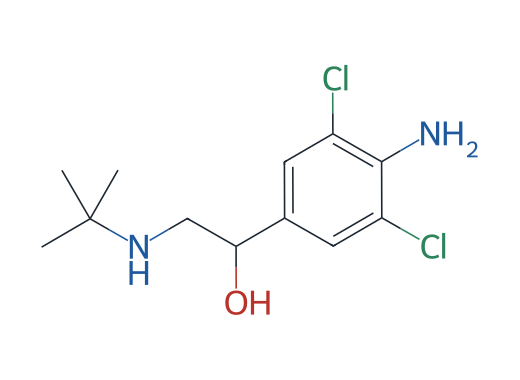
Also called clenbuterol hydrochloride, Ventipulmin (equine), 4-amino-alpha-[(tert-butylamino)methyl]-3,5-dichlorobenzyl alcohol, clen
- US status
- Veterinary only (horses). Never approved for humans.
- DEA
- Not scheduled
- WADA
- S1.2 Other Anabolic Agents; prohibited at all times
- Class
- Beta-2 adrenergic agonists (performance/fat-loss misuse)
Jump to doses reported ↓ Dose math calculator
What it is
Clenbuterol is a long-acting beta-2 adrenergic agonist, the same drug class as asthma relievers like salbutamol, but far longer-acting S1S5. In the US it is approved only as Ventipulmin, an oral syrup given to horses to open the airways in airway obstruction; each mL contains 72.5 mcg of clenbuterol hydrochloride, and the label reads "Not for use in humans" S1S2. It is not a steroid. People misuse it as a fat-loss and "lean out" drug, usually as tablets or liquid taken by mouth S5S11. There is no human pharmaceutical clenbuterol product in the US, so anything used that way is veterinary, imported or non-pharmaceutical supply.
How it works
Clenbuterol is a beta-2 adrenergic agonist: it binds the same receptors adrenaline uses, raising cyclic AMP inside the cell. In airway smooth muscle that relaxes the muscle and opens the airways, which is its approved veterinary use in horses S1S2. The reason it is misused is what the same receptors do elsewhere. Beta-2 stimulation in fat tissue drives lipolysis and raises metabolic rate and body temperature, and in livestock and rodents it acts directly on muscle to increase lean mass — the "repartitioning" effect behind its reputation S5. Whether that muscle effect occurs in people at tolerable amounts has never been shown. What separates it from an asthma inhaler is duration and route: it is taken systemically and its half-life is long, roughly a day or more, so the cardiovascular effects of beta-2 stimulation accumulate instead of passing — tachycardia, tremor, and potassium driven into cells causing hypokalemia S5S6S7. Receptor down-regulation also means the metabolic effect fades within weeks while the cardiac load does not, and the same mechanism explains the poisonings from contaminated meat and adulterated heroin S8S15S16.
Legal status
- FDA: Not approved for any human use. The only US approval is the equine syrup Ventipulmin S1S2. A drug marketed for human use without approval is an unapproved new drug under federal law; the label itself restricts the product to use by or on the order of a licensed veterinarian in horses S1.
- Food animals: Clenbuterol is specifically prohibited from extralabel use in food-producing animals; it is illegal to give it to cattle or other food animals, which is why it has caused food-poisoning outbreaks when that ban was broken S3S15S16.
- DEA: Not a controlled substance. It is not an anabolic steroid and carries no DEA schedule. That does not make human use or distribution legal: it remains an unapproved drug for people.
- "Research use only" / "not for human consumption" labels: These labels do not make human use legal or safe. They signal that no one has checked the product for human use. We do not name or link to sellers.
- WADA (sport): Listed under S1.2 Other Anabolic Agents and prohibited at all times, in and out of competition, with no threshold S4. (WADA classes it as an anabolic agent even though it is a beta-2 agonist; it is a non-Specified substance.)
- International (short): Across many countries clenbuterol is a prescription-only or veterinary-restricted drug and its use in meat production is banned; documented poisoning outbreaks from treated livestock occurred in Spain and Portugal S15S16.
What the research actually shows
Evidence: E for people. No human clinical trial has established clenbuterol as a safe or effective fat-loss or performance drug. What exists in humans is a toxicology record: poison-centre case series, public-health outbreak investigations and single-patient case reports, which describe harm rather than benefit S5S6.
| Study | Design | People | What was measured | Result |
|---|---|---|---|---|
| Kumari 2023 S5 | Systematic review (PRISMA) of case reports/series | 24 athletes | Adverse events, route, dose | Oral use most common; reported daily doses 20 µg–30 mg; events included supraventricular tachycardia, atrial fibrillation, chest pain, myocardial injury, myocarditis, myocardial infarction, cardiomyopathy, hyperglycaemia and death. Cardiac complications were the most common |
| Brett 2014 S6 | Retrospective poisons-centre series | 63 exposures (NSW, Australia) | Reasons for use, clinical features, outcomes | At least 53 (84%) required hospitalisation; most common use was bodybuilding and slimming; commonest features tachycardia, GI upset and tremor; one cardiac arrest in a 21-year-old man |
| Hoffman 2001 S7 | Single case, lab-confirmed | 28-year-old woman | Vitals, electrolytes, serum level | Sinus tachycardia 140/min, hypokalemia (2.4 mmol/L), hypophosphatemia, hypomagnesemia; symptomatic >20 hours after a reportedly small ingestion |
| Heroin-adulteration outbreaks S8S9S10 | Public-health/case series | Dozens across several US states | Atypical reactions after heroin use | Clenbuterol confirmed as a heroin adulterant; tachycardia, palpitations, chest pain and hospitalisations in people who did not know they had taken it |
| Pediatric ingestions S11S12 | Case reports | 2-year-old; 13-year-old | Vitals, labs, ECG | Tremor, tachycardia, hypotension; hyperglycaemia, hypokalaemia, hypophosphataemia; prolonged QTc and ST changes in the adolescent |
What we don't know: almost everything a human drug label would tell you, including whether it produces meaningful fat loss in people, a dose that is safe, long-term heart and muscle effects, and how risk scales with dose. The published human data is weighted toward harm, and the systematic review concluded the lack of evidence for benefit sits against serious, sometimes fatal, toxicity S5.
Reported benefits
- In animals: bronchodilation in horses is the approved effect S1; in livestock, beta-agonists shift carcass composition toward lean mass, which is exactly why feeding clenbuterol to food animals is banned S3.
- In people: fat loss and a "leaning out" or muscle-sparing effect are the reasons people misuse it S5, but no human trial has shown these outcomes. Any claimed benefit is user-reported, not tested.
Side effects
Common: tremor (especially of the hands), tachycardia and palpitations, anxiety and restlessness, headache, sweating, nausea and muscle cramps S5S6S11S12. Serious: chest pain, dangerous heart rhythms (supraventricular tachycardia, atrial fibrillation), very low potassium, high blood sugar, myocardial injury and infarction, and in reported cases cardiac arrest and death S5S6S7S13S14.
Dangers and red flags
Clenbuterol's danger is not subtle: it is a potent, long-acting heart and metabolic stimulant with a long half-life, so an overdose keeps driving the heart for many hours.
- Cardiac toxicity is the headline harm. The systematic review of clenbuterol in athletes found cardiac complications were the most common adverse events, including supraventricular tachycardia, atrial fibrillation, chest pain, myocardial injury, myocarditis, myocardial infarction, cardiomyopathy and death S5. Separate case reports describe myocardial infarction in a 17-year-old bodybuilder and a non-ST-segment-elevation myocardial infarction in a teenager who took it to lose weight S13S14.
- Hypokalemia and electrolyte collapse. Beta-2 stimulation drives potassium into cells. A lab-confirmed case showed potassium falling to 2.4 mmol/L with low phosphate and magnesium and a heart rate of 140/min that stayed symptomatic for more than 20 hours S7. Pediatric cases show the same pattern of hypokalaemia, hypophosphataemia and hyperglycaemia, with prolonged QTc and ST changes on ECG S11S12. Low potassium is itself a trigger for dangerous rhythms.
- Hospitalisations are the rule, not the exception. In a poisons-centre series of 63 exposures, at least 84% needed hospital admission, and the people exposed were mostly using it for bodybuilding or slimming, not medicine; there was a cardiac arrest in a 21-year-old S6. A poisons-centre review called clenbuterol toxicity "an emerging epidemic" S17.
- Poisoning you did not choose. Clenbuterol has sickened people who never meant to take it. It has been detected as an adulterant in heroin, causing clusters of tachycardia, palpitations and chest pain and multi-state hospitalisations S8S9S10. It has also caused food-poisoning outbreaks when it was illegally fed to livestock and residues ended up in meat and liver, including an outbreak affecting 50 people in Portugal and an epidemiologically confirmed outbreak in Catalonia, Spain S15S16.
- Children and accidental exposure. Small ingestions have hospitalised a 2-year-old and a 13-year-old, with hypotension that may not respond to standard adrenergic treatment and can require beta-blockers S11S12. There is no safe household presence for a drug this potent.
- No human product means no quality control. With no approved human clenbuterol, there is no guaranteed strength, purity or labelling; dosing is in micrograms, so small measuring errors are large dosing errors.
- Who is at particular risk: anyone with heart disease, arrhythmia, high blood pressure, low potassium, or thyroid disease, and children. There is no human label, so there are no labelled contraindications to rely on.
Talk to a licensed clinician. A doctor can check whether a drug is right for you, order the labs, and get you a real product from a real pharmacy. If you are already using something, tell them. They have heard it before, and it changes what they test for. If you have chest pain, trouble breathing, signs of a stroke, a hot red swollen injection site, or thoughts of harming yourself, call 911 or go to an ER. For poisoning help: Poison Control 1-800-222-1222. Crisis line: 988.
Doses reported
We don't recommend sh*t. These are the doses studies, labels and harm-reduction sources report. That's information, not advice. Talk to a licensed clinician.
| Source | Dose | Frequency | Duration | Context |
|---|---|---|---|---|
| S1S2 FDA animal label (Ventipulmin) | 0.8 mcg/kg (0.5 mL per 100 lb) initial, titrated in steps to a maximum of 3.2 mcg/kg | Twice daily (b.i.d.) | Up to 30 days at the effective dose | Horses only. An equine bronchodilator dose. Not a human dose |
| S5 Kumari 2023 systematic review | 20 µg to 30 mg per day (range reported across cases) | Oral, per source | Varies | Documented exposures linked to the harms above, drawn from case reports of athletes. Reported figures, not a tested or safe range |
These rows are reported figures from the published literature, not guidance. The first is an animal label; the second is the range that appeared in human poisoning and adverse-event reports, shown next to the harms those same reports describe. Neither is a dose anyone has tested as safe in people, and we are not converting either into a dose "for you." No human therapeutic dosing data exists for the uses people seek.
Monitoring a doctor would order
There is no human clenbuterol guideline. In the toxicology literature, clinicians managing clenbuterol poisoning monitor heart rate and rhythm (continuous ECG, watching for prolonged QTc and arrhythmia), blood pressure, and electrolytes, especially potassium, phosphate and magnesium, along with blood glucose, and they replace electrolytes and may use beta-blockers to control the cardiovascular effects S7S11S12. Tell any clinician what you actually took; because clenbuterol is long-acting, symptoms can persist for many hours to days S6S7.
Bottom line
Clenbuterol is a horse airway drug that people misuse for fat loss. It has never been approved or tested as a human medicine, it is not a controlled substance but is still an unapproved drug for people, and it is banned in sport at all times. The human record is overwhelmingly a record of harm: pounding fast heart rhythms that last for hours, dangerously low potassium, heart attacks in otherwise healthy young people, hospitalisations in the great majority of reported exposures, and poisonings in people who took it by accident through tainted heroin or contaminated meat. The biggest risk is cardiac.
Sources
- [S1] VENTIPULMIN (clenbuterol hydrochloride) syrup, for oral use in horses only. Boehringer Ingelheim Animal Health USA. Approved by FDA under NADA 140-973 (DailyMed). 'Not for use in humans.' (label)
- [S2] 21 CFR 520.452, Clenbuterol syrup (conditions of use in horses; oral dosage-form new animal drug) (eCFR). (regulator)
- [S3] 21 CFR 530.41(a)(2), Drugs prohibited for extralabel use in animals: clenbuterol prohibited for extralabel use in food-producing animals (eCFR). (regulator)
- [S4] World Anti-Doping Agency. 2026 Prohibited List, S1.2 Other Anabolic Agents (clenbuterol); prohibited at all times, non-Specified substance. (regulator)
- [S5] Kumari S, Pal B, Sahu SK, Prabhakar PK, Tewari D. Adverse events of clenbuterol among athletes: a systematic review of case reports and case series. Int J Legal Med. 2023;137(4):1023-1037. PMID 37062796. (review)
- [S6] Brett J, Dawson AH, Brown JA. Clenbuterol toxicity: a NSW poisons information centre experience. Med J Aust. 2014;200(4):219-21. PMID 24580525. (human-observational)
- [S7] Hoffman RJ, Hoffman RS, Freyberg CL, Poppenga RH, Nelson LS. Clenbuterol ingestion causing prolonged tachycardia, hypokalemia, and hypophosphatemia with confirmation by quantitative levels. J Toxicol Clin Toxicol. 2001;39(4):339-44. PMID 11527226. (human-case-series)
- [S8] Centers for Disease Control and Prevention (CDC). Atypical reactions associated with heroin use--five states, January-April 2005. MMWR Morb Mortal Wkly Rep. 2005;54(32):793-6. PMID 16107783. (regulator)
- [S9] Ali M, Foster Y, Brooks M, Roomiany P. An Outbreak of Beta-2 Adrenergic Toxicity from Adulterated Heroin. Am J Med. 2016;129(8):e125-6. PMID 27103048. (human-case-series)
- [S10] Gleason B, et al. Collaborative Public Health Investigation of Clenbuterol-Adulterated Heroin Outbreak--Richmond, Virginia, March-April 2015. J Public Health Manag Pract. 2017;23(2):e8-e11. PMID 28121776. (human-observational)
- [S11] Bonney CF, Hatten B, Wang GS. Toxicity From Unintentional Pediatric Ingestion of a Performance-Enhancing Drug: A Case Report With Review of Clenbuterol Toxicity and Treatment. J Emerg Med. 2019;57(4):e105-e108. PMID 31493966. (human-case-series)
- [S12] Tester AA, Logan S, Pollock L, McKie A. Clenbuterol: a new toxic substance in paediatrics. BMJ Case Rep. 2020;13(3):e233180. PMID 32169984. (human-case-series)
- [S13] Quinley KE, Chen HY, Yang HS, Lynch KL, Olson KR. Clenbuterol causing non-ST-segment elevation myocardial infarction in a teenage female desiring to lose weight: case and brief literature review. Am J Emerg Med. 2016;34(8):1739.e5-7. PMID 26873408. (human-case-series)
- [S14] Kierzkowska B, Stanczyk J, Kasprzak JD. Myocardial infarction in a 17-year-old body builder using clenbuterol. Circ J. 2005;69(9):1144-6. PMID 16127201. (human-case-series)
- [S15] Barbosa J, Cruz C, Martins J, et al. Food poisoning by clenbuterol in Portugal. Food Addit Contam. 2005;22(6):563-6. PMID 16019830. (human-observational)
- [S16] Salleras L, Dominguez A, Mata E, et al. Epidemiologic study of an outbreak of clenbuterol poisoning in Catalonia, Spain. Public Health Rep. 1995;110(3):338-42. PMID 7610227. (human-observational)
- [S17] Bilkoo P, Thomas J, Ferencz S, et al. Clenbuterol toxicity: an emerging epidemic. A case report and review. Conn Med. 2007;71(2):89-91. PMID 17393901. (human-case-series)