
AAS ancillaries & fertility drugs
Clomiphene (clomifene)
Also called Clomid, Serophene, clomifene citrate, clomiphene citrate, clomid
- US status
- Approved
- DEA
- Not a controlled substance
- WADA
- S4.2 Anti-estrogenic substances; prohibited at all times (named)
- Class
- AAS ancillaries & fertility drugs
Jump to doses reported ↓ Dose math calculator
What it is
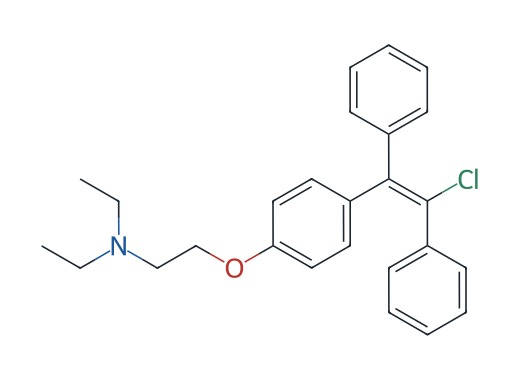
Clomiphene (clomifene), sold as Clomid, is a selective estrogen receptor modulator (SERM). It is an approved drug for ovulatory dysfunction in women. It appears on this reference because men, including anabolic-steroid users, take it off-label to raise testosterone and to restart their own hormone production after steroid use, uses it was never approved for.
How it works
The pituitary decides how much LH and FSH to release partly by sensing circulating estrogen: more estrogen means less gonadotropin. Clomiphene blocks estrogen receptors at the hypothalamus and pituitary, so that feedback signal goes unread and the brain behaves as though estrogen were low, raising GnRH pulses and therefore LH and FSH S1. In women, the resulting FSH rise recruits follicles and can restore ovulation — the approved use S1. In men, the LH rise stimulates the testes' Leydig cells to make more testosterone from within, which is why it is taken off-label to raise testosterone or to restart the body's own production after androgen use suppressed it; the published support for that is uncontrolled follow-up series, not approval-grade evidence S2S3. The molecule is a mixture of two isomers with differing receptor behaviour, and because it blocks estrogen receptors rather than removing estrogen, its effects in other tissues — eyes, endometrium, mood — do not follow from the pituitary effect S1.
Legal status
- FDA: Approved to treat ovulatory dysfunction in women trying to conceive. Male use for hypogonadism or hormonal recovery is off-label and not approved S1.
- DEA: Not a controlled substance.
- Prescription drug: clomiphene is a prescription medicine; grey-market "research chemical" clomiphene is an unapproved product of unverified content.
- WADA: Named under S4.2 (anti-estrogenic substances) and prohibited at all times in sport S4.
- International (short): Not reviewed for this page yet.
What the research actually shows
Evidence: A for the approved use; moderate observational data for male hypogonadism. Clomiphene's role in female ovulation induction is well established. Its male use is supported by smaller, mostly observational studies.
| Study | Design | People | Dose studied | Result |
|---|---|---|---|---|
| Label S1 | Approved indication | Women with ovulatory dysfunction | 50 mg/day for 5 days (100 mg course if needed) | Induces ovulation; basis of approval |
| Katz 2012 S2 | Observational cohort | Young hypogonadal men | Oral clomiphene citrate | Raised testosterone; reported improvement in hypogonadal symptoms |
| Moskovic 2012 S3 | Long-term observational | Hypogonadal men | Oral clomiphene citrate | Sustained testosterone increase over long-term use; generally well tolerated |
What we don't know: the long-term safety and fertility outcomes of male off-label use at scale, and whether grey-market clomiphene is accurately dosed.
Reported benefits
In women: ovulation induction S1. In men (off-label): higher testosterone and LH/FSH, which is why it is used both for hypogonadism and to help recover the hormonal axis after anabolic-steroid use; the male data are mostly observational but fairly consistent S2S3.
Side effects
Common: hot flushes, mood changes, and visual disturbances (blurring, flashes), which are a notable clomiphene effect; in women, ovarian enlargement and a raised chance of multiple pregnancy. Serious: visual symptoms can occasionally persist; ovarian hyperstimulation syndrome in women; and SERMs as a class can raise the risk of blood clots S1.
Dangers and red flags
- Visual symptoms. Clomiphene can cause visual disturbances; the label advises stopping and evaluation if they occur S1.
- Multiple pregnancy / ovarian effects in women S1.
- Grey-market product. "Research chemical" clomiphene is an unapproved product of unverified content.
- Not a license to use steroids safely. Using clomiphene to recover after steroids does not make steroid use safe.
- Sport: named and prohibited at all times S4.
Doses reported
We don't recommend sh*t. These are the doses studies, labels and harm-reduction sources report. That's information, not advice. Talk to a licensed clinician.
The rows below are the FDA label dosing for the approved female use, plus the fact that the male studies used oral clomiphene citrate (specific regimens varied). We do not invent a male dose. Clomiphene is a tablet, so the reconstitution calculator does not apply.
| Source | Dose | Unit / route | Frequency | Timing | Duration | Titration / escalation | Context |
|---|---|---|---|---|---|---|---|
| S1 Label (first course) | 50 mg | mg, oral | Once daily for 5 days | Start about day 5 of menstruation | 5-day course | If no ovulation, a second course of 100 mg/day for 5 days | Ovulatory dysfunction, women |
| S1 Label (limit) | — | — | — | — | Not beyond about 6 treatment courses (including about 3 ovulatory ones) | — | Overall label limit |
| S2S3 Male use (off-label) | Oral clomiphene citrate (regimen varied; not standardized) | mg, oral | Varied | — | Months to long-term | Not standardized | Male hypogonadism / hormonal recovery (observational) |
Monitoring a doctor would order
In women, clinicians monitor ovulation and ovarian response and advise on multiple-pregnancy risk, and evaluate any visual symptoms S1. In men using it off-label, a clinician would track testosterone, LH/FSH, and symptoms, and watch for visual and clot risks S2S3.
Bottom line
Clomiphene (Clomid) is an approved SERM for female ovulation induction, with moderate observational support for off-label male hypogonadism and post-steroid hormonal recovery. It can cause visual disturbances and, as a SERM, carries clot risk. It is a prescription drug, named and banned in sport at all times.
Sources
- [S1] Clomiphene citrate tablets. US prescribing information (DailyMed). Indicated for ovulatory dysfunction in women; label dosing 50 mg daily for 5 days, with a 100 mg course if needed; not beyond about 6 treatment courses. Set ID 72719958-7454-4c54-9bb4-f3054d0c5d82. (label)
- [S2] Katz DJ, et al. Outcomes of clomiphene citrate treatment in young hypogonadal men. BJU Int. 2012;110:573-578. PMID 22044663. (human-observational)
- [S3] Moskovic DJ, et al. Clomiphene citrate is safe and effective for long-term management of hypogonadism. BJU Int. 2012;110:1524-1528. PMID 22458540. (human-observational)
- [S4] World Anti-Doping Agency. 2026 Prohibited List, section S4.2 (anti-estrogenic substances; clomifene named). (regulator)