
Insulins & glucose-regulating peptides (approved)
Dasiglucagon
Also called Zegalogue, ZP4207, ready-to-use glucagon analog
- US status
- Discontinued (approved 2021; Drugs@FDA lists both presentations as discontinued)
- DEA
- Not a controlled substance
- WADA
- Not on the 2026 Prohibited List
- Class
- Insulins & glucose-regulating peptides (approved)
Jump to doses reported ↓ Dose math calculator
What it is
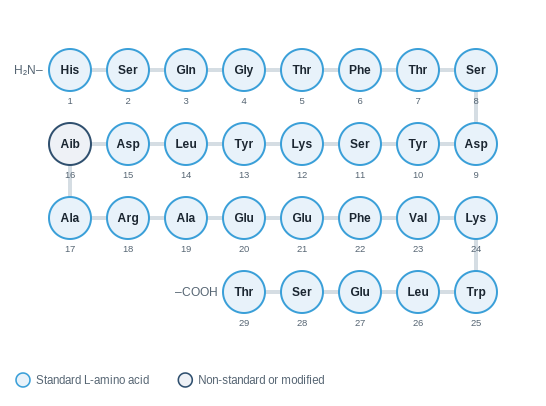
Dasiglucagon (Zegalogue) is a lab-made glucagon analog, 29 amino acids long, made as a ready-to-use liquid S1S3. Standard glucagon kits are a powder that has to be mixed right before use. It is an emergency rescue for severe low blood sugar in people with diabetes aged 6 and older, given as a single 0.6 mg shot under the skin from an autoinjector or prefilled syringe S1. Drugs@FDA lists both presentations as discontinued S2.
How it works
Like natural glucagon, it switches on glucagon receptors in the liver, which then breaks down stored sugar (glycogen) and releases glucose into the blood S1. It only works if the liver has glycogen stored S1. Its half-life is about 30 minutes, and it is broken down like natural glucagon in the blood, liver and kidney S1. In trials, blood sugar recovered in a median of 10 minutes S1S3.
Legal status
- FDA: Approved Mar 22 2021 for severe low blood sugar in people with diabetes aged 6 and older S1S2. Drugs@FDA lists both the autoinjector and prefilled syringe as discontinued S2, although DailyMed still carries a current label S1. Use in congenital hyperinsulinism (a rare cause of persistent lows in babies) has been studied but is not in the US label S1S4.
- DEA: Not a controlled substance.
- WADA: Not named on the 2026 Prohibited List S5.
What the research actually shows
Evidence: A. Approved on three randomized, double-blind, placebo-controlled trials in type 1 diabetes S1.
| Study | Design | People | Dose studied | Result |
|---|---|---|---|---|
| Trial A (NCT03378635), Pieber 2021 S1S3 | Double-blind RCT, 2:1:1 | 170 adults with type 1 diabetes, low blood sugar induced by IV insulin | 0.6 mg dasiglucagon vs placebo vs 1 mg mixed glucagon | Median recovery 10 min vs 40 min (placebo) vs 12 min (glucagon). Recovery within 15 min: 99% vs 2% vs 95% |
| Trial B (NCT03688711) S1 | Double-blind RCT, 3:1 | 45 adults with type 1 diabetes | 0.6 mg vs placebo | Median recovery 10 vs 35 min |
| Trial C (NCT03667053) S1 | Double-blind RCT, 2:1:1 | 42 children aged 6–17 (≥20 kg) with type 1 diabetes | 0.6 mg vs placebo vs glucagon | Median recovery 10 min vs 30 min (placebo) vs 10 min (glucagon) |
| De Leon 2025 S4 | Randomized crossover, double-blind, then open-label | 12 infants (7 days to 12 months) with congenital hyperinsulinism on IV glucose | Dasiglucagon vs placebo, 48 h each; then 21 days open-label | IV glucose needed fell to 4.3 vs 9.5 mg/kg/min |
What we don't know: We found no published evidence for any non-medical use.
Reported benefits
A ready-to-use rescue shot with no mixing step, restoring blood sugar about as fast as standard glucagon in trials S1S3. In infants with congenital hyperinsulinism, it cut the IV glucose needed, but that use is not FDA-labeled S4.
Side effects
Common (≥2%, label): adults: nausea, vomiting, headache, diarrhea and injection-site pain. Children: nausea, vomiting, headache and injection-site pain S1. In the adult trial, nausea and vomiting were most frequent S3. Serious (label warnings): dangerous blood pressure spikes in pheochromocytoma; rebound low blood sugar with insulinoma; severe allergic reactions; and lack of effect when liver glycogen is low S1.
Dangers and red flags
- Call for help immediately after giving it. If there's no response after 15 minutes, a second 0.6 mg dose from a new device may be given while waiting S1.
- Feed after waking: carbohydrates restore liver glycogen and prevent another low S1.
- Won't work on an empty liver (starvation, adrenal insufficiency, chronic lows) S1.
- Contraindicated in pheochromocytoma and insulinoma S1.
- Availability: with Drugs@FDA listing it discontinued S2, devices offered outside pharmacies are of unknown origin.
Doses reported
We don't recommend sh*t. These are the doses studies, labels and harm-reduction sources report. That's information, not advice. Talk to a licensed clinician.
| Source | Who | Dose | Route | Repeat | Notes | Cite |
|---|---|---|---|---|---|---|
| Zegalogue label | Adults and children 6+ with diabetes, severe low blood sugar | 0.6 mg (single-dose device, 0.6 mg/0.6 mL) | Subcutaneous: lower belly, buttocks, thigh or outer upper arm | One more 0.6 mg from a new device after 15 min if no response | Single-use; do not reuse | S1 |
| Trials A, B, C | Type 1 diabetes, induced lows | 0.6 mg vs placebo (and 1 mg glucagon in A and C) | Subcutaneous | Single dose | Research setting | S1S3 |
| De Leon 2025 | Infants with congenital hyperinsulinism | Dose and route per paper (not in abstract) | Per paper | 48 h crossover, then 21 days | Not FDA-labeled | S4 |
No non-medical dosing sources were found.
About the calculator: Zegalogue is a ready-to-use single 0.6 mg dose; there is nothing to mix or measure. The calculator below is for powders, and its inputs start blank. Open the full calculator →
Monitoring a doctor would order
Blood glucose until the person has recovered and is eating, and follow-up on why the severe low happened S1. Infants treated for congenital hyperinsulinism need specialist hospital monitoring S4.
Bottom line
Dasiglucagon is a ready-to-use glucagon analog that rescued severe lows in a median 10 minutes in trials. Drugs@FDA lists it as discontinued, so check what is actually available. It is not a performance drug and is not on the WADA list.
Sources
- [S1] ZEGALOGUE (dasiglucagon) injection, 0.6 mg/0.6 mL autoinjector and prefilled syringe. US prescribing information (DailyMed, Novo Nordisk). Set ID 14704879-872c-4967-8779-04a3bbdfb4e6. Includes Trials A (NCT03378635), B (NCT03688711) and C (NCT03667053). (label)
- [S2] Drugs@FDA. ZEGALOGUE, NDA 214231 (original approval Mar 22 2021): marketing status of presentations. (regulator)
- [S3] Pieber TR, et al. Dasiglucagon: a next-generation glucagon analog for rapid and effective treatment of severe hypoglycemia: results of phase 3 randomized double-blind clinical trial. Diabetes Care. 2021;44:1361-1367. PMID 35239971. NCT03378635. (rct)
- [S4] De Leon DD, et al. Dasiglucagon in children with congenital hyperinsulinism up to 1 year of age: results from a randomized clinical trial. J Clin Endocrinol Metab. 2025;110:e2674-e2681. PMID 39584500. (rct)
- [S5] World Anti-Doping Agency. 2026 Prohibited List (in force Jan 1 2026). Dasiglucagon is not named on the List. (regulator)