
Reproductive & hormonal peptides (approved)
Degarelix
Also called Firmagon, degarelix acetate, FE 200486
- US status
- Approved
- DEA
- Not a controlled substance
- WADA
- Not named on the 2026 Prohibited List
- Class
- Reproductive & hormonal peptides (approved)
Jump to doses reported ↓ Dose math calculator
What it is
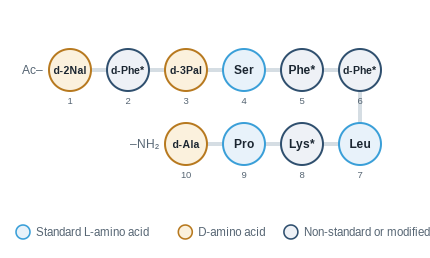
Degarelix (Firmagon) is a man-made peptide that blocks the receptor for gonadotropin-releasing hormone (GnRH) on the pituitary gland. It is an approved prescription drug for advanced prostate cancer, given as an injection under the skin of the belly once every 28 days after a larger starting dose S1. It belongs to the "GnRH antagonist" class, the opposite approach to GnRH agonists like leuprolide.
How it works
Prostate cancer usually needs testosterone to grow. Testosterone production depends on LH from the pituitary, which depends on GnRH from the brain. GnRH agonists shut this chain down indirectly, by over-stimulating the receptor until it stops responding, which causes a testosterone surge first. Degarelix simply sits in the receptor and blocks it, so LH and testosterone fall straight away, with no surge S1S2. After injection it forms a slow-release depot under the skin, which is why the dose lasts a month. In the pivotal trial, testosterone was at castration level (50 ng/dL or less) in 96% of men by day 3, compared with none on leuprolide S1.
Legal status
- FDA: Approved for advanced prostate cancer S1.
- DEA: Not a controlled substance.
- WADA: GnRH antagonists are not named on the 2026 Prohibited List; S2.2.1 names GnRH and its agonist analogues S5. Degarelix lowers testosterone rather than raising it.
- International (short): Not reviewed for this page.
What the research actually shows
Evidence: A. Approved on a one-year randomized phase 3 trial against leuprolide, with a later cardiovascular safety trial.
| Study / source | Design | People | Dose studied | Result |
|---|---|---|---|---|
| CS21, Klotz 2008 S2S1S4 | Randomized, open-label vs leuprolide, 1 year | 610 men with prostate cancer (any stage) | 240 mg start, then 80 mg (or 160 mg) every 28 days, subcutaneous; leuprolide 7.5 mg IM monthly | Testosterone kept at castration level from day 28 to 364 in 97.2% (240/80 mg) vs 96.4% (leuprolide); at day 3, 96.1% vs 0%; PSA fell faster with degarelix |
| Label, PSA S1 | Secondary endpoint of CS21 | Same | 240/80 mg | PSA down 64% at 2 weeks, 85% at 1 month, 95% at 3 months; the label cautions there is no evidence faster PSA decline means more clinical benefit |
| PRONOUNCE S3 | Randomized vs leuprolide, stopped early | 545 men with prostate cancer and known heart or blood-vessel disease | Degarelix vs leuprolide for 12 months | Major cardiovascular events 5.5% vs 4.1% (HR 1.28, 95% CI 0.59–2.79, P = 0.53): no difference shown |
What we don't know for this page: whether degarelix is safer for the heart than GnRH agonists. That was the question PRONOUNCE set out to answer, but it enrolled too few men and saw too few events to settle it S3. The 160 mg maintenance dose tested in CS21 is not approved S1.
Reported benefits
Fast, flare-free drop in testosterone to castration levels, maintained over a year about as well as leuprolide S1S2. Avoiding the flare matters most for men whose cancer could cause harm if testosterone briefly rose, such as those with spinal metastases.
Side effects
Common (CS21, degarelix 240/80 mg vs leuprolide): injection-site reactions (pain, redness, swelling, hardness or a lump) 35% vs under 1%; hot flash 26% vs 21%; raised liver enzymes (transaminases and GGT) 10% vs 5%; weight gain 9% vs 12%; hypertension 6% vs 4%; back pain 6% vs 8%; chills 5% vs 0%; constipation 5% vs 5% S1. Most were grade 1 or 2 S1. Serious: severe allergic reactions (anaphylaxis, hives, swelling of the face and throat) reported after marketing; QT prolongation from androgen deprivation; fetal harm S1.
Dangers and red flags
- Allergy. Anyone who had a severe reaction should not get it again S1.
- Heart rhythm. Androgen deprivation can prolong the QT interval; the label asks doctors to weigh this in people with congenital long QT, heart failure, electrolyte problems, or on other QT-prolonging drugs S1.
- Long-term testosterone loss. Hot flashes, weight gain and other effects of low testosterone are expected with long treatment S1.
- Pregnancy. It can cause fetal harm S1.
- Who should avoid it: anyone with a history of severe hypersensitivity to degarelix or its ingredients S1.
Doses reported
We don't recommend sh*t. These are the doses studies, labels and harm-reduction sources report. That's information, not advice. Talk to a licensed clinician.
Degarelix comes as powder vials with prefilled syringes of sterile water. The label's mixing gives two fixed concentrations: each 120 mg starting-dose vial plus 3 mL water gives 40 mg/mL (3 mL withdrawn), and the 80 mg maintenance vial plus 4.2 mL water gives 20 mg/mL (4 mL withdrawn) S1. The calculator below is prefilled with the 120 mg / 3 mL label presentation only.
| Source | Population | Dose | Route | Frequency and timing | Duration | Titration or escalation | Cite |
|---|---|---|---|---|---|---|---|
| Firmagon label, starting dose | Advanced prostate cancer | 240 mg, as two 120 mg injections of 3 mL each (40 mg/mL) | Subcutaneous, belly | Once | — | First maintenance dose 28 days later | S1 |
| Firmagon label, maintenance | Advanced prostate cancer | 80 mg as one 4 mL injection (20 mg/mL) | Subcutaneous, belly | Every 28 days | Ongoing | None | S1 |
| CS21 / Klotz 2008 | Prostate cancer | 240 mg, then 80 mg or 160 mg | Subcutaneous | Every 28 days | 12 months | Two maintenance arms; 160 mg not approved | S2S1 |
| PRONOUNCE | Prostate cancer with cardiovascular disease | Degarelix (dose not stated in the abstract) | Subcutaneous | — | 12 months | — | S3 |
There is no known non-medical use with published dosing, so we report no community doses.
Open the dose math calculator →
Monitoring a doctor would order
Testosterone and PSA; liver tests (enzyme rises were common in the trial); an ECG and electrolytes in people at risk of QT prolongation; watching for allergic reactions during and after injection S1.
Bottom line
Degarelix (Firmagon) is a GnRH blocker for advanced prostate cancer. It drops testosterone to castration levels within days and avoids the testosterone flare that GnRH agonists cause, while controlling testosterone over a year about as well as leuprolide. Its standout side effect is injection-site pain and lumps; hot flashes and liver-enzyme rises are common. Whether it is easier on the heart than agonists remains unproven.
Sources
- [S1] FIRMAGON (degarelix for injection), for subcutaneous use. US prescribing information (DailyMed), Ferring. Advanced prostate cancer; 240 mg starting dose and 80 mg maintenance dose; reconstitution; hypersensitivity, QT and embryo-fetal warnings; adverse reactions and clinical study NCT00295750. Set ID ab11dd8a-0fd9-4013-89ab-e114557c7e4b. (label)
- [S2] Klotz L, et al. The efficacy and safety of degarelix: a 12-month, comparative, randomized, open-label, parallel-group phase III study in patients with prostate cancer. BJU Int. 2008;102:1531-1538. PMID 19035858. (rct)
- [S3] Lopes RD, et al. Cardiovascular safety of degarelix versus leuprolide in patients with prostate cancer: the primary results of the PRONOUNCE randomized trial. Circulation. 2021;144:1295-1307. PMID 34459214. (rct)
- [S4] ClinicalTrials.gov. NCT00295750: degarelix vs leuprolide one-year phase 3 trial in prostate cancer (CS21). (rct)
- [S5] World Anti-Doping Agency. 2026 Prohibited List (S2.2.1 names GnRH and its agonist analogues; GnRH antagonists such as degarelix are not named). (regulator)