
Other approved peptide drugs
Desmopressin
Also called DDAVP, desmopressin acetate, 1-deamino-8-D-arginine vasopressin, Nocdurna, Noctiva
- US status
- Approved
- DEA
- Not a controlled substance
- WADA
- Not listed as prohibited
- Class
- Other approved peptide drugs
Jump to doses reported ↓ Dose math calculator
What it is
Desmopressin (DDAVP) is a man-made version of the hormone vasopressin. It is an approved prescription drug used to treat central diabetes insipidus, bedwetting in children, nighttime urination in adults, and to boost clotting factors before procedures in mild hemophilia A and type 1 von Willebrand disease. It comes as tablets, a nasal spray and an injection S1.
How it works
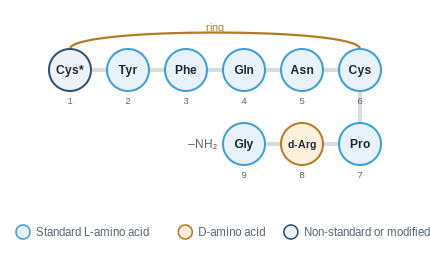
Desmopressin is vasopressin with two changes — the first amino acid is deaminated and D-arginine replaces L-arginine at position 8 — which makes it act almost entirely on the V2 receptor and leaves little of vasopressin's V1 effect on blood vessels S1. V2 receptors sit on the kidney's collecting ducts; activating them moves aquaporin water channels into the tubule wall so more water is reabsorbed, and the result is a smaller volume of more concentrated urine. That is the whole basis of its use in central diabetes insipidus, bedwetting and nighttime urination S1S2.
V2 receptors on the lining of blood vessels also trigger release of stored von Willebrand factor and factor VIII, which is why a dose shortly before a procedure temporarily raises clotting factor levels in mild hemophilia A and type 1 von Willebrand disease S1. Because the drug holds back water but not salt, the predictable hazard is dilutional low blood sodium, which is why the label pairs it with fluid restriction S1.
Legal status
- FDA: Approved for central diabetes insipidus, primary nocturnal enuresis, nocturia, and certain bleeding conditions S1.
- Compounding: an approved drug substance dispensed as a prescription product.
- DEA: Not a controlled substance.
- "Research use only" labels: not relevant; this is a prescription drug.
- WADA (sport): Not listed as prohibited.
- International (short): Not reviewed for this page yet.
What the research actually shows
Evidence: A. Desmopressin is an approved drug with randomized trials across its uses.
| Study | Design | People | Dose studied | Result |
|---|---|---|---|---|
| Skoog 1997 S2 | Randomized, double-blind, placebo-controlled | Children with primary nocturnal enuresis | Oral desmopressin | Reduced wet nights versus placebo |
| Label S1 | Approved indications | Diabetes insipidus, enuresis, bleeding | Route- and age-specific dosing | Basis of approval |
What we don't know for this page: nothing unusual; desmopressin is a well-characterized approved drug.
Reported benefits
Controls excessive urination in diabetes insipidus, cuts bedwetting and nighttime urination, and temporarily raises clotting factor VIII and von Willebrand factor for minor procedures S1S2.
Side effects
Common: headache, nausea, flushing, and stomach upset S1. Serious: the biggest risk is hyponatremia (dangerously low blood sodium) from water retention, which can cause seizures; this is why fluids are limited around dosing and sodium is monitored, especially in the young and old S1.
Dangers and red flags
- Low sodium / water intoxication. The key danger; can be life-threatening and is the reason for fluid restriction and sodium checks S1.
- Who should avoid it: people with low sodium or a history of it, and certain kidney problems, per the label S1.
- Counterfeit/grey-market risk. Only a pharmacy-dispensed product is the genuine drug.
Doses reported
We don't recommend sh*t. These are the doses studies, labels and harm-reduction sources report. That's information, not advice. Talk to a licensed clinician.
Desmopressin is taken as a tablet, nasal spray, or clinician-given injection, so the reconstitution calculator does not apply. Dosing differs a lot by age, route and use; see the label.
| Source | Dose | Unit / route | Frequency | Timing | Duration | Titration / escalation | Context |
|---|---|---|---|---|---|---|---|
| S1 Label (injection) | 2–4 mcg | mcg, IV/SC (in divided doses) | Per label by indication | In care setting | Per label | Adjusted to response and sodium | Diabetes insipidus; bleeding prophylaxis |
| S2 Skoog 1997 | Oral desmopressin | mg, oral | At bedtime | Evening | Study duration | Titrated to response | Childhood bedwetting trial |
Monitoring a doctor would order
Blood sodium (especially after starting or dose changes), fluid intake, and symptoms of low sodium such as headache, nausea or confusion S1.
Bottom line
Desmopressin is an approved, well-studied vasopressin analog for diabetes insipidus, bedwetting, nighttime urination and certain bleeding disorders. Its central danger is low blood sodium from water retention, which drives the fluid limits and sodium monitoring around its use. It is a prescription medicine.