
Anabolic-androgenic steroids (AAS)
DHB (1-testosterone cypionate; dihydroboldenone)
Also called 1-testosterone, dihydroboldenone, Δ1-dihydrotestosterone, 1-testosterone cypionate, DHB, 1-AD (prohormone precursor)
- US status
- Not approved. Never a medicine.
- DEA
- Schedule III (21 CFR 1308.13(f), listed as Δ1-dihydrotestosterone / '1-testosterone')
- WADA
- S1.1 Anabolic androgenic steroids; prohibited at all times
- Class
- Anabolic-androgenic steroids (AAS)
Jump to doses reported ↓ Dose math calculator
What it is
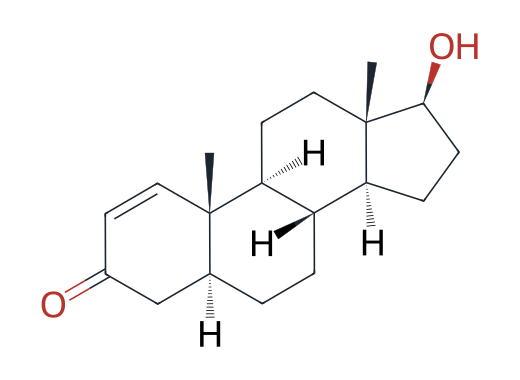
DHB — "dihydroboldenone," chemically 1-testosterone (Δ1-dihydrotestosterone) — is an injectable anabolic-androgenic steroid, usually sold grey-market as a cypionate or other ester. It is the 5α-reduced form of boldenone, and in laboratory work it is a potent androgen with strong anabolic activity S1. It has never been a medicine. In the early 2000s its precursor was sold as the "prohormone" supplement 1-AD until such products were brought under the controlled-substance laws S2.
How it works
DHB is an androgen: it binds the androgen receptor inside muscle and other target cells, and the receptor-hormone complex then acts on DNA to raise muscle protein synthesis and produce androgenic effects in skin, hair and the prostate. In receptor and tissue assays it behaved as a potent androgen with strong anabolic activity S1.
Two structural points shape what it does. It is already 5α-reduced (it is the 5α form of boldenone), so 5-alpha-reductase cannot amplify it further, and it is not a substrate for aromatase, so it does not convert to estrogen — which is why users expect no estrogen-driven water retention. Like any androgen given from outside, it suppresses the brain's LH and FSH signal and therefore the body's own testosterone production, the mechanism behind the testicular shrinkage and infertility seen across this class S7. All of this is inferred from laboratory work and from androgen pharmacology as a class; no human study of DHB exists S1.
Legal status
- FDA: Never approved for any use, human or veterinary. It has no legitimate medical role S1.
- DEA: Schedule III anabolic steroid, listed by name as "Δ1-dihydrotestosterone (also known as '1-testosterone')" in 21 CFR 1308.13(f) S4. Possessing it without a valid prescription is a federal crime S5.
- Prohormone history: its precursor (1-AD) was sold as a dietary supplement before being controlled; a "supplement" label does not make it legal now S2.
- WADA: Prohibited at all times under S1.1; 1-androgens are a known doping-test target S3S6.
- International (short): Not reviewed for this page yet.
What the research actually shows
Evidence: D. There are no human clinical trials of DHB. The direct evidence is a laboratory/animal study showing it is a potent androgen with anabolic effects S1, plus analytical work on its precursor supplement and on detecting 1-androgens in doping tests S2S3. Everything about its use in people is extrapolation from these and from the AAS class.
| Study | Design | Subjects | Dose studied | Result |
|---|---|---|---|---|
| Friedel 2006 S1 | Laboratory / animal assay | Preclinical models | Receptor and tissue assays | 1-testosterone is a potent androgen with strong anabolic activity |
| Reilly 2004 S2 | Analytical (human samples) | Supplement users | "1-AD" supplement | Characterized 1-AD metabolism to 1-testosterone and related hormones |
| Verheyden 2007 S3 | Analytical | Lab samples | — | Methods to detect 1-androgens (doping context) |
What we don't know: everything about DHB's safety, effective dose and long-term effects in humans — none of it has been studied in a trial.
Reported benefits
No human benefit has been shown in any trial. Users report lean muscle gain without water retention — user-reported, not tested. Its laboratory potency suggests strong androgenic activity, which also means strong androgenic side effects S1S7.
Side effects
With no human data, expected effects are those of a potent androgen S7: Common: marked suppression of the body's own testosterone, acne, oily skin, male-pattern hair loss, and (users commonly report) significant injection-site pain. Serious: unfavorable cholesterol changes, raised blood pressure, and the cardiovascular strain seen across AAS; virilization in women that can be permanent S7.
Dangers and red flags
- No human safety data. No trial has ever studied DHB in people S1S7.
- Potent androgen. Laboratory potency predicts strong androgenic effects and side effects S1.
- Controlled substance. Non-prescription possession is a federal crime S5.
- Cardiovascular and hormonal (class). AAS use suppresses natural testosterone and is linked to heart disease S7.
- Grey-market quality. All DHB is underground-lab product of unknown identity, dose and sterility; about half of AAS samples in cohort data did not match their label S8.
- Sport: prohibited at all times S6.
- Who should avoid it: everyone — it is not a medicine and has never been tested in people.
Doses reported
We don't recommend sh*t. These are the doses studies, labels and harm-reduction sources report. That's information, not advice. Talk to a licensed clinician.
No human dosing data found. There is no label, no trial and no citable human dose. We do not list illicit physique doses, which have no citable medical source.
| Source | Dose | Unit / route | Frequency | Timing | Duration | Titration / escalation | Context |
|---|---|---|---|---|---|---|---|
| — | No human dose established | — | — | — | — | — | No human study exists |
Open the dose math calculator: oil mode →
Monitoring a doctor would order
No human monitoring standard exists for DHB. For any potent androgen, a clinician would check testosterone, a lipid panel, blood pressure, hematocrit and liver tests, and (in women) signs of virilization S7. Tell the clinician what was actually used.
Bottom line
DHB ("dihydroboldenone," 1-testosterone) is an injectable steroid that has never been a medicine and has never been tested in a human trial — the only direct evidence is a lab study showing it is a potent androgen. It is a Schedule III controlled substance whose non-prescription possession is a federal crime, all of it is grey-market product of unknown quality, and its expected risks are the hormonal, cardiovascular and virilizing harms of potent anabolic steroids. It is banned in sport at all times.
Sources
- [S1] Friedel A, et al. 17beta-hydroxy-5alpha-androst-1-en-3-one (1-testosterone) is a potent androgen with anabolic properties. Toxicol Lett. 2006;165(2):149-55. PMID 16621347. (animal)
- [S2] Reilly CA, et al. Analysis of the nutritional supplement 1AD, its metabolites, and related endogenous hormones in biological matrices using LC-MS/MS. J Anal Toxicol. 2004;28(1):1-10. PMID 14987417. (human-observational)
- [S3] Verheyden K, et al. Mass spectrometric detection of and similarities between 1-androgens. Anal Chim Acta. 2007;586(1-2):57-72. PMID 17386697. (in-vitro)
- [S4] 21 CFR 1308.13(f), Schedule III anabolic steroids; Δ1-dihydrotestosterone ('1-testosterone') (17β-hydroxy-5α-androst-1-en-3-one) (eCFR). (regulator)
- [S5] 21 U.S.C. 844, Penalties for simple possession. (regulator)
- [S6] World Anti-Doping Agency. 2026 Prohibited List, section S1.1 (anabolic androgenic steroids). (regulator)
- [S7] Pope HG Jr, et al. Adverse health consequences of performance-enhancing drugs: an Endocrine Society scientific statement. Endocr Rev. 2014;35:341-75. PMID 24423981. (review)
- [S8] Smit DL, et al. Baseline characteristics of the HAARLEM study: 100 male amateur athletes using anabolic androgenic steroids. Scand J Med Sci Sports. 2020;30:531-539. PMID 31663164. (human-observational)