
Brain, sleep & 'longevity' research peptides
Dihexa
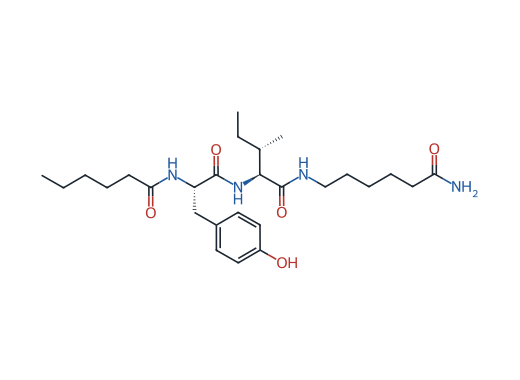
Also called PNB-0408, N-hexanoic-Tyr-Ile-(6) aminohexanoic amide, Dihexa acetate
- US status
- Not approved
- DEA
- Not a controlled substance
- WADA
- Not named; falls under the S0 catch-all if no health authority has approved it
- Class
- Brain, sleep & 'longevity' research peptides
Jump to doses reported ↓ Dose math calculator
What it is
Dihexa (research code PNB-0408) is a small molecule built from the hormone fragment angiotensin IV. It was designed at Washington State University as a brain "procognitive" compound, and it is marketed online as a "nootropic" for memory, taken by mouth or applied to the skin. No study in humans has been published S1.
How it works
Dihexa is derived from angiotensin IV, and in rat and cell-culture work it appears to act through the hepatocyte growth factor (HGF)/c-Met system — a receptor pathway that drives the formation and strengthening of synapses, the connections between nerve cells S4S5. In the key animal study it improved memory in a water-maze task and increased synapse formation, and the effect disappeared when HGF/c-Met signalling was blocked, which is the main evidence that this is the pathway it works through S4.
The mechanism is therefore inferred entirely from animal and in-vitro work; no human study has been published, so nothing is known about whether it reaches or acts on the human brain at any amount S1. One consequence of the proposed mechanism deserves naming: c-Met is a growth-factor receptor, and a compound that drives nerve-cell growth through it could in principle drive unwanted growth elsewhere S1S5.
Legal status
- FDA: Not approved for any use in the US.
- Compounding: FDA had placed dihexa in Category 2. On Apr 22 2026 it was removed from Category 2 because the nomination was withdrawn; FDA's safety summary remains posted and states plainly that "FDA has not identified any human exposure data on drug products containing dihexa acetate administered via any route of administration" and that the agency "lacks important information regarding any safety issues" S1. FDA has said it intends to consult its compounding advisory committee about dihexa before the end of February 2027 S2.
- DEA: Not a controlled substance.
- "Research use only" products: see our explainer.
- WADA: Not named on the 2026 List; the S0 catch-all covers substances with no health-authority approval S3.
What the research actually shows
Evidence: D. Everything published is in animals or cells. There is no human trial, no established dose for people, and no human safety record S1.
| Study | Design | Model | Dose studied | Result |
|---|---|---|---|---|
| Benoist et al 2014 S4 | Lab and animal study | Rats; cultured neurons | Oral and direct-to-brain doses | Improved memory in a water-maze task and increased synapse formation; effect blocked when the HGF/c-Met system was shut off |
| Wright & Harding 2015 S5 | Review | — | — | Proposes the HGF/c-Met system as an Alzheimer's target; dihexa is the lead example, still preclinical |
| Wells et al 2024 S6 | Animal study | Rats, Huntington's-like model | — | An angiotensin-IV analog eased some movement and chemistry changes |
What we don't know: whether dihexa does anything in people, whether it is safe, the right dose, and whether a molecule that drives nerve growth could also drive unwanted growth over time S1S5.
Reported benefits
- In rats: better memory and more synapses in learning tasks S4.
- In people: nothing has been tested S1.
Side effects
Common: not characterized in humans; no human studies exist S1. Serious: none documented, because there is no human safety data S1.
Dangers and red flags
- No human data at all. FDA states outright that no human exposure data exists S1; anyone using it is the experiment.
- Growth-factor caution. Dihexa's whole mechanism is amplifying a growth-factor pathway (HGF/c-Met) that is also involved in tumor growth; the long-term consequences in people are unstudied S5.
- Product quality. Grey-market vials and capsules are not checked for identity, purity or dose.
- Who should avoid it: everyone, in the sense that there is no evidence base; certainly anyone pregnant, breastfeeding, or with a history of cancer.
- Sport: likely banned under WADA S0 S3.
Doses reported
We don't recommend sh*t. These are the doses studies, labels and harm-reduction sources report. That's information, not advice. Talk to a licensed clinician.
No human dosing data found in a source we could check. There is no FDA label and no human study S1. The published doses are animal doses, which do not convert to human doses by simple scaling; see dosing myths. We do not fill the gap with vendor or forum figures.
Open the dose math calculator →
Monitoring a doctor would order
No guideline exists. We found no source naming dihexa-specific monitoring.
Bottom line
Dihexa is a lab-designed brain compound that improved memory in rats by boosting a synapse-building growth-factor pathway. FDA says there is no human exposure data of any kind. That makes every claim about it in people untested, and the same growth-promoting mechanism that is the selling point is also the main open safety question.
Sources
- [S1] FDA. Certain Bulk Drug Substances for Use in Compounding that May Present Significant Safety Risks (entry: Dihexa acetate: 'FDA has not identified any human exposure data... FDA lacks important information regarding any safety issues'). Content current as of 04/22/2026. (regulator)
- [S2] FDA. Meeting of the Pharmacy Compounding Advisory Committee (FDA intends to consult the committee on LL-37, GHK-Cu, dihexa, melanotan II and PEG-MGF before the end of February 2027). (regulator)
- [S3] World Anti-Doping Agency. 2026 Prohibited List, section S0 (Non-approved substances). (regulator)
- [S4] Benoist CC, et al. The procognitive and synaptogenic effects of angiotensin IV-derived peptides are dependent on activation of the hepatocyte growth factor/c-met system. J Pharmacol Exp Ther. 2014;351(2):390-402. PMID 25187433. (animal)
- [S5] Wright JW, Harding JW. The Brain Hepatocyte Growth Factor/c-Met Receptor System: A New Target for the Treatment of Alzheimer's Disease. J Alzheimers Dis. 2015;45(4):985-1000. PMID 25649658. (review)
- [S6] Wells RG, et al. Effects of an Angiotensin IV Analog on 3-Nitropropionic Acid-Induced Huntington's Disease-Like Symptoms in Rats. J Huntingtons Dis. 2024;13(1):55-66. PMID 38489193. (animal)