
Brain, sleep & 'longevity' research peptides
DSIP (emideltide)
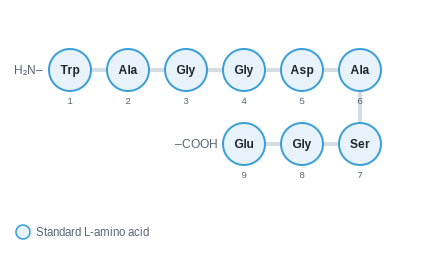
Also called Delta sleep-inducing peptide, emideltide, Trp-Ala-Gly-Gly-Asp-Ala-Ser-Gly-Glu, DSIP acetate
- US status
- Not approved
- DEA
- Not a controlled substance
- WADA
- Not named; falls under the S0 catch-all if no health authority has approved it
- Class
- Brain, sleep & 'longevity' research peptides
Jump to doses reported ↓ Dose math calculator
What it is
DSIP is a nine-amino-acid peptide (Trp-Ala-Gly-Gly-Asp-Ala-Ser-Gly-Glu), named emideltide in FDA documents S3. It was isolated from rabbit brain blood in 1977 and named for its apparent ability to boost slow-wave ("delta") sleep S6. Despite the name, the link between DSIP and sleep "has never been further characterized," no DSIP gene or receptor has been found, and the sleep hypothesis is described in the scientific literature as "extremely poorly documented and still weak" S6. In the human studies that exist it was given by intravenous infusion S3S8. Online it is sold as a powder in 2-20 mg vials for people to reconstitute and inject under the skin or use as a nasal spray; there is no human data for those routes S3.
How it works
No one knows how DSIP works, and that is the central fact about it. Despite nearly fifty years of study, no DSIP gene and no DSIP receptor have ever been identified, and the scientific literature describes the link between the peptide and sleep as "extremely poorly documented and still weak" S6. Earlier work proposed effects on sleep architecture and on hormone release, but no target has been pinned down and no coherent pathway has been established S6S7.
Two practical points follow. First, a nine-amino-acid peptide given by injection is broken down quickly by peptidases, and how much — if any — reaches the brain was never established, which is why the human studies that exist used intravenous infusion S3S8. Second, because no receptor is known, there is no way to predict the dose-response, the duration of effect, or what the nasal and under-the-skin products sold online would do; FDA's review found the human data inadequate on all of these points S3.
Legal status
- FDA: Not approved for any use in the US.
- Compounding: FDA had placed emideltide (DSIP) in Category 2, citing possible immune reactions (immunogenicity) for injectable routes and peptide-impurity concerns, and stating it "lacks sufficient information to know whether the drug would cause harm if administered to humans" S1. The nomination was withdrawn, so FDA moved it to its "nominated but withdrawn" list S1. FDA's compounding advisory committee reviewed it on Jul 24 2026 for opioid withdrawal, chronic insomnia and narcolepsy S2. In its briefing document, FDA concluded that "a balancing of the criteria weighs against" adding emideltide to the 503A bulks list, citing insufficient evidence of effectiveness and immunogenicity concerns S3.
- HHS draft policy (Oct 30 2026): DSIP is not one of the six peptides HHS proposed to tolerate in compounding (that list is BPC-157, epitalon, KPV, MOTS-c, semax and TB-500) S4.
- DEA: Not a controlled substance.
- "Research use only" products: see our explainer.
- WADA: Not named on the 2026 List. Section S0 covers any pharmacological substance with no current approval by any government health authority S5.
What the research actually shows
Evidence: C. The human record is a handful of small studies, most from one Swiss group in the 1980s, nearly all using intravenous DSIP. FDA counted doses of 25-150 nmol/kg given intravenously to about 209 subjects across 1 to 15 days S3. Results are mixed and the studies are described by FDA as having "poor study methodologies" and small samples S3. There is no modern, blinded, placebo-controlled trial, and no human study of the under-the-skin or nasal products sold online S3.
| Study | Design | People | Dose studied | Result |
|---|---|---|---|---|
| Schneider-Helmert & Schoenenberger 1981 S8 | Randomized, double-blind, placebo-controlled crossover | 6 adults with chronic insomnia | 25 nmol/kg IV before bed | Slight arousal in the first hour, then a reported trend toward fewer awakenings and higher sleep efficiency; no change in time to fall asleep |
| Schneider-Helmert 1987 S9 | Externally-controlled (no placebo arm) | 14 adults with chronic insomnia | 30 nmol/kg IV nightly for 7 nights | Authors reported shorter time to fall asleep and more total sleep; FDA notes there was no placebo arm and the sample was tiny |
| Bes et al 1992 S10 | Double-blind, placebo-controlled | 16 adults with chronic insomnia | 25 nmol/kg IV on 3 nights | No significant difference from placebo on objective or subjective sleep |
| Dick et al 1984 S11 | Open-label, uncontrolled | 60 people in opioid withdrawal | 25 nmol/kg IV, up to 6 times/day, up to 6 days | Authors reported improved withdrawal signs; no control group, subjective assessment |
What we don't know: whether DSIP improves sleep in a properly controlled trial (the one placebo-controlled sleep study found nothing S10), whether the injected or nasal products sold online do anything at all, the right dose, and long-term safety.
Reported benefits
- In 1980s IV insomnia studies: mixed; one uncontrolled study and one external-control study reported better sleep, the one placebo-controlled study did not S8S9S10.
- In opioid/alcohol withdrawal (uncontrolled): authors reported fewer withdrawal signs, but with no control group S11S12.
- "Sleep peptide" use by self-injection or nasal spray: not tested in any study we found S3.
Side effects
Common: in IV withdrawal studies, nine of 107 subjects had minor transient effects such as sweating, headache, nausea and vertigo S3. Serious: three subjects in one withdrawal study had serious effects, including hypotension (low blood pressure) at the start of the first injection, and one had "progressive hypotension" after a second injection S3.
Dangers and red flags
- The sleep claim is weak at its root. No DSIP receptor or gene has been identified, and the peptide's natural role is still unknown S6.
- Route mismatch. All human data is intravenous and old; the subcutaneous and nasal vials sold online have no human evidence, and FDA flagged immunogenicity risk for injectable routes S1S3.
- Product quality. FDA found the nominated material "not well-characterized," with missing tests for impurities, aggregates and endotoxins S3; grey-market vials carry none of that documentation.
- Who should avoid it: there is no safety evidence for use in pregnancy, breastfeeding, children, or anyone with low blood pressure, given the hypotension signal S3.
- Sport: likely banned under WADA's S0 catch-all S5.
Doses reported
We don't recommend sh*t. These are the doses studies, labels and harm-reduction sources report. That's information, not advice. Talk to a licensed clinician.
There is no FDA label. Every human dose we can tie to a source is intravenous and from a research setting, not the self-injected or nasal products sold as "sleep peptides."
| Source | Population | Dose | Route | Frequency and timing | Duration | Cite |
|---|---|---|---|---|---|---|
| Schneider-Helmert & Schoenenberger 1981 | 6 adults with chronic insomnia | 25 nmol/kg (about 21 µg/kg) | Intravenous | Once, before bed | Crossover nights | S8 |
| Schneider-Helmert 1987 | 14 adults with chronic insomnia | 30 nmol/kg | Intravenous | Nightly | 7 nights | S9 |
| Bes et al 1992 | 16 adults with chronic insomnia | 25 nmol/kg | Intravenous | Nightly | 3 nights | S10 |
| Dick et al 1984 | 60 people in opioid withdrawal | 25 nmol/kg (about 21 µg/kg) | Intravenous | Up to 6 times/day | Up to 6 days | S11 |
| Backmund et al 1998 | 7 people in opioid withdrawal | 35 nmol/kg | Intravenous | Scheduled, tapering over the week | 7 days | S12 |
We found no peer-reviewed survey or harm-reduction source giving subcutaneous or nasal doses for healthy users, so we report none.
Open the dose math calculator →
Monitoring a doctor would order
No guideline exists. We found no source naming DSIP-specific monitoring.
Bottom line
DSIP is a 1970s "sleep peptide" that was never pinned down: no receptor, no gene, and a sleep hypothesis the literature itself calls weak. The human studies are small, old and intravenous, and the one placebo-controlled sleep study found no benefit. FDA's own 2026 review recommended against letting pharmacies compound it. The injected and nasal versions sold online have no human evidence at all.
Sources
- [S1] FDA. Certain Bulk Drug Substances for Use in Compounding that May Present Significant Safety Risks (entry: Emideltide (DSIP), 'Bulk drug substances nominated but withdrawn'). Content current as of 04/22/2026. (regulator)
- [S2] FDA. July 23-24, 2026: Meeting of the Pharmacy Compounding Advisory Committee (Jul 24 agenda: emideltide (DSIP) reviewed for opioid withdrawal, chronic insomnia and narcolepsy). (regulator)
- [S3] FDA. Briefing Document for Emideltide-Related Bulk Drug Substances, Pharmacy Compounding Advisory Committee, July 23-24, 2026 (Conclusion and Recommendation; summary of clinical studies and doses). (regulator)
- [S4] HHS. Enforcement Discretion Policy Regarding 503A Compounding Using Certain Peptide Bulk Drug Substances (draft policy; covers BPC-157, epitalon, KPV, MOTS-c, semax and TB-500 only). Federal Register FR Doc 2026-22192, Oct 30 2026. (regulator)
- [S5] World Anti-Doping Agency. 2026 Prohibited List, section S0 (Non-approved substances). (regulator)
- [S6] Kovalzon VM, Strekalova TV. Delta sleep-inducing peptide (DSIP): a still unresolved riddle. J Neurochem. 2006;97(2):303-9. PMID 16539679. (review)
- [S7] Graf MV, Kastin AJ. Delta-sleep-inducing peptide (DSIP): an update. Peptides. 1986;7(6):1165-87. PMID 3550726. (review)
- [S8] Schneider-Helmert D, Schoenenberger GA. The influence of synthetic DSIP (delta-sleep-inducing peptide) on disturbed human sleep. Experientia. 1981;37(9):913-7. PMID 7028502. (human-observational)
- [S9] Schneider-Helmert D. Effects of delta-sleep-inducing peptide on 24-hour sleep-wake behaviour in severe chronic insomnia. Eur Neurol. 1987;27(2):120-9. PMID 3622582. (human-observational)
- [S10] Bes F, Hofman W, Schuur J, Van Boxtel C. Effects of delta sleep-inducing peptide on sleep of chronic insomniac patients. A double-blind study. Neuropsychobiology. 1992;26(4):193-7. PMID 1299794. (rct)
- [S11] Dick P, Costa C, Fayolle K, Grandjean ME, Khoshbeen A, Tissot R. DSIP in the treatment of withdrawal syndromes from alcohol and opiates. Eur Neurol. 1984;23(5):364-71. PMID 6548969. (human-observational)
- [S12] Backmund M, et al. Opioid detoxification with delta sleep-inducing peptide: results of an open clinical trial. J Clin Psychopharmacol. 1998;18(3):257-8. PMID 9617990. (human-observational)