
Other approved peptide drugs
Eptifibatide
Also called Integrilin, glycoprotein IIb/IIIa inhibitor
- US status
- Approved
- DEA
- Not a controlled substance
- WADA
- Not listed as prohibited
- Class
- Other approved peptide drugs
Jump to doses reported ↓ Dose math calculator
What it is
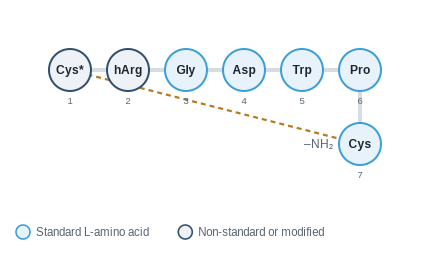
Eptifibatide is a small cyclic peptide and an approved prescription drug (Integrilin) given by IV to prevent clots in acute coronary syndromes and during procedures to open heart arteries S1.
How it works
Platelets stick to each other through the glycoprotein IIb/IIIa receptor on their surface, which grabs fibrinogen and von Willebrand factor and uses them as bridges between platelets. Every pathway that activates platelets — thrombin, ADP, collagen, thromboxane — converges on this receptor, so blocking it blocks clumping no matter what set it off.
Eptifibatide is a cyclic heptapeptide built around a KGD sequence that mimics the receptor's natural binding motif. It sits in the receptor and competitively prevents fibrinogen from binding, so platelets cannot aggregate S1. The block is dose-dependent and reversible: platelet function begins returning within hours of stopping the infusion as the drug is cleared, largely by the kidney, which matters when surgery may be needed S1. Preventing platelet aggregation is also exactly how it causes bleeding — the benefit and the main harm come from the same mechanism S2S3.
Legal status
- FDA: Approved for acute coronary syndrome and for patients undergoing PCI S1.
- Compounding: an approved drug substance handled as a hospital injectable.
- DEA: Not a controlled substance.
- "Research use only" labels: not relevant; this is a hospital prescription drug.
- WADA (sport): Not listed as prohibited.
- International (short): Not reviewed for this page yet.
What the research actually shows
Evidence: A. Eptifibatide is approved, with large randomized trials.
| Study | Design | People | Dose studied | Result |
|---|---|---|---|---|
| PURSUIT S2 | Randomized, placebo-controlled | 10,948 patients with acute coronary syndrome | IV bolus + infusion | Fewer death/heart-attack events, with more bleeding |
| ESPRIT S3 | Randomized, placebo-controlled | 2,064 patients having stent placement | Double-bolus + infusion | Fewer ischemic events after stenting, with more bleeding |
What we don't know for this page: nothing unusual; its use has narrowed as oral antiplatelet drugs improved.
Reported benefits
Reduces clotting-related events (heart attack, urgent repeat procedures) in acute coronary syndrome and during PCI S2S3.
Side effects
Common: bleeding S1. Serious: major bleeding, and low platelet counts (thrombocytopenia), which the label says to watch for S1.
Dangers and red flags
- Bleeding is the main risk S1.
- Thrombocytopenia can occur and needs platelet monitoring S1.
- Hospital-only drug. Dosed by weight and kidney function by the care team S1.
Doses reported
We don't recommend sh*t. These are the doses studies, labels and harm-reduction sources report. That's information, not advice. Talk to a licensed clinician.
Eptifibatide is given by IV by the care team; there is no self-administered reconstitution, so the inline calculator does not apply.
| Source | Dose | Unit / route | Frequency | Timing | Duration | Titration / escalation | Context |
|---|---|---|---|---|---|---|---|
| S1 Label | 180 mcg/kg bolus, then 2 mcg/kg/min | mcg/kg, IV | Bolus + infusion | In hospital | Up to 72-96 h or through PCI | Reduced in kidney impairment | ACS and PCI |
| S2 PURSUIT | 180 mcg/kg bolus + 2 mcg/kg/min | mcg/kg, IV | Bolus + infusion | — | Up to 72 h | Weight-based | Acute coronary syndrome trial |
| S3 ESPRIT | Double 180 mcg/kg bolus + 2 mcg/kg/min | mcg/kg, IV | Bolus + infusion | — | Through stenting | Weight-based | Stent trial |
Monitoring a doctor would order
Signs of bleeding, blood counts including platelets, and kidney function (which affects dosing) S1.
Bottom line
Eptifibatide is an approved IV antiplatelet drug for acute coronary syndrome and coronary stenting, with large trials showing fewer ischemic events at the cost of more bleeding. It is a hospital drug dosed by weight and kidney function and monitored for bleeding and low platelets. It is a prescription medicine.
Sources
- [S1] EPTIFIBATIDE injection. US prescribing information (DailyMed). (label)
- [S2] The PURSUIT Trial Investigators. Inhibition of platelet glycoprotein IIb/IIIa with eptifibatide in patients with acute coronary syndromes. N Engl J Med. 1998;339:436-43. PMID 9705684. (rct)
- [S3] ESPRIT Investigators. Novel dosing regimen of eptifibatide in planned coronary stent implantation (ESPRIT): a randomised, placebo-controlled trial. Lancet. 2000;356:2037-44. PMID 11145489. (rct)