
Other approved peptide drugs
Etelcalcetide
Also called Parsabiv, AMG 416, calcimimetic peptide
- US status
- Approved
- DEA
- Not a controlled substance
- WADA
- Not listed as prohibited
- Class
- Other approved peptide drugs
Jump to doses reported ↓ Dose math calculator
What it is
Etelcalcetide is a peptide "calcimimetic" and an approved prescription drug (Parsabiv) for secondary hyperparathyroidism, a common problem in people on dialysis whose parathyroid hormone (PTH) runs too high. It is given IV into the dialysis line three times a week by staff S1.
How it works
The parathyroid gland carries a calcium-sensing receptor that reads the calcium level in blood; when calcium is high, the receptor tells the gland to release less parathyroid hormone (PTH). In advanced kidney disease that control loop fails, the glands enlarge, and PTH runs high, which pulls calcium out of bone and damages it.
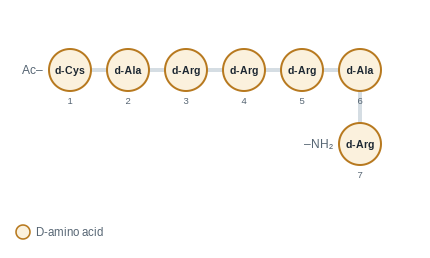
Etelcalcetide is a calcimimetic: it binds the calcium-sensing receptor at a site separate from calcium itself and makes the receptor more responsive, so the gland behaves as if blood calcium were higher than it is and secretes less PTH S1. It is a D-amino-acid peptide that attaches to the receptor through a disulfide bond, which is why a few minutes' infusion holds its effect for days and allows three-times-weekly dosing into the dialysis line S1. Lower PTH pulls serum calcium down as well, and that predictable drop — not a separate toxicity — is the main thing monitoring is built around S1S2.
Legal status
- FDA: Approved for secondary hyperparathyroidism in adults with CKD on hemodialysis S1.
- Compounding: an approved drug substance given as a clinic injectable.
- DEA: Not a controlled substance.
- "Research use only" labels: not relevant; this is a prescription drug.
- WADA (sport): Not listed as prohibited.
- International (short): approved in multiple regions.
What the research actually shows
Evidence: A. Etelcalcetide is approved, with randomized trials versus placebo and versus cinacalcet.
| Study | Design | People | Dose studied | Result |
|---|---|---|---|---|
| Block 2017 (vs placebo) S2 | Randomized, placebo-controlled | Hemodialysis patients with secondary hyperparathyroidism | IV three times weekly | More patients achieved a large reduction in PTH |
| Block 2017 (vs cinacalcet) S3 | Randomized, active-controlled | Hemodialysis patients | IV etelcalcetide vs oral cinacalcet | Non-inferior (and in some measures better) PTH lowering than oral cinacalcet |
What we don't know for this page: nothing unusual; the main management issue is low blood calcium.
Reported benefits
Lowers parathyroid hormone in dialysis patients, with the convenience of IV dosing during dialysis instead of a daily pill S2S3.
Side effects
Common: low blood calcium (hypocalcemia), nausea, vomiting, diarrhea, muscle spasms, and headache S1. Serious: symptomatic hypocalcemia (which can cause seizures or heart-rhythm problems), worsening heart failure, and effects on heart rhythm (QT) S1.
Dangers and red flags
- Hypocalcemia. The main risk; calcium is monitored and corrected S1.
- Heart effects from low calcium (QT prolongation, worsening heart failure) S1.
Doses reported
We don't recommend sh*t. These are the doses studies, labels and harm-reduction sources report. That's information, not advice. Talk to a licensed clinician.
Etelcalcetide is given IV into the dialysis circuit by staff; there is no self-administration or reconstitution, so the inline calculator does not apply.
| Source | Dose | Unit / route | Frequency | Timing | Duration | Titration / escalation | Context |
|---|---|---|---|---|---|---|---|
| S1 Label | 5 mg start (range 2.5-15 mg) | mg, IV (into venous dialysis line) | Three times weekly | At end of dialysis | Ongoing | Titrated to PTH and calcium | Secondary hyperparathyroidism |
| S2S3 Block 2017 | Titrated IV | mg, IV | Three times weekly | — | 26-27 weeks | Titrated to PTH | Hyperparathyroidism trials |
Monitoring a doctor would order
Serum calcium (especially early and after dose changes), PTH, and symptoms of low calcium or heart failure S1.
Bottom line
Etelcalcetide is an approved IV calcimimetic peptide that lowers parathyroid hormone in dialysis patients, with randomized trials against placebo and oral cinacalcet. Its main risk is low blood calcium, which is monitored and corrected. It is a prescription medicine given during dialysis.
Sources
- [S1] PARSABIV (etelcalcetide) injection. US prescribing information (DailyMed). (label)
- [S2] Block GA, et al. Effect of Etelcalcetide vs Placebo on Serum Parathyroid Hormone in Patients Receiving Hemodialysis With Secondary Hyperparathyroidism. JAMA. 2017;317:146-155. PMID 28097355. (rct)
- [S3] Block GA, et al. Effect of Etelcalcetide vs Cinacalcet on Serum Parathyroid Hormone in Patients Receiving Hemodialysis. JAMA. 2017;317:156-164. PMID 28097356. (rct)