
AAS ancillaries & fertility drugs
Exemestane
Also called Aromasin, aromatase inactivator, FCE 24304, aromasin
- US status
- Approved
- DEA
- Not a controlled substance
- WADA
- S4.1 Aromatase inhibitors; prohibited at all times (named)
- Class
- AAS ancillaries & fertility drugs
Jump to doses reported ↓ Dose math calculator
What it is
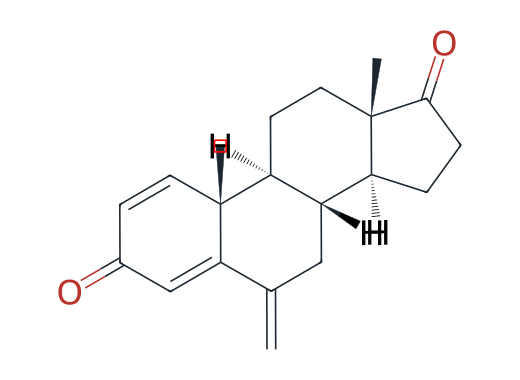
Exemestane (Aromasin) is a steroidal aromatase inactivator: an oral drug, built on the androgen skeleton, that permanently disables the enzyme the body uses to make estrogen. It is an approved prescription drug for estrogen-receptor-positive breast cancer in postmenopausal women, taken as one 25 mg tablet a day after a meal S1S5. It appears on this reference because anabolic-steroid users take it off-label to keep estrogen down, a use it was never approved for; only one small, 10-day dose-finding study has been done in healthy young men S4.
How it works
Aromatase converts androgens (androstenedione and testosterone) into estrogens (estrone and estradiol). In postmenopausal women this conversion in peripheral tissue is the main source of estrogen S1. Exemestane is shaped like androstenedione, aromatase's natural substrate. The enzyme takes it up as if it were androstenedione, and in processing it the enzyme becomes permanently bound and inactivated. That is why it is called a "suicide" or irreversible inactivator, unlike letrozole and anastrozole, which block the enzyme reversibly. The body has to make new enzyme to recover, so a single 25 mg dose suppresses circulating estrogens maximally 2 to 3 days later, and the effect persists for 4 to 5 days S1.
In the label's dose-finding work, estrogen suppression started at 5 mg/day and reached at least 85% to 95% at 25 mg/day; 25 mg cut whole-body aromatization by 98% S1. Exemestane also lowers sex hormone binding globulin (SHBG) at daily doses of 2.5 mg and up S1. In healthy young men, 25 mg/day lowered estradiol by 38% and raised testosterone by 60%, because less estrogen feedback lets the pituitary drive the testes harder S4. Its own plasma half-life is about 24 hours in women and was 8.9 hours in young men S1S4, but enzyme inactivation outlasts the drug.
Legal status
- FDA: Approved (NDA 020753) for adjuvant treatment of estrogen-receptor-positive early breast cancer in postmenopausal women who switch to it after 2 to 3 years of tamoxifen (to complete 5 years of hormonal therapy), and for advanced breast cancer that progressed on tamoxifen S1S5. Use in men is off-label.
- DEA: Not a controlled substance.
- Prescription drug: exemestane needs a prescription. Grey-market "research chemical" exemestane is an unapproved product of unknown content and strength.
- WADA: Named under S4.1 (aromatase inhibitors), prohibited at all times, in and out of competition; it is a Specified Substance S6.
- International (short): Not reviewed for this page yet.
What the research actually shows
Evidence: A for its approved use. Exemestane is backed by large phase 3 breast-cancer trials, including a prevention trial. Data in men are limited to one short dose-finding study.
| Study | Design | People | Dose studied | Result |
|---|---|---|---|---|
| IES (Coombes 2004) S2 | Randomized, double-blind | 4,742 postmenopausal women after 2-3 years of tamoxifen | 25 mg/day oral vs continuing tamoxifen | 32% lower risk of recurrence, new breast cancer or death (HR 0.68); absolute disease-free survival gain 4.7% at 3 years; overall survival not significantly different |
| MAP.3 (Goss 2011) S3 | Randomized, double-blind, placebo-controlled | 4,560 postmenopausal women at moderately raised breast-cancer risk | 25 mg/day oral | Invasive breast cancer down 65% (0.19% vs 0.55% per year; HR 0.35); no significant difference in fractures, heart events or other cancers over a median 35 months |
| Mauras 2003 S4 | Randomized crossover dose-finding plus PK study | 12 healthy young men, 14-26 years (PK in 10) | 25 mg and 50 mg/day oral for 10 days | Estradiol down 38% (25 mg) and 32% (50 mg); testosterone up 60% and 56%; lipids and IGF-1 unchanged over 10 days |
| Label S1 | Dose-ranging and approval trials | Postmenopausal women with breast cancer | 0.5-600 mg/day studied; 25 mg/day approved | Estrogen suppression maximal (85-95%) at 25 mg/day; basis of approval |
What we don't know: anything about long-term exemestane use in men, including bone, lipid, heart and fertility effects. The only male data run for 10 days S4.
Reported benefits
- Breast cancer (approved): switching from tamoxifen to exemestane improved disease-free survival and cut contralateral breast cancers (9 vs 20) S2.
- Prevention: large drop in invasive breast cancer in higher-risk postmenopausal women S3 (prevention is not a labeled indication).
- Men (off-label): lowers estradiol and raises testosterone in the short term S4. Steroid users favor it because it is irreversible and steroidal; whether that changes real outcomes has never been studied.
Side effects
Common (label): hot flushes, fatigue, joint pain, headache, insomnia, increased sweating, nausea and increased appetite S1. Serious: falling bone mineral density over time; the label asks for a vitamin D check before starting S1. In IES, heart-related ischemic events were 1.6% on exemestane vs 0.6% on tamoxifen S1. Gastric ulcer was slightly more common, mostly in people also taking anti-inflammatory painkillers S1. In men, estrogen driven too low causes joint pain, low libido, low mood, worse lipids and bone loss.
Dangers and red flags
- Irreversible suppression. Because the enzyme is destroyed rather than blocked, estrogen stays down for days after a dose S1. Overshooting is harder to reverse quickly than with a reversible inhibitor.
- Bone loss. The label documents bone density loss over 24 months S1.
- Drug interactions. Strong CYP3A4 inducers (for example rifampicin, phenytoin) lower exemestane levels; the label doubles the dose in that case S1.
- Pregnancy. Can cause fetal harm S1.
- Grey-market product. "Research chemical" exemestane is unapproved and of unknown content.
- Sport: named and prohibited at all times S6.
Doses reported
We don't recommend sh*t. These are the doses studies, labels and harm-reduction sources report. That's information, not advice. Talk to a licensed clinician.
The first two rows are the FDA label dosing. The others are doses used in trials, in their source units. There is no citable medical dosing for off-label estrogen control in steroid users, so none is listed. Exemestane is a fixed-dose tablet, so the reconstitution calculator does not apply.
| Source | Population | Dose | Unit / route | Frequency | Timing | Duration | Titration / escalation |
|---|---|---|---|---|---|---|---|
| S1 Aromasin label | Postmenopausal breast cancer (adjuvant and advanced) | 25 mg | mg, oral tablet | Once daily | After a meal | Adjuvant: to complete 5 years of hormonal therapy; advanced: until progression | Fixed dose |
| S1 Aromasin label | Taking a strong CYP3A4 inducer | 50 mg | mg, oral tablet | Once daily | After a meal | As above | Label adjustment for interaction |
| S2 IES | After 2-3 years of tamoxifen | 25 mg | mg, oral | Once daily | — | Remainder of 5 years | None |
| S3 MAP.3 | Higher-risk postmenopausal women (prevention, not labeled) | 25 mg | mg, oral | Once daily | — | Median follow-up 35 months | None |
| S4 Mauras 2003 (research) | Healthy young men | 25 mg or 50 mg | mg, oral | Once daily | — | 10 days each, 14-day washout | Crossover; the two doses suppressed estradiol about equally |
Open the dose math calculator →
Monitoring a doctor would order
- 25-hydroxy vitamin D before starting, per the label S1.
- Bone mineral density (DXA) during long use S1.
- Lipids and cardiovascular risk, given the ischemic event signal in IES S1.
- Men (off-label): estradiol, testosterone, SHBG, lipids and bone density; short-term data show estradiol drops and testosterone rises within 10 days S4.
Bottom line
Exemestane (Aromasin) is an approved steroidal aromatase inactivator with strong phase 3 evidence in postmenopausal breast cancer and breast-cancer prevention. It works by permanently disabling the estrogen-making enzyme, so its effect outlasts the drug by days. In men it lowers estradiol and raises testosterone over 10 days; there are no long-term male data at all. Overshooting estrogen damages bone, lipids, libido and mood. Prescription only; named and banned in sport at all times.
Sources
- [S1] AROMASIN (exemestane) tablets. US prescribing information (DailyMed), revised 12/2024. Label dose 25 mg once daily after a meal; 50 mg once daily with a strong CYP3A4 inducer. Set ID cf066b7a-032a-416c-8d40-15ba581423e3. (label)
- [S2] Coombes RC, et al. A randomized trial of exemestane after two to three years of tamoxifen therapy in postmenopausal women with primary breast cancer (IES). N Engl J Med. 2004;350:1081-92. PMID 15014181. (rct)
- [S3] Goss PE, et al. Exemestane for breast-cancer prevention in postmenopausal women (NCIC CTG MAP.3). N Engl J Med. 2011;364:2381-91. PMID 21639806. NCT00083174. (rct)
- [S4] Mauras N, et al. Pharmacokinetics and dose finding of a potent aromatase inhibitor, aromasin (exemestane), in young males. J Clin Endocrinol Metab. 2003;88:5951-6. PMID 14671195. (rct)
- [S5] US FDA, Drugs@FDA. AROMASIN (exemestane), NDA 020753; original approval 1999. (regulator)
- [S6] World Anti-Doping Agency. 2026 Prohibited List, section S4.1 (aromatase inhibitors; exemestane named). Classes S4.1 and S4.2 are Specified Substances. (regulator)