
GLP-1 & incretin drugs (approved)
Exenatide
Also called Byetta, Bydureon, Bydureon BCise, exendin-4, generic exenatide injection
- US status
- Approved
- DEA
- Not a controlled substance
- WADA
- Not on the 2026 Prohibited List
- Class
- GLP-1 & incretin drugs (approved)
Jump to doses reported ↓ Dose math calculator
What it is
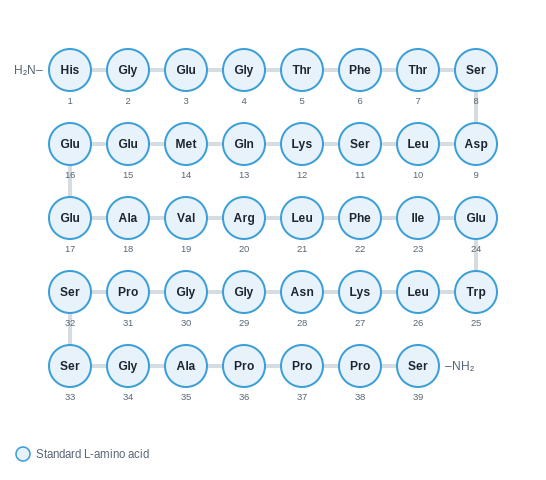
Exenatide is a GLP-1 receptor agonist: a 39-amino-acid synthetic peptide originally identified in a lizard, the Gila monster (Heloderma suspectum) S1. Today it is sold as a generic twice-daily injection pen for type 2 diabetes S1. The original twice-daily brand (Byetta) and the once-weekly brands (Bydureon, Bydureon BCise) are no longer marketed S3S4.
How it works
Exenatide copies the action of GLP-1, a gut hormone released after meals. It makes the pancreas release more insulin when blood sugar is high, holds back glucagon (which tells the liver to release sugar), and slows stomach emptying, so sugar from a meal enters the blood more slowly S1. Its sequence only partly overlaps human GLP-1, which makes it resistant to the enzyme that breaks GLP-1 down in minutes S1. Even so, the twice-daily form peaks about 2 hours after a shot and is designed to be taken before the two main meals S1. The weekly versions packed exenatide into slow-dissolving polymer microspheres S2.
Legal status
- FDA: Generic exenatide injection is approved, with diet and exercise, to improve blood-sugar control in adults with type 2 diabetes S1. It is not approved for weight loss or type 1 diabetes.
- Byetta: FDA withdrew the Byetta application at the maker's request because the product was no longer marketed, effective Sep 3 2025 S3. FDA later found that Byetta was not withdrawn for reasons of safety or effectiveness, which lets generics that copy it stay on the market S5.
- Bydureon and Bydureon BCise (weekly): approvals withdrawn because they were no longer marketed, effective Apr 8 2026 S4. The last BCise label covered adults and children 10 and older with type 2 diabetes S2.
- DEA: Not a controlled substance.
- "Research use only" powder: not the approved product; nobody checks content or sterility. See our explainer.
- WADA: Not on the 2026 Prohibited List S9.
What the research actually shows
Evidence: A. Exenatide has randomized trials going back two decades, including a cardiovascular-outcomes trial of more than 14,000 people S6S7S8.
| Study | Design | People | Dose studied | Result |
|---|---|---|---|---|
| DeFronzo et al 2005 S6 | Triple-blind RCT, 30 weeks | 336 adults with type 2 diabetes on metformin | 5 mcg twice daily for 4 weeks, then 5 or 10 mcg twice daily, vs placebo | HbA1c −0.78% (10 mcg) and −0.40% (5 mcg) vs +0.08%. Weight −2.8 kg and −1.6 kg. No severe low blood sugar |
| DURATION-1, Drucker et al 2008 S7 | Open-label RCT, 30 weeks | 295 adults with type 2 diabetes | 2 mg once weekly vs 10 mcg twice daily | HbA1c −1.9% (weekly) vs −1.5% (twice daily); HbA1c ≤7% in 77% vs 61%; similar weight loss |
| EXSCEL, Holman et al 2017 S8 | Double-blind RCT, median 3.2 years | 14,752 adults with type 2 diabetes (73% with prior CV disease) | Extended-release 2 mg weekly vs placebo | CV death, heart attack or stroke: 11.4% vs 12.2% (HR 0.91, 95% CI 0.83–1.00). Safe versus placebo, but not proven better. No significant difference in pancreatitis or pancreatic cancer |
What we don't know: the weekly form's cardiovascular benefit missed statistical significance S8; long-term data for the generic twice-daily product come from the original Byetta trials S1.
Reported benefits
In trials: lower HbA1c and modest, dose-related weight loss (about 1.6–2.8 kg over 30 weeks on the twice-daily form), without much low blood sugar when not combined with insulin or sulfonylureas S6S7. The weekly form lowered HbA1c more than the twice-daily form S7. Weight loss in people without diabetes: not an approved use; user reports are not tested.
Side effects
Common (twice-daily label; ≥5% and more often than placebo): nausea, low blood sugar, vomiting, diarrhea, feeling jittery, dizziness, headache, indigestion, constipation and weakness. Nausea usually fades over time S1. Weekly form (BCise label): injection-site nodules and nausea were most common S2. Serious (label warnings): acute pancreatitis; low blood sugar with insulin or sulfonylureas; kidney injury from dehydration; severe GI reactions; antibodies to exenatide; serious allergic reactions including anaphylaxis and angioedema; drug-induced immune thrombocytopenia (antibodies that destroy platelets, with serious and sometimes fatal bleeding); gallbladder disease; aspiration during anesthesia or deep sedation S1. The weekly form also carried a boxed warning for thyroid C-cell tumors in rodents and a warning about serious injection-site reactions S2.
Dangers and red flags
- Low platelets: if drug-induced thrombocytopenia happens, the label says stop exenatide and never use it again S1.
- Kidneys: not recommended with severe kidney impairment (creatinine clearance under 30 mL/min) or end-stage kidney disease; in dialysis patients, single 5 mcg doses were poorly tolerated S1. The weekly form was not recommended below an eGFR of 45 S2.
- Never share a pen, even with a new needle S1.
- Who should not use it (label): prior severe allergy to exenatide; prior drug-induced thrombocytopenia from exenatide S1. Weekly form: personal or family history of medullary thyroid carcinoma or MEN 2 S2.
- Oral drugs: slowed stomach emptying can change how other pills are absorbed S1.
- Grey-market powder is not the approved pen and has no checked identity or sterility.
- Sport: not prohibited S9.
Doses reported
We don't recommend sh*t. These are the doses studies, labels and harm-reduction sources report. That's information, not advice. Talk to a licensed clinician.
FDA label (twice-daily exenatide), as written S1: - Start: 5 mcg under the skin twice daily, any time in the 60 minutes before the morning and evening meals (or the two main meals, about 6 or more hours apart). Do not inject after a meal. - Increase: may go to 10 mcg twice daily after 1 month, based on response. - Pens: 5 mcg per dose (300 mcg/1.2 mL) and 10 mcg per dose (600 mcg/2.4 mL); both 250 mcg/mL, 60 doses per pen. - Sites: thigh, belly or upper arm; rotate sites.
Withdrawn weekly form (Bydureon BCise, last label) S2: 2 mg under the skin once every 7 days, any time of day, with or without meals; supplied as a single-dose autoinjector of 2 mg in 0.85 mL.
| Source | Population | Dose | Route | Frequency and timing | Duration | Titration or escalation | Cite |
|---|---|---|---|---|---|---|---|
| FDA label (generic) | Adults with type 2 diabetes | 5 mcg, then 10 mcg | Subcutaneous pen | Twice daily, within 60 min before morning and evening meals | Ongoing | 5 → 10 mcg after 1 month if needed | S1 |
| Bydureon BCise label (withdrawn product) | Adults and children 10+ with type 2 diabetes | 2 mg | Subcutaneous autoinjector | Once every 7 days | Ongoing | None | S2 |
| DeFronzo et al | 336 adults with T2D on metformin | 5 mcg or 10 mcg | Subcutaneous | Twice daily | 30 weeks | 5 mcg for 4 weeks, then assigned dose | S6 |
| DURATION-1 | 295 adults with T2D | 2 mg weekly vs 10 mcg twice daily | Subcutaneous | Weekly vs twice daily | 30 weeks | Per trial design | S7 |
| EXSCEL | 14,752 adults with T2D | 2 mg extended-release | Subcutaneous | Once weekly | Median 3.2 years | None | S8 |
No survey or harm-reduction source with numbers for non-prescribed exenatide use was found that we could cite. We have not filled the gap.
Note the units: the twice-daily drug is dosed in micrograms (mcg), 1,000 times smaller than milligrams. The approved pen delivers a fixed dose, so there is nothing to mix. The calculator below does unit and volume arithmetic only; inputs start blank. Open the full calculator →
Monitoring a doctor would order
Per the label: blood glucose, especially with insulin or a sulfonylurea; kidney function, particularly if vomiting or diarrhea cause dehydration; watching for pancreatitis, unusual bleeding or bruising (thrombocytopenia), allergic reactions and gallbladder symptoms; telling the anesthesia team before procedures S1.
Bottom line
Exenatide is one of the older GLP-1 drugs. It lowers blood sugar and weight modestly, and a large outcomes trial showed it was safe for the heart but did not prove a benefit. The brand-name versions are gone; a generic twice-daily pen remains. Watch for nausea, the rare platelet reaction and kidney problems, and remember that its doses are in micrograms.
Sources
- [S1] Exenatide injection, USP. US prescribing information (DailyMed, Amneal Pharmaceuticals, version published Jun 30 2026). Set ID e6cb5c8f-e97f-4a6a-95a4-939fd2393949. (label)
- [S2] BYDUREON BCISE (exenatide extended-release) injectable suspension. US prescribing information, Drugs@FDA label file NDA 209210 s025 (2025). (label)
- [S3] FDA. Teva Branded Pharmaceutical Products R&D, Inc., et al.; Withdrawal of Approval of 39 New Drug Applications (includes NDA 021773, Byetta). Federal Register, Aug 4 2025, FR Doc. 2025-14683; approval withdrawal effective Sep 3 2025. (regulator)
- [S4] FDA. Aspen Global Inc., et al.; Withdrawal of Approval of 46 New Drug Applications (includes NDA 022200, Bydureon, and NDA 209210, Bydureon BCise). Federal Register, Mar 9 2026, FR Doc. 2026-04546; approval withdrawal effective Apr 8 2026. (regulator)
- [S5] FDA. Determination That DIBENZYLINE (Phenoxybenzamine Hydrochloride) Oral Capsule, 10 Milligrams, and Other Drug Products Were Not Withdrawn From Sale for Reasons of Safety or Effectiveness (includes BYETTA, NDA 021773). Federal Register, Nov 13 2026, FR Doc. 2026-23141. (regulator)
- [S6] DeFronzo RA, et al. Effects of exenatide (exendin-4) on glycemic control and weight over 30 weeks in metformin-treated patients with type 2 diabetes. Diabetes Care. 2005;28:1092-1100. PMID 15855572. (rct)
- [S7] Drucker DJ, et al. Exenatide once weekly versus twice daily for the treatment of type 2 diabetes (DURATION-1): a randomised, open-label, non-inferiority study. Lancet. 2008;372:1240-1250. PMID 18782641. NCT00308139. (rct)
- [S8] Holman RR, et al. Effects of Once-Weekly Exenatide on Cardiovascular Outcomes in Type 2 Diabetes (EXSCEL). N Engl J Med. 2017;377:1228-1239. PMID 28910237. NCT01144338. (rct)
- [S9] World Anti-Doping Agency. 2026 Prohibited List (in force Jan 1 2026). (regulator)