
Reproductive & hormonal peptides (approved)
Ganirelix
Also called ganirelix acetate injection, Fyremadel, Org 37462
- US status
- Approved
- DEA
- Not a controlled substance
- WADA
- Not named on the 2026 Prohibited List
- Class
- Reproductive & hormonal peptides (approved)
Jump to doses reported ↓ Dose math calculator
What it is
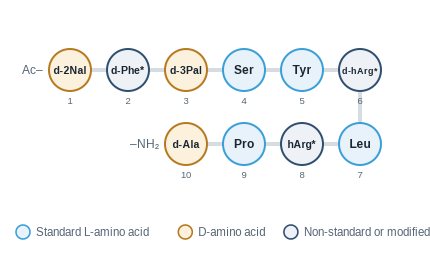
Ganirelix is a synthetic ten-amino-acid peptide that blocks the pituitary's receptor for gonadotropin-releasing hormone (GnRH) S1. It is an approved prescription fertility drug, sold as generic ganirelix acetate injection and as Fyremadel S1S2. During IVF, it is taken as a once-daily injection under the skin for a few days to stop the body from releasing eggs before the clinic can collect them. It comes ready to use in a prefilled syringe S1.
How it works
Ovulation is set off by a surge of LH from the pituitary. In IVF, fertility drugs (FSH) grow several follicles at once, and a natural LH surge before egg collection would release the eggs too early. Ganirelix competes with the body's GnRH at the pituitary receptor and blocks it, which quickly and reversibly lowers LH (and FSH to a lesser degree) without the initial surge that GnRH agonists cause S1. Peak blood levels come about one hour after injection S1. When the follicles are ready, an hCG injection is given to finish egg maturation, and ganirelix is stopped S1.
Legal status
- FDA: Approved for inhibiting premature LH surges in women undergoing controlled ovarian hyperstimulation S1S2.
- Who prescribes it: the label says it should be prescribed by physicians experienced in infertility treatment S1.
- DEA: Not a controlled substance.
- WADA: GnRH antagonists are not named on the 2026 Prohibited List S5.
- International (short): Not reviewed for this page.
What the research actually shows
Evidence: A. Approved on a randomized dose-finding trial and a randomized comparative trial, with class-level meta-analysis since.
| Study / source | Design | People | Dose studied | Result |
|---|---|---|---|---|
| Dose-finding study, 1998 S3S1 | Randomized, double-blind, six doses | 333 women on recombinant FSH | 62.5 to 2,000 mcg once daily, subcutaneous | LH surges (≥10 IU/L) in 16% at 62.5 mcg, 9% at 125 mcg and 1.4% at 250 mcg; vital pregnancy rate per attempt highest at 250 mcg (35.7%); highest and lowest doses stopped early |
| Comparative study S1 | Randomized, open-label vs a long GnRH agonist approach | 463 women given ganirelix | 250 mcg daily from day 6 of FSH | Ganirelix taken for 5.4 days on average; ongoing pregnancy 20.3% per attempt and 23.3% per transfer |
| Al-Inany 2016, Cochrane S4 | Meta-analysis of 73 randomized trials | 12,212 women; antagonists vs long agonist approaches | Antagonist regimens including 0.25 mg daily | No clear difference in live birth (OR 1.02); less ovarian hyperstimulation syndrome (OR 0.61) |
What we don't know for this page: the Cochrane findings cover GnRH antagonists as a group (ganirelix and cetrorelix), not ganirelix alone S4.
Reported benefits
Reliably prevents the early LH surge during IVF stimulation with a few days of daily injections, no initial flare, and, as a class, a lower risk of ovarian hyperstimulation syndrome than the long agonist approach without lowering live-birth rates S1S3S4.
Side effects
Common (794 women in controlled trials, counted regardless of cause): gynecological abdominal pain 4.8%; fetal death 3.7%; headache 3.0%; ovarian hyperstimulation syndrome 2.4%; vaginal bleeding 1.8%; injection-site reaction 1.1%; nausea 1.1% S1. Serious: rare allergic reactions, including anaphylaxis (anaphylactic shock), angioedema and hives, as early as the first dose, reported after marketing S1. High neutrophil counts were seen in 11.9% of women in the trials; the clinical meaning is unclear S1. Birth outcomes: an observational study of more than 1,000 newborns found birth-defect rates comparable to those after GnRH agonist treatment; the label notes that IVF itself may carry slightly higher rates and that a causal link to ganirelix is unknown S1.
Dangers and red flags
- Pregnancy must be excluded first. It is contraindicated in known or suspected pregnancy; in animals it increased litter loss S1.
- Breastfeeding. Should not be used while breastfeeding S1.
- Allergy. Not advised in women with severe allergic conditions; stop it if a reaction is suspected S1.
- Over-response. hCG should be withheld if the ovaries are abnormally enlarged, to lower the chance of ovarian hyperstimulation syndrome S1.
- Who should avoid it: anyone allergic to ganirelix, its ingredients, GnRH or other GnRH analogs S1.
Doses reported
We don't recommend sh*t. These are the doses studies, labels and harm-reduction sources report. That's information, not advice. Talk to a licensed clinician.
Ganirelix is a ready-to-use 250 mcg/0.5 mL prefilled syringe, used once and discarded. There is nothing to dissolve or measure, so the inline calculator does not apply.
| Source | Population | Dose | Route | Frequency and timing | Duration | Titration or escalation | Cite |
|---|---|---|---|---|---|---|---|
| Ganirelix label | Women in controlled ovarian hyperstimulation | 250 mcg (one 0.5 mL prefilled syringe) | Subcutaneous | Once daily in the mid to late follicular phase, after FSH started on day 2 or 3 of the menstrual period | Until the day of the hCG injection | None | S1 |
| Comparative study (label) | IVF | 250 mcg | Subcutaneous | Once daily from day 6 of FSH | 5.4 days on average | None | S1 |
| Dose-finding study 1998 | IVF | 62.5, 125, 250, 500, 1,000 or 2,000 mcg | Subcutaneous | Once daily from menstrual day 7 | About 5 days (median) | Six fixed arms; 250 mcg became the label dose | S3 |
There is no known non-medical use with published dosing, so we report no community doses.
Open the dose math calculator →
Monitoring a doctor would order
Ultrasound of follicle size and number to time the hCG injection; estradiol levels; pregnancy test before starting; watching for ovarian hyperstimulation and allergic reactions S1.
Bottom line
Ganirelix is a GnRH blocker used for a few days during IVF to stop the eggs from being released before collection. The 250 mcg daily dose was chosen in a randomized dose-finding trial, and as a class GnRH antagonists cut the risk of ovarian hyperstimulation compared with older agonist approaches without lowering live-birth rates. Side effects are mostly mild; rare allergic reactions, sometimes with the first dose, are the main safety concern.
Sources
- [S1] Ganirelix acetate injection 250 mcg/0.5 mL prefilled syringe. US prescribing information (DailyMed), Organon. Indication, pharmacology, clinical studies (dose-finding study and comparative study), contraindications, precautions, adverse events, dosage. Set ID 32fb74ff-993a-49fe-8943-e029372b863e. (label)
- [S2] FYREMADEL (ganirelix acetate) injection. US prescribing information (DailyMed), Ferring. Set ID 5f0908b5-3551-47fd-95f7-3669b0dff7f1. (label)
- [S3] The ganirelix dose-finding study group. A double-blind, randomized, dose-finding study to assess the efficacy of the gonadotrophin-releasing hormone antagonist ganirelix (Org 37462) to prevent premature luteinizing hormone surges in women undergoing ovarian stimulation with recombinant follicle stimulating hormone (Puregon). Hum Reprod. 1998;13:3023-3031. PMID 9853849. (rct)
- [S4] Al-Inany HG, et al. Gonadotrophin-releasing hormone antagonists for assisted reproductive technology. Cochrane Database Syst Rev. 2016;4:CD001750. PMID 27126581. (review)
- [S5] World Anti-Doping Agency. 2026 Prohibited List (S2.2.1 names GnRH and its agonist analogues; GnRH antagonists such as ganirelix are not named). (regulator)