
Skin, tanning & sexual-health peptides
GHK-Cu (copper peptide)
Also called copper tripeptide-1, glycyl-L-histidyl-L-lysine copper, GHK copper, prezatide copper
- US status
- Not approved as a drug
- DEA
- Not a controlled substance
- WADA
- Not named
- Class
- Skin, tanning & sexual-health peptides
Jump to doses reported ↓ Dose math calculator
What it is
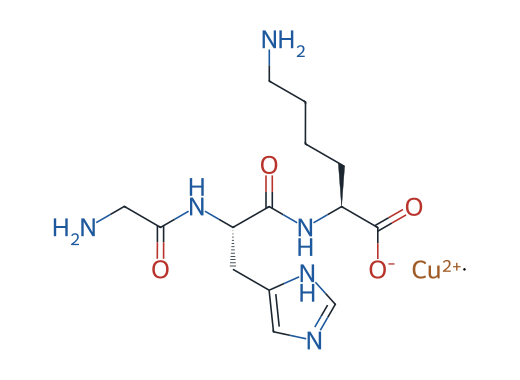
GHK is a three-amino-acid peptide (glycine, histidine, lysine) found naturally in the body; GHK-Cu is the same peptide bound to copper. It is an ingredient in skin-care products, and online it is also sold as an injectable "research" powder S5S8S9. Topical creams and injected vials are different products with different evidence, and almost all the human data are for skin products.
How it works
GHK is a copper-binding tripeptide: its histidine and glycine residues hold a copper(II) ion with high affinity, so the molecule works largely as a copper carrier, handing the metal to enzymes that need it for connective-tissue repair. Copper is a required cofactor for lysyl oxidase, the enzyme that cross-links collagen and elastin. In lab and animal work GHK-Cu increases collagen and glycosaminoglycan production by skin fibroblasts, supports new blood-vessel growth, and shifts the expression of a large number of genes involved in repair and inflammation S5S9.
That is the proposed mechanism, and it is drawn almost entirely from cell, animal and gene-expression work; the human evidence that exists is for topical products on wounds and skin, with mixed results, and there is no human study of injected GHK-Cu at all S6S7S8. The injectable route raises a mechanistic concern the creams do not: the same copper-carrying property that makes the molecule work moves copper around the body, and nobody has measured what repeated injections do to copper balance S1.
Legal status
- FDA: No GHK-Cu drug product is approved.
- Compounding (injectable): FDA had placed injectable GHK-Cu in Category 2, writing that compounded injectable drugs "may pose risk for immunogenicity due to the potential for aggregation and peptide-related impurities" and that "there are limited data in humans" S1. The nomination was withdrawn and FDA lists it under withdrawn nominations S1. Injectable GHK-Cu has no category and is not covered by the HHS draft enforcement-discretion policy of Oct 30 2026.
- Compounding (non-injectable): after a nominator clarified in May 2026 that it had withdrawn only the injectable route, FDA put "GHK-Cu (except for injectable routes of administration)" back in 503A Category 1, the list of substances under evaluation S2.
- Next step: FDA says it will consult its Pharmacy Compounding Advisory Committee on GHK-Cu before the end of February 2027 S2S3.
- DEA: Not a controlled substance.
- "Research use only" vials: see our explainer.
- WADA: Not named on the 2026 List. Section S0 covers pharmacological substances with no government approval for human therapeutic use S4; whether WADA treats GHK-Cu that way is a question for your anti-doping organization.
What the research actually shows
Evidence: C. A few small randomized trials of topical GHK-Cu products exist, with mixed results. We found no human study of injected GHK-Cu.
| Study | Design | People | Dose studied | Result |
|---|---|---|---|---|
| Mulder et al 1994 S6 | Randomized, evaluator-blinded, vehicle-controlled, multicenter | People with diabetic neuropathic foot ulcers | Topical GHK-Cu gel, a metered dose applied daily, alongside standardized wound care | Median 98.5% closure of plantar ulcers vs 60.8% with vehicle; fewer ulcer infections (7% vs 34%) when started right after debridement |
| Bishop et al 1992 S7 | Randomized, evaluator-blinded, three arms | 86 evaluable people with venous leg ulcers | 0.4% tripeptide copper cream vs silver sulfadiazine 1% vs inert vehicle | No better than placebo; silver sulfadiazine shrank ulcers more |
| Miller et al 2006 S8 | Randomized | 13 people after CO2 laser resurfacing around the mouth | Skin-care regimen with or without GHK-Cu for 12 weeks | No objective difference in redness, wrinkles or skin quality; higher patient satisfaction with GHK-Cu |
| Pickart et al 2018 S5 | Narrative review by GHK researchers | — | — | Describes lab and animal effects on collagen, blood vessels and gene expression; not a systematic review |
What we don't know: whether injecting GHK-Cu does anything in people, what an injected amount would do to copper levels or the immune system, and whether grey-market vials contain what they say.
Reported benefits
- In topical human trials: faster closure of diabetic foot ulcers in one trial S6; no benefit for venous ulcers in another S7; no objective skin benefit after laser resurfacing, though patients liked it more S8.
- In lab and animal studies: more collagen, blood-vessel growth and tissue repair S5.
- Injected: none established.
Side effects
Common: the trial abstracts we read do not list side-effect rates for topical GHK-Cu S6S7S8. Serious: none reported in those abstracts. For injection there are no human safety data; FDA flagged immune reactions and impurities as possible risks S1.
Dangers and red flags
- Injectable products have no human track record. FDA cited "limited data in humans" S1.
- Immune reactions and impurities. FDA's concern for injectable compounded GHK-Cu S1. Grey-market vials are not tested for identity, dose, sterility or endotoxin.
- Blood-vessel growth. Lab work reports that GHK stimulates blood vessel outgrowth S5. That may help wounds; whether it matters for someone with cancer is unknown. This is a theoretical concern, not a documented harm.
- Who should avoid it: for injection, there is no evidence base for use in pregnancy, breastfeeding, children, or people with a serious illness.
Doses reported
We don't recommend sh*t. These are the doses studies, labels and harm-reduction sources report. That's information, not advice. Talk to a licensed clinician.
There is no FDA label for any GHK-Cu product. The only human dose data we found are for topical products.
| Source | Population | Dose | Route | Frequency and timing | Duration | Titration or escalation | Cite |
|---|---|---|---|---|---|---|---|
| Bishop et al 1992 | Adults with venous leg ulcers (86 evaluable) | 0.4% tripeptide copper complex cream | Topical, on the ulcer | Not stated in the abstract | Not stated in the abstract | None reported | S7 |
| Mulder et al 1994 | Adults with diabetic neuropathic foot ulcers | "Metered dose" of GHK-Cu gel; concentration not stated in the abstract | Topical, on the ulcer | Once daily, started right after debridement | Not stated in the abstract | None reported | S6 |
| Miller et al 2006 | Adults after CO2 laser resurfacing (13 completed) | GHK-Cu skin-care products; concentration not stated in the abstract | Topical, face | As part of a post-treatment skin regimen | 12 weeks | None reported | S8 |
Injected GHK-Cu: no human dosing data found. We found no clinical study, label, or peer-reviewed user survey with injection doses we could check. Vendor and forum figures are not cited here.
Open the dose math calculator →
Monitoring a doctor would order
No guideline exists for injected GHK-Cu. We found no source naming specific monitoring.
Bottom line
GHK-Cu is a natural copper-binding peptide used in skin care. Small topical trials are mixed: one positive for diabetic foot ulcers, one negative for leg ulcers, one with no objective benefit after laser treatment. Injection has no human data at all. FDA has put topical and other non-injectable forms back under evaluation for compounding and plans an advisory review by February 2027; injectable GHK-Cu remains outside any compounding category.
Sources
- [S1] FDA. Certain Bulk Drug Substances for Use in Compounding that May Present Significant Safety Risks (entry: GHK-Cu (for injectable routes of administration), 'Bulk drug substances nominated but withdrawn'). Content current as of 04/22/2026. (regulator)
- [S2] FDA. Bulk Drug Substances Nominated for Use in Compounding Under Section 503A of the FD&C Act (Category 1, 2 and 3 lists). Updated May 14, 2026 (GHK-Cu, except for injectable routes, returned to Category 1). (regulator)
- [S3] FDA. Meeting of the Pharmacy Compounding Advisory Committee (to be held before the end of February 2027; agenda includes GHK-Cu and melanotan II). (regulator)
- [S4] World Anti-Doping Agency. 2026 Prohibited List, section S0 (Non-approved substances). (regulator)
- [S5] Pickart L, et al. Regenerative and Protective Actions of the GHK-Cu Peptide in the Light of the New Gene Data. Int J Mol Sci. 2018;19(7):1987. PMID 29986520. (review)
- [S6] Mulder GD, et al. Enhanced healing of ulcers in patients with diabetes by topical treatment with glycyl-l-histidyl-l-lysine copper. Wound Repair Regen. 1994;2(4):259-69. PMID 17147644. (rct)
- [S7] Bishop JB, et al. A prospective randomized evaluator-blinded trial of two potential wound healing agents for the treatment of venous stasis ulcers. J Vasc Surg. 1992;16(2):251-7. PMID 1495150. (rct)
- [S8] Miller TR, et al. Effects of topical copper tripeptide complex on CO2 laser-resurfaced skin. Arch Facial Plast Surg. 2006;8(4):252-9. PMID 16847171. (rct)
- [S9] Mortazavi SM, et al. Topically applied GHK as an anti-wrinkle peptide: Advantages, problems and prospective. Bioimpacts. 2025;15:30071. PMID 39963574. (review)