
Growth hormone & GH-axis peptides
GHRP-2
Also called pralmorelin, GH-releasing peptide-2, KP-102, GPA-748
- US status
- Not approved
- DEA
- Not a controlled substance
- WADA
- S2.2 Growth hormone secretagogues / GH-releasing peptides; prohibited at all times
- Class
- Growth hormone & GH-axis peptides
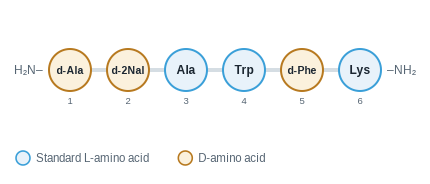
Jump to doses reported ↓ Dose math calculator
What it is
GHRP-2 (pralmorelin) is a synthetic hexapeptide that mimics ghrelin S2. It was developed decades ago mainly as a tool to test the pituitary's ability to release growth hormone, not as a treatment, and it was never approved as a drug in the US. Today it reaches people as grey-market "research" powder sold for muscle, appetite and anti-aging uses it was never approved for.
How it works
GHRP-2 is a synthetic hexapeptide that acts as an agonist at the growth hormone secretagogue receptor (GHS-R1a), the receptor the body's own ghrelin uses. Activating it on pituitary somatotrophs triggers a pulse of growth hormone release, and it also acts in the hypothalamus to reduce somatostatin's braking effect — which is why its effect adds to that of GHRH rather than overlapping with it S2. Downstream, the GH pulse raises IGF-1 from the liver; that is the pathway users are aiming at.
Two things follow from the mechanism. It produces pulses, not a plateau: it can only release the pituitary's stored GH, so it does nothing if the pituitary cannot respond, which is exactly why it was developed as a provocative test of pituitary function rather than a treatment S3S4. And GHS-R1a activation is not confined to growth hormone — the same receptor drives appetite, and GH secretagogues of this class also raise ACTH, cortisol and prolactin S5.
Legal status
- FDA: Not approved for any use. GHRP-2 sits on the FDA 503B compounding category 2 list (added September 2023), signalling an FDA safety concern S1.
- Diagnostic use abroad: pralmorelin has been used outside the US as a GH-stimulation test agent; that is a controlled diagnostic context, not approval for the body-composition uses it is marketed for S2S3.
- DEA: Not a controlled substance.
- "Research use only" powder: grey-market GHRP-2 is an unapproved drug of unknown quality. See our explainer.
- WADA: Prohibited at all times as a GH secretagogue under S2.2 S5.
- International (short): Not reviewed for this page yet.
What the research actually shows
Evidence: C. GHRP-2 is one of the better-studied GH-releasing peptides for its pharmacology — it reliably provokes a GH pulse in humans — but the published human work is about GH release and diagnostic testing, not about the muscle, fat-loss or anti-aging outcomes it is sold for.
| Study | Design | People | What it showed |
|---|---|---|---|
| Bowers 1995 S2 | Human pharmacology | Adults | GHRP-2 released GH in humans and acted additively with GHRH |
| JPEM 2010 S3 | Human observational | Children | GHRP-2 produced a measurable GH response, supporting its use as a provocative test |
| JPEM 2024 S4 | Human observational | Adolescents | Robust GH responses to GHRP-2, consistent with strong secretagogue activity |
What we don't know: whether GHRP-2 produces meaningful muscle, fat-loss or anti-aging benefits in healthy adults (no trial has tested this), its long-term safety, and whether a grey-market vial contains real, sterile peptide at the stated amount.
Reported benefits
In studies: a reliable pulse of growth hormone, which is why it was used as a diagnostic agent S2S3S4. Like other ghrelin mimetics it tends to increase appetite. The muscle, recovery and anti-aging claims made for grey-market GHRP-2 have not been tested in trials.
Side effects
Common: increased appetite is expected from a ghrelin mimetic; transient rises in prolactin and cortisol have been described for the GHRP class; injection-site reactions S2. Serious: no long-term safety database exists for the way it is used off-label. Raising GH and IGF-1 carries the same theoretical concerns as growth hormone (glucose effects, tissue growth).
Dangers and red flags
- No approval, narrow human data. The human studies are about GH release and diagnosis, not benefit or safety for self-use S2S3.
- FDA safety flag. Category 2 compounding placement S1.
- Product quality. Sold as "research" powder of unverified identity, dose and sterility.
- Marketed for untested uses. Body-composition and anti-aging claims have no trial support.
- Sport: prohibited at all times S5.
Doses reported
We don't recommend sh*t. These are the doses studies, labels and harm-reduction sources report. That's information, not advice. Talk to a licensed clinician.
There is no FDA label (never approved), so there is no label dose. The human literature reports GHRP-2 mainly as a single diagnostic dose given intravenously to provoke a GH pulse, not as a repeated self-injected regimen.
| Source | Dose | Unit / route | Frequency | Context |
|---|---|---|---|---|
| S2 Bowers 1995 | Pharmacologic GH-releasing doses | IV / SC, pharmacology study | Single doses | Healthy adults, GH-release study |
| S3 JPEM 2010 | Provocative test dose | IV, diagnostic | Single test | Children, GH-stimulation testing |
No validated survey or harm-reduction source with citable numbers for non-pharmacy subcutaneous GHRP-2 use was found that we could cite; we will not fill that gap with forum or vendor numbers.
Open the dose math calculator →
Monitoring a doctor would order
There is no guideline for this unapproved drug. By analogy to other GH-axis agents a clinician might check IGF-1 and glucose, and the GHRP class can transiently raise prolactin and cortisol; no monitoring standard exists for off-label use S2.
Bottom line
GHRP-2 (pralmorelin) is a never-approved ghrelin-mimetic peptide that reliably releases growth hormone and was used mainly as a diagnostic test agent. Nothing has tested the muscle, fat-loss or anti-aging uses it is now sold for. FDA lists it as a category 2 compounding safety risk, it is sold as grey-market "research" powder of unknown quality, and it is banned in sport at all times.
Sources
- [S1] FDA. Certain Bulk Drug Substances for Use in Compounding that May Present Significant Safety Risks (GHRP-2 on the 503B category 2 list). Content current as of 04/22/2026. (regulator)
- [S2] Bowers CY, et al. Growth hormone (GH)-releasing effects of synthetic peptide GH-releasing peptide-2 and GH-releasing hormone in humans. Metabolism. 1995;44:1202-1210. PMID 7666796. (human-pk)
- [S3] Growth hormone response to GH-releasing peptide-2 in children. J Pediatr Endocrinol Metab. 2010;23:697-704. PMID 20662346. (human-observational)
- [S4] Robust growth hormone responses to GH-releasing peptide 2 in adolescents. J Pediatr Endocrinol Metab. 2024. PMID 38958228. (human-observational)
- [S5] World Anti-Doping Agency. 2026 Prohibited List, section S2.2 (growth hormone secretagogues). (regulator)