
Insulins & glucose-regulating peptides (approved)
Glucagon
Also called Glucagon Emergency Kit, Gvoke, Gvoke HypoPen, Baqsimi (nasal), glucagon for injection
- US status
- Approved
- DEA
- Not a controlled substance
- WADA
- Not on the 2026 Prohibited List
- Class
- Insulins & glucose-regulating peptides (approved)
Jump to doses reported ↓ Dose math calculator
What it is
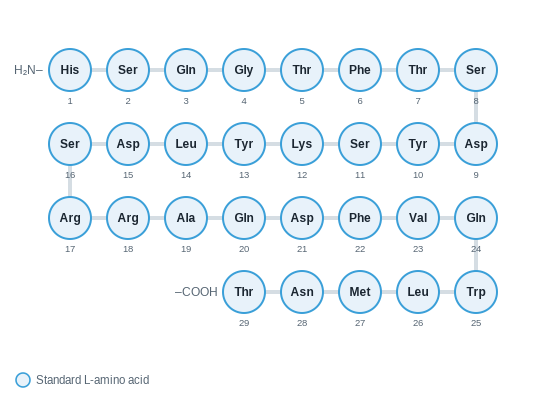
Glucagon is a 29-amino-acid hormone made by the pancreas. It is insulin's opposite number: it raises blood sugar. As a drug, it is the emergency rescue for severe low blood sugar in people with diabetes, when the person cannot safely eat or drink S1S2S3. Hospitals also use it to briefly relax the stomach and bowel during X-ray exams S1. Forms: - Emergency kits: 1 mg powder plus a syringe of liquid, mixed on the spot S1. - Gvoke: a ready-to-use liquid in an auto-injector, prefilled syringe or kit S2. - Baqsimi: a 3 mg nasal powder; it is not inhaled S3.
How it works
Glucagon switches on glucagon receptors in the liver. That makes the liver break down its stored sugar (glycogen) and release glucose into the blood S1. Injected, it raises blood sugar within about 10 minutes, peaking around 30 minutes (mean 136 mg/dL under the skin, 138 mg/dL in the muscle at 26 minutes) S1. It is cleared fast, with a half-life of 8–18 minutes S1. It only works if the liver has glycogen stored. In starvation, adrenal insufficiency or chronic low blood sugar it may fail, and glucose is needed instead S1. Outside the liver, it relaxes the smooth muscle of the gut, which is why radiologists use it S1.
Legal status
- FDA: Approved since 1960 for severe low blood sugar in people with diabetes and as a radiology aid S1. Gvoke is approved for ages 2 and up and Baqsimi for ages 1 and up S2S3. Prescription only.
- DEA: Not a controlled substance.
- WADA: Glucagon is not named on the 2026 Prohibited List S5.
What the research actually shows
Evidence: A. Decades of use, plus controlled trials of newer forms against the standard injection S3S4.
| Study | Design | People | Dose studied | Result |
|---|---|---|---|---|
| Rickels et al 2016 S4 | Randomized crossover noninferiority trial | 75 adults with type 1 diabetes, low blood sugar induced by IV insulin | Nasal glucagon 3 mg vs IM glucagon 1 mg | Success (glucose ≥70 mg/dL or +20 mg/dL within 30 min) in 98.7% vs 100%. Mean time to success 16 vs 13 min. Head/face discomfort 25% vs 9%; nausea 35% vs 38% |
| Baqsimi label, Study 1 (NCT03339453) S3 | Randomized crossover | 70 adults with type 1 diabetes | Nasal 3 mg vs IM 1 mg | 100% success with both; mean time 11.6 vs 9.9 min |
| Baqsimi label, Study 3 (NCT01997411) S3 | Randomized | 48 children aged 4 to <17 with type 1 diabetes | Nasal 3 mg vs IM 0.5–1 mg by weight | 100% reached +20 mg/dL within 20 min in both arms |
| Glucagon kit label pharmacology S1 | Pharmacodynamics | — | 1 mg SC or IM | Glucose rises within 10 min; peak ~30 min SC, ~26 min IM |
What we don't know: We found no published evidence for non-medical uses. Glucagon is not a body-composition or weight-loss drug on its own; switching on the glucagon receptor is part of how investigational dual agonists such as survodutide and mazdutide work (see those pages).
Reported benefits
A fast rescue for severe lows that someone else can give when the person is unconscious, seizing or unable to swallow S1S2S3. The ready-to-use and nasal forms remove the mixing step S2S3. In radiology, it temporarily stops gut movement for clearer images S1.
Side effects
Injection (kit label, post-approval reports): nausea, vomiting, headache, dizziness, weakness, pallor, diarrhea, sleepiness, injection-site redness and swelling, and low blood pressure S1. Gvoke (≥2% in trials): adults: nausea, vomiting, injection-site swelling and headache. Children: nausea, low blood sugar, vomiting, headache, belly pain, high blood sugar and injection-site reactions S2. Baqsimi (≥10%): nausea, vomiting, headache, nose and throat irritation (runny or stuffy nose, nosebleed, cough), and watery, red or itchy eyes S3. Serious (label warnings): dangerous blood pressure spikes in people with pheochromocytoma; rebound low blood sugar in people with insulinoma; severe allergic reactions including anaphylaxis; a skin rash (necrolytic migratory erythema) with continuous infusion; and raised blood pressure and heart rate in people with heart disease during radiology use S1.
Dangers and red flags
- Call for help immediately after giving it. The labels say to call emergency services right after the dose, and to give a second dose after 15 minutes only if there's no response, while waiting S1S2S3.
- Feed after waking. Once the person can swallow, give carbohydrates to restore liver glycogen and prevent another low S1S3.
- Won't work on an empty liver (starvation, adrenal insufficiency, chronic lows) S1.
- Contraindicated in pheochromocytoma and insulinoma, and in glucagonoma when used for radiology S1.
- Kit glucagon is mixed and used immediately; discard any unused portion S1.
- Indomethacin users may be more prone to lows after glucagon S1.
Doses reported
We don't recommend sh*t. These are the doses studies, labels and harm-reduction sources report. That's information, not advice. Talk to a licensed clinician.
| Source | Product | Who | Dose | Route | Repeat | Notes | Cite |
|---|---|---|---|---|---|---|---|
| Glucagon kit label | 1 mg powder + 1 mL diluent = 1 mg/mL | Adults and children ≥20 kg | 1 mg (1 mL) | SC or IM (upper arm, thigh, buttocks); IV by clinicians only | One more 1 mg dose after 15 min if no response | Use immediately after mixing | S1 |
| Glucagon kit label | Same | Children <20 kg | 0.5 mg (0.5 mL) or 20–30 mcg/kg | SC, IM or IV (clinicians) | One more 0.5 mg after 15 min if no response | — | S1 |
| Glucagon kit label (radiology) | Same | Adults | Duodenum/small bowel: 0.25–0.5 mg IV or 1 mg IM. Stomach: 0.5 mg IV or 2 mg IM. Colon: 2 mg IM ~10 min before | IV or IM | — | 2 mg doses cause more nausea and vomiting | S1 |
| Gvoke label | Ready-to-use liquid | Ages 12+ | 1 mg | SC (lower belly, outer thigh, outer upper arm) | New device after 15 min if no response | Single-use | S2 |
| Gvoke label | Same | Ages 2 to <12, <45 kg | 0.5 mg | SC | As above | — | S2 |
| Gvoke label | Same | Ages 2 to <12, ≥45 kg | 1 mg | SC | As above | — | S2 |
| Baqsimi label | Nasal powder | Ages 1+ | 3 mg, one spray in one nostril | Intranasal (not inhaled) | Another 3 mg after 15 min if no response | Single-use; do not test the device | S3 |
| Rickels 2016 trial | Nasal vs IM | Adults with type 1 diabetes | 3 mg nasal vs 1 mg IM | — | — | Research comparison | S4 |
No non-medical dosing sources were found, and we have not filled that gap.
About the calculator: the emergency kit is mixed as 1 mg powder + 1 mL liquid = 1 mg/mL. The calculator below is prefilled with that label presentation only. Gvoke and Baqsimi are ready to use and need no math. Open the full calculator →
Monitoring a doctor would order
Blood glucose before and after the dose and until the person is eating. Blood pressure and heart rate in people with heart disease during radiology use. Follow-up on why the severe low happened, including the insulin or sulfonylurea dose S1.
Bottom line
Glucagon is the emergency antidote for severe low blood sugar, given by someone else, followed by a call for help and food once the person wakes. It comes as a mix-it kit, a ready-to-use pen or a nasal spray. It is not a performance drug on its own and is not on the WADA list.
Sources
- [S1] GLUCAGON for injection (emergency kit, 1 mg). US prescribing information (DailyMed, Amphastar Pharmaceuticals). Set ID 8cc40354-b5ac-45b6-a211-93b44444f2a3. (label)
- [S2] GVOKE (glucagon injection) HypoPen, PFS, Kit and VialDx. US prescribing information (DailyMed, Xeris Pharmaceuticals). Set ID 92385737-dbad-98c5-e053-2995a90a2805. (label)
- [S3] BAQSIMI (glucagon) nasal powder 3 mg. US prescribing information (DailyMed, Amphastar Pharmaceuticals). Set ID f1f5df9b-872f-44e5-a18f-f0b68e7e9254. Includes Study 1 (NCT03339453) and Study 3 (NCT01997411). (label)
- [S4] Rickels MR, et al. Intranasal glucagon for treatment of insulin-induced hypoglycemia in adults with type 1 diabetes: a randomized crossover noninferiority study. Diabetes Care. 2016;39:264-270. PMID 26681725. (rct)
- [S5] World Anti-Doping Agency. 2026 Prohibited List (in force Jan 1 2026). Glucagon is not named on the List. (regulator)