
Brain, sleep & 'longevity' research peptides [tripeptide]
Glutathione (injection/IV)
Also called GSH, reduced glutathione, L-glutathione, gamma-Glu-Cys-Gly
- US status
- Not approved
- DEA
- Not a controlled substance
- WADA
- Not named by name. Given intravenously, WADA's M2.2 rule limits IV infusions to 100 mL per 12 hours (outside hospital care).
- Class
- Brain, sleep & 'longevity' research peptides [tripeptide]
Jump to doses reported ↓ Dose math calculator
What it is
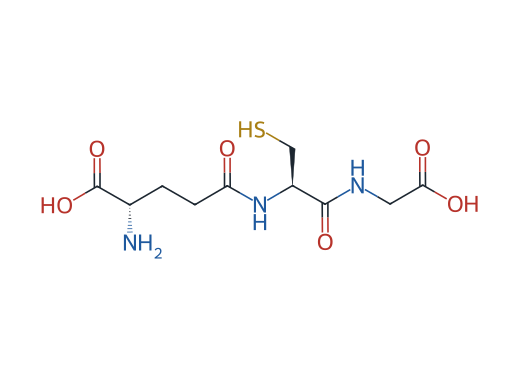
Glutathione is a tripeptide (gamma-Glu-Cys-Gly) that every cell in the body makes. It is sold and given as an oral supplement, an intravenous "drip," and an intramuscular injection, and marketed for skin whitening, anti-aging, "detox" and general wellness. As a supplement glutathione is generally recognized as safe; the questions on this page are about the injectable and IV products used for cosmetic and wellness claims, which are a different matter S8.
How it works
Glutathione is the cell's main internal antioxidant. The cysteine in the middle of the tripeptide carries a reactive thiol (-SH) group that neutralizes reactive oxygen species and is the handle the liver uses in phase II detoxification, where glutathione is conjugated onto toxins to make them water-soluble for excretion. Every cell makes its own from three amino acids.
For skin lightening, the proposed mechanism is interference with melanin production: glutathione inhibits tyrosinase, the rate-limiting enzyme in melanin synthesis, and shifts the pathway from dark eumelanin toward lighter pheomelanin S8. The practical problem is delivery. Swallowed glutathione is largely broken down in the gut into its amino acids, so it raises the body's building blocks more than circulating glutathione, which is the stated reason for the IV and intramuscular products — and the injectable route is where the human evidence is thinnest and the risk highest S7S8. The small oral trials that found a measurable effect on skin pigment saw it fade after stopping, consistent with continuous suppression of an enzyme rather than any lasting change S5S6.
Legal status
- FDA: There is no FDA-approved injectable glutathione drug product for skin-whitening, anti-aging or wellness uses S2. FDA and dermatology bodies have specifically warned that injectable skin-whitening glutathione is unapproved and its safety is unestablished S8.
- Compounding: The bulk substance glutathione sits in 503A Category 1 ("under evaluation"), meaning FDA does not currently intend to act against a pharmacy compounding it under the interim-policy conditions S1. That is not the same as approval: a compounded injectable is still not an FDA-approved, quality-assured drug.
- DEA: Not a controlled substance.
- "Research use only" products: see our explainer.
- WADA: Glutathione is not named as a prohibited substance, but when it is given as an IV drip, WADA's M2.2 rule - no IV infusions over 100 mL per 12 hours except in hospital care - can make the method a violation for athletes S3.
What the research actually shows
Evidence: C. For skin lightening, there are a few small randomized trials of oral glutathione with modest, short-lived effects S5S6, but a systematic review concluded the overall evidence is limited and weak, and that injectable/IV use rests on even thinner data while carrying more risk S7. For Parkinson's disease, a small IV pilot trial found it well tolerated but did not show a clear, lasting benefit S4. The popular "glutathione drip for wellness/detox" has essentially no outcome-trial support.
| Study | Design | People | Dose studied | Result |
|---|---|---|---|---|
| Arjinpathana & Asawanonda 2012 S5 | Randomized, double-blind, placebo-controlled | 60 adults | 500 mg/day by mouth | Small reduction in skin melanin at some sites vs placebo over 4 weeks |
| Weschawalit et al 2017 S6 | Randomized, double-blind, placebo-controlled | Healthy women | 250 mg/day by mouth (reduced or oxidized form) | Modest effects on skin pigment and elasticity |
| Hauser et al 2009 S4 | Randomized, double-blind pilot | 21 Parkinson's patients | 1,400 mg IV, 3 times/week for 4 weeks | Well tolerated; a small early improvement that was not statistically significant and faded after stopping |
| Dilokthornsakul et al 2019 S7 | Systematic review | — | — | Evidence for skin lightening is limited and of low quality; injectable use not supported |
What we don't know: whether IV or injected glutathione does anything lasting for skin tone, aging or "detox," the right dose or schedule, and the long-term safety of repeated injections S7S8.
Reported benefits
- Oral, skin tone: small, temporary lightening in short trials S5S6.
- Parkinson's (IV): a small, non-significant early change in a pilot trial S4.
- IV "wellness/detox," anti-aging: not demonstrated in outcome trials S7.
Side effects
Common: oral glutathione is generally well tolerated in trials S6. Injection and IV carry injection-site reactions and the risks of any infusion. Serious: dermatology reviews warn that unapproved injectable skin-whitening glutathione has been linked to serious reactions, including severe skin reactions, and that sterility and product quality of these injections are a real concern S8.
Dangers and red flags
- IV drips are the risk. The oral supplement is low-risk; the cosmetic IV and injection products are unapproved, and regulators warn their safety is unestablished S8.
- Sterility and dosing. Compounded or grey-market injectables can be contaminated, under- or over-concentrated, or wrongly reconstituted.
- Infusion method, in sport. Even "clean" glutathione can trip WADA's infusion-volume rule S3.
- Who should be cautious: anyone pregnant or breastfeeding, anyone with asthma (there are reports of bronchospasm with inhaled/nebulized forms), and anyone considering repeated IV drips for cosmetic reasons.
Doses reported
We don't recommend sh*t. These are the doses studies, labels and harm-reduction sources report. That's information, not advice. Talk to a licensed clinician.
There is no FDA-approved injectable label for the wellness uses. The doses below are from the trials cited; the oral figures are the better-supported ones.
| Source | Population | Dose | Route | Frequency | Duration | Cite |
|---|---|---|---|---|---|---|
| Arjinpathana & Asawanonda 2012 | Healthy adults (skin) | 500 mg | Oral | Daily | 4 weeks | S5 |
| Weschawalit et al 2017 | Healthy women (skin) | 250 mg | Oral | Daily | 12 weeks | S6 |
| Hauser et al 2009 | Parkinson's patients | 1,400 mg | Intravenous | 3 times/week | 4 weeks | S4 |
We found no rigorous trial supporting a specific IV or intramuscular "wellness" dose, so we report none for those uses.
Open the dose math calculator →
Monitoring a doctor would order
No specific guideline exists for cosmetic use. In the Parkinson's trial, glutathione was given under medical supervision with monitoring for infusion reactions S4.
Bottom line
Glutathione is a natural tripeptide and a safe-enough oral supplement with small, temporary effects on skin tone. The injectable and IV "whitening," anti-aging and detox products that drive the market are unapproved, backed by weak data, and flagged by regulators as having unestablished safety. The bulk ingredient is in FDA's Category 1 for compounding, which is not approval.
Sources
- [S1] FDA. Bulk Drug Substances Nominated for Use in Compounding Under Section 503A (Category 1 list, 'Glutathione'). Updated May 14, 2026. (regulator)
- [S2] FDA. Drugs@FDA database (no approved injectable glutathione drug product for wellness/skin uses). Searched product name. (regulator)
- [S3] World Anti-Doping Agency. 2026 Prohibited List, section M2.2 (Intravenous infusions and/or injections of more than 100 mL per 12 hours). (regulator)
- [S4] Hauser RA, et al. Randomized, double-blind, pilot evaluation of intravenous glutathione in Parkinson's disease. Mov Disord. 2009;24(7):979-83. PMID 19230029. (rct)
- [S5] Arjinpathana N, Asawanonda P. Glutathione as an oral whitening agent: a randomized, double-blind, placebo-controlled study. J Dermatolog Treat. 2012;23(2):97-102. PMID 20524875. (rct)
- [S6] Weschawalit S, et al. Glutathione and its antiaging and antimelanogenic effects. Clin Cosmet Investig Dermatol. 2017;10:147-153. PMID 28490897. (rct)
- [S7] Dilokthornsakul W, et al. The clinical effect of glutathione on skin color and other related skin conditions: A systematic review. J Cosmet Dermatol. 2019;18(3):728-737. PMID 30895708. (review)
- [S8] Sonthalia S, et al. Glutathione as a skin whitening agent: Facts, myths, evidence and controversies. Indian J Dermatol Venereol Leprol. 2016;82(3):262-72. PMID 27088927. (review)