
Reproductive & hormonal peptides (approved)
Gonadorelin
Also called GnRH, LHRH, LH-RH, gonadotropin-releasing hormone, gonadorelin acetate, gonadorelin hydrochloride
- US status
- Discontinued for human use (no current US human product)
- DEA
- Not a controlled substance
- WADA
- S2.2.1, named (gonadorelin): prohibited at all times in males
- Class
- Reproductive & hormonal peptides (approved)
Jump to doses reported ↓ Dose math calculator
What it is
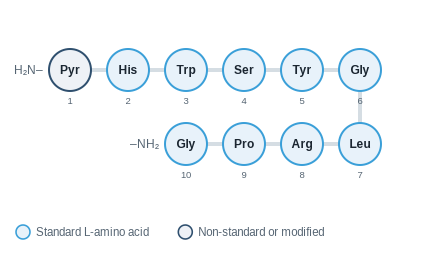
Gonadorelin is a synthetic copy of GnRH (gonadotropin-releasing hormone), the ten-amino-acid hormone the hypothalamus uses to tell the pituitary to release the fertility hormones LH and FSH S3. Its amino-acid sequence is identical to the body's own GnRH S3. Two human versions were once FDA-approved, Factrel and Lutrepulse, and both are discontinued S1S2. The gonadorelin products sold under FDA approval today are veterinary, for cattle S3. In medicine it has been studied mainly as a pulse pump to restore fertility in people whose hypothalamus does not make GnRH. It is also sold online as a research peptide and promoted as a substitute for hCG during testosterone therapy, a use we found no trial for.
How it works
In the body, GnRH is released in short bursts; in monkeys the natural rhythm was about once an hour S4. Each burst prompts the pituitary to release LH and FSH, which in turn drive the ovaries or testes S3S4. Timing is everything: - Pulses work. In monkeys whose own GnRH had been abolished, a GnRH dose once an hour restored normal pituitary hormone release S4. - Constant exposure backfires. A continuous infusion failed to restore it, and switching pulsed animals to a continuous infusion shut the pituitary response down ("desensitization") S4. That shutdown is how long-acting GnRH agonists such as leuprolide work. - It is gone in minutes. After an IV injection in people, gonadorelin's half-life was 2.4 minutes S5.
That is why medical use relies on a small pump that delivers a dose at short fixed intervals around the clock (every 2 hours in one study of men) S6S7S8. One or two injections a day do not copy that pattern.
Legal status
- FDA: No current US human product. Factrel (NDA 018123) and Lutrepulse (NDA 019687) are both listed as discontinued S1S2. Factrel for cattle is approved as a veterinary drug, for use by or on the order of a veterinarian S3.
- Compounding: Gonadorelin does not appear on FDA's 503A Category 1, 2 or 3 lists S10. Whether a pharmacy may compound it depends on the general 503A rules for ingredients, which we did not resolve for this page.
- DEA: Not a controlled substance.
- WADA: Named on the 2026 Prohibited List under S2.2.1; prohibited at all times in males S11.
- International (short): Not reviewed for this page.
What the research actually shows
Evidence: B for pulsatile fertility treatment (a meta-analysis of mostly observational studies plus small series in men). No evidence for the "hCG substitute" use during testosterone therapy.
| Study / source | Design | People | Dose studied | Result |
|---|---|---|---|---|
| Belchetz 1978 S4 | Animal study | Rhesus monkeys with hypothalamic lesions | Intermittent (hourly) vs continuous IV GnRH | Hourly pulses restored LH/FSH release; continuous infusion did not and shut down the response |
| Fauconnier 1978 S5 | Pharmacokinetics | 6 volunteers | Single IV injection | Half-life 2.4 ± 0.4 minutes |
| Tranoulis 2018 S6 | Systematic review and meta-analysis | 35 studies (3 randomized), 1,002 women with hypothalamic amenorrhea | Pulsatile GnRH, IV or subcutaneous | High ovulation rates; subcutaneous comparable to IV; ovarian hyperstimulation rare and mild; multiple pregnancy low but slightly above the general population |
| Liu 1988 S7 | Two-group comparison, 2 years | 16 men with complete isolated hypogonadotropic hypogonadism | Pulsatile GnRH 143–714 ng/kg every 2 hours subcutaneous (5 men) vs hCG/hMG (11 men) | Testosterone rose into the normal range with GnRH (lower than with hCG/hMG); testicular growth not significantly different |
| Büchter 1998 S9 | Case series | 42 men with secondary hypogonadism | Pulsatile GnRH or hCG/hMG | Sperm appeared in 54 of 57 treatment courses; pregnancies in 26 of 36 |
| Zhang 2019 S8 | Non-randomized comparison | 28 azoospermic men with congenital hypogonadotropic hypogonadism | Pulsatile gonadorelin pump (10) vs hCG/hMG (18) | Sperm appeared sooner with the pump (median 6 vs 14 months); 90% vs 83% overall |
What we don't know: we found no published trial of gonadorelin injected once or twice a day to keep the testes working during testosterone therapy. All of the human fertility evidence uses pulse pumps in people who lack their own GnRH.
Reported benefits
- Pulse pump, women with hypothalamic amenorrhea: high ovulation rates with mostly single pregnancies and a low risk of ovarian hyperstimulation S6.
- Pulse pump, men with GnRH deficiency: testosterone in the normal range, testicular growth and sperm production, and pregnancies in partners S7S8S9.
Side effects
- Pump site: skin redness and hardening at the needle site was a common side effect of the pump in men S8.
- IV pumps: occasional superficial thrombophlebitis (vein inflammation) S6.
- Women: ovarian hyperstimulation (rare, mild) and a slightly higher rate of multiple pregnancy S6.
Dangers and red flags
- Wrong pattern, wrong result. Continuous exposure can switch the pituitary off rather than on S4. Injecting a fast-cleared hormone once or twice a day is not what the fertility studies tested S5S6.
- No human-grade source. With no current US human product, injectable gonadorelin sold online is of unknown purity, strength and sterility S1S2.
- Veterinary products are not for people. The cattle product is labeled for use in cattle only, by or on a veterinarian's order S3.
- Sport. Prohibited at all times in male athletes S11.
Doses reported
We don't recommend sh*t. These are the doses studies, labels and harm-reduction sources report. That's information, not advice. Talk to a licensed clinician.
There is no current US human label, so the calculator below starts blank. The vial sizes offered are those of the former Factrel human product S1; no dose is prefilled.
| Source | Population | Dose | Route | Frequency and timing | Duration | Titration or escalation | Cite |
|---|---|---|---|---|---|---|---|
| Liu 1988 | Men with complete isolated hypogonadotropic hypogonadism | 143–714 ng/kg per pulse | Subcutaneous, by pump | Every 2 hours, around the clock | 2 years | Range across patients | S7 |
| Belchetz 1978 | Rhesus monkeys (animal) | Pulses vs continuous infusion | IV | Once an hour vs continuous | Not stated in the abstract | None | S4 |
| Factrel for cattle (veterinary) | Dairy and beef cattle with ovarian follicular cysts | 100 mcg (2 mL) | Intramuscular | Single injection | Once | None | S3 |
| Factrel for cattle (veterinary) | Lactating dairy cows, timed insemination | 100–200 mcg (2–4 mL) | Intramuscular | Day 0, then a second dose 30–72 hours after a dinoprost injection given 6–8 days later | Up to about 11 days | None | S3 |
We found no peer-reviewed source for the once- or twice-daily injected doses promoted for men on testosterone, so we report none.
Open the dose math calculator →
Monitoring a doctor would order
For pulse-pump fertility treatment: LH, FSH and sex-hormone levels; ultrasound of follicles in women; testicular size and semen analysis in men; checks of the pump site S6S7S8.
Bottom line
Gonadorelin is the body's own GnRH, made in a lab. It only stimulates the pituitary reliably when delivered in frequent pulses, because it is cleared in minutes and constant exposure shuts the system down. Given that way by pump, it restores ovulation in women and sperm production in men who lack their own GnRH. There is no current US human product, and the popular use as a daily injection to replace hCG during testosterone therapy has no published trial behind it.
Sources
- [S1] Drugs@FDA. NDA 018123, Factrel (gonadorelin hydrochloride) injectable, 0.1, 0.2 and 0.5 mg base per vial. Marketing status: discontinued. Original approval September 30, 1982. (regulator)
- [S2] Drugs@FDA. NDA 019687, Lutrepulse (gonadorelin acetate) kit, 0.8 and 3.2 mg per vial. Marketing status: discontinued. Original approval October 10, 1989. (regulator)
- [S3] Factrel (gonadorelin injection) 50 mcg/mL, for use in cattle only. Veterinary labeling (DailyMed), Zoetis. Approved under NADA 139-237. Set ID 1451663c-b85a-4b45-8b27-6d572d0032f9. (label)
- [S4] Belchetz PE, et al. Hypophysial responses to continuous and intermittent delivery of hypothalamic gonadotropin-releasing hormone. Science. 1978;202:631-633. PMID 100883. (animal)
- [S5] Fauconnier JP, et al. Rate of disappearance in plasma of synthetic LH-RH intravenously injected in man. Gynecol Obstet Invest. 1978;9:229-237. PMID 378777. (human-pk)
- [S6] Tranoulis A, et al. Efficacy and safety of pulsatile gonadotropin-releasing hormone therapy among patients with idiopathic and functional hypothalamic amenorrhea: a systematic review of the literature and a meta-analysis. Fertil Steril. 2018;109:708-719.e8. PMID 29605411. (meta-analysis)
- [S7] Liu L, et al. Two-year comparison of testicular responses to pulsatile gonadotropin-releasing hormone and exogenous gonadotropins from the inception of therapy in men with isolated hypogonadotropic hypogonadism. J Clin Endocrinol Metab. 1988;67:1140-1145. PMID 3142911. (human-observational)
- [S8] Zhang L, et al. The pulsatile gonadorelin pump induces earlier spermatogenesis than cyclical gonadotropin therapy in congenital hypogonadotropic hypogonadism men. Am J Mens Health. 2019;13:1557988318818280. PMID 30569789. (human-observational)
- [S9] Büchter D, et al. Pulsatile GnRH or human chorionic gonadotropin/human menopausal gonadotropin as effective treatment for men with hypogonadotropic hypogonadism: a review of 42 cases. Eur J Endocrinol. 1998;139:298-303. PMID 9758439. (human-case-series)
- [S10] U.S. FDA. 503A Categories 1, 2 and 3 bulk drug substance lists (updated May 14, 2026); gonadorelin does not appear. (regulator)
- [S11] World Anti-Doping Agency. 2026 Prohibited List, section S2.2.1 (gonadotrophin-releasing hormone (GnRH, gonadorelin) and its agonist analogues, prohibited in males). (regulator)