
Reproductive & hormonal peptides (approved)
Goserelin
Also called Zoladex, goserelin acetate implant, ICI 118630
- US status
- Approved
- DEA
- Not a controlled substance
- WADA
- S2.2.1 GnRH agonist analogues (goserelin named); prohibited at all times in males
- Class
- Reproductive & hormonal peptides (approved)
Jump to doses reported ↓ Dose math calculator
What it is
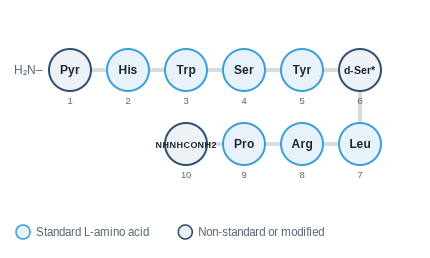
Goserelin (Zoladex) is a man-made version of gonadotropin-releasing hormone (GnRH), the brain hormone that switches on the pituitary's release of LH and FSH. It is an approved prescription drug that comes as a tiny rod-shaped implant, pre-loaded in a syringe with a wide needle, and placed under the skin of the lower belly by a clinician. The rod slowly dissolves and releases the drug for 28 days (3.6 mg) or 12 weeks (10.8 mg) S1S2. It is used in prostate cancer, breast cancer, endometriosis, and to thin the womb lining before surgery.
How it works
Natural GnRH comes in pulses. Goserelin is a stronger, longer-acting copy delivered nonstop, so the pituitary first over-responds (a short rise in testosterone or estrogen called the flare) and then shuts down its LH and FSH release. After a few weeks, testosterone in men falls to castration levels and estrogen in premenopausal women falls to postmenopausal levels S1. Starving hormone-sensitive cancers, endometriosis and the uterine lining of these hormones is what makes it work. The polymer rod is fully biodegradable, so nothing has to be removed S1.
Legal status
- FDA: Approved. Zoladex 3.6 mg for prostate cancer (with flutamide and radiation for stage T2b–T4, and for palliation of advanced disease), palliative treatment of advanced breast cancer in pre- and perimenopausal women, endometriosis, and endometrial thinning before ablation S1. Zoladex 10.8 mg for prostate cancer only; it is not indicated in women S2.
- Who gives it: placed under the skin under a physician's supervision S1.
- DEA: Not a controlled substance.
- WADA: GnRH agonists, with goserelin named, are prohibited at all times in males under S2.2.1 S4.
- International (short): Not reviewed for this page.
What the research actually shows
Evidence: A. Goserelin is backed by large randomized cancer trials and FDA labels.
| Study / source | Design | People | Dose studied | Result |
|---|---|---|---|---|
| Bolla 1997 (EORTC) S3 | Randomized: radiotherapy alone vs radiotherapy plus goserelin | 415 men with locally advanced prostate cancer | 3.6 mg subcutaneous every 4 weeks for 3 years (plus cyproterone in month 1) | 5-year overall survival 79% vs 62% (P = 0.001); disease-free survival 85% vs 48% |
| Label, stage B2–C prostate cancer S1 | Controlled trial: goserelin + flutamide + radiation vs radiation alone | 466 men | 3.6 mg depot plus flutamide 250 mg three times a day | Local failure at 4 years 16% vs 33% (P < 0.001); median disease-free survival 4.4 vs 2.6 years |
| Label, advanced prostate cancer S1 | Controlled studies vs orchiectomy (surgical castration) | Men with advanced prostate cancer | 3.6 mg every 28 days | Hormone response, tumor response and survival similar to orchiectomy |
| Label, 10.8 mg S2 | Controlled studies vs 3.6 mg | Men with advanced prostate cancer | 10.8 mg every 12 weeks | Testosterone suppression similar to the 3.6 mg implant |
What we don't know for this page: the labels note there are no clinical data on treating benign gynecological conditions for more than 6 months, and no safety data on retreatment for endometriosis S1.
Reported benefits
- Prostate cancer: combined with radiation, longer survival and better local control in locally advanced disease S3S1; in advanced disease, results similar to surgical castration S1.
- Breast cancer: palliative treatment of advanced, hormone-sensitive disease in pre- and perimenopausal women S1.
- Endometriosis: pain relief and smaller lesions for the length of therapy, studied in women 18 and older for 6 months S1.
- Endometrial thinning: thins the lining before ablation for abnormal uterine bleeding S1.
Side effects
Common (men, >10%): hot flashes, sexual dysfunction, decreased erections, and lower urinary tract symptoms S1. Common (women, >20%): hot flushes, headache, sweating, acne, mood swings, depression, decreased libido, vaginal inflammation, breast shrinkage, oily skin and swelling of the legs S1. Serious: tumor flare in the first weeks, which can include blocked ureters and spinal cord compression; high blood sugar and diabetes; heart attack, sudden cardiac death and stroke in men; high calcium in people with bone metastases; allergic reactions; severe skin reactions including Stevens-Johnson syndrome S1. Injection-site and blood-vessel injury, including bleeding and hemorrhagic shock needing transfusion or surgery, has been reported; the label asks for extra care in people with low body weight or on blood thinners S1.
Dangers and red flags
- Wide needle, real bleeding risk. The implant goes in through a 16-gauge needle, and the syringe cannot be used to check for a blood vessel. Serious bleeding has been reported S1.
- Bone loss in women. After 6 months, women in the studies lost an average of 4.3% of spinal bone density, only partly regained a year later S1.
- Pregnancy. Contraindicated in pregnancy except in advanced breast cancer; it can harm a fetus and raises the risk of pregnancy loss. Pregnancy must be ruled out before use for benign conditions, and premenopausal women must use non-hormonal contraception during treatment and for 12 weeks after S1.
- Wrong product for women. The 10.8 mg implant is not indicated in women because it does not reliably suppress estrogen S2.
- Sport. Prohibited in males at all times S4.
- Who should avoid it: anyone with a known allergy to GnRH, GnRH agonists or the implant's components S1.
Doses reported
We don't recommend sh*t. These are the doses studies, labels and harm-reduction sources report. That's information, not advice. Talk to a licensed clinician.
Goserelin is a fixed-dose implant that a clinician places. There is nothing to dissolve, mix or measure, so the inline calculator does not apply.
| Source | Population | Dose | Route | Frequency and timing | Duration | Titration or escalation | Cite |
|---|---|---|---|---|---|---|---|
| Zoladex 3.6 mg label | Prostate cancer, breast cancer, endometriosis | 3.6 mg implant | Subcutaneous, front of belly below the navel | Every 28 days | Cancer: long term; endometriosis: 6 months | None | S1 |
| Zoladex 3.6 mg label | Stage B2–C prostate cancer with flutamide and radiation | 3.6 mg, then 10.8 mg 28 days later (one option the label describes) | Subcutaneous | Start 8 weeks before radiation | Through radiation | None | S1 |
| Zoladex 3.6 mg label | Endometrial thinning before ablation | One or two 3.6 mg implants | Subcutaneous | Four weeks apart | Surgery 4 weeks after one implant, or 2 to 4 weeks after the second | None | S1 |
| Zoladex 10.8 mg label | Prostate cancer (men only) | 10.8 mg implant | Subcutaneous | Every 12 weeks | Long term | None | S2 |
| Bolla 1997 | Locally advanced prostate cancer, with radiotherapy | 3.6 mg | Subcutaneous | Every 4 weeks | 3 years | None | S3 |
There is no known non-medical use with published dosing, so we report no community doses.
Open the dose math calculator →
Monitoring a doctor would order
Blood sugar or HbA1c; heart-risk checks in men; calcium in people with bone metastases; watching for flare symptoms in men with spinal or urinary-tract disease; bone mineral density before any repeat course for endometriosis; and watching the injection site for bleeding or pain S1.
Bottom line
Goserelin (Zoladex) is a long-established GnRH agonist implant that shuts down testosterone or estrogen. Added to radiation, it improved survival in locally advanced prostate cancer, and it is used in breast cancer, endometriosis and before uterine surgery. The risks come from the hormone shutdown (hot flashes, bone loss, metabolic and heart risks in men) and from the implant itself, which can cause serious bleeding.
Sources
- [S1] ZOLADEX (goserelin implant) 3.6 mg. US prescribing information (DailyMed), TerSera Therapeutics. Indications, dosing, warnings (tumor flare, hyperglycemia, cardiovascular risk, hypercalcemia, injection-site and vascular injury), bone-density data. Set ID 294b168b-6e5f-4db9-bf70-d599271458b3. (label)
- [S2] ZOLADEX (goserelin implant) 10.8 mg. US prescribing information (DailyMed), TerSera Therapeutics. Prostate cancer only; not indicated in women. Set ID e4cb3c20-2738-400a-b522-3f36f71fe6c5. (label)
- [S3] Bolla M, et al. Improved survival in patients with locally advanced prostate cancer treated with radiotherapy and goserelin. N Engl J Med. 1997;337(5):295-300. PMID 9233866. (rct)
- [S4] World Anti-Doping Agency. 2026 Prohibited List, section S2.2.1 (testosterone-stimulating peptides in males, including GnRH agonist analogues such as goserelin). (regulator)