
Growth hormone & GH-axis peptides
Hexarelin
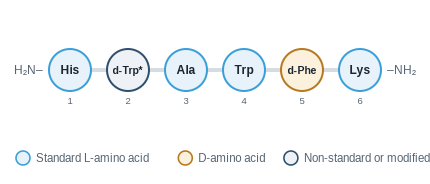
Also called examorelin, His-D-2-methyl-Trp-Ala-Trp-D-Phe-Lys-NH2, GH-releasing peptide
- US status
- Not approved
- DEA
- Not a controlled substance
- WADA
- S2.2 Growth hormone secretagogues / GH-releasing peptides; prohibited at all times
- Class
- Growth hormone & GH-axis peptides
Jump to doses reported ↓ Dose math calculator
What it is
Hexarelin (examorelin) is a synthetic hexapeptide GH-releasing peptide, closely related to GHRP-6 S1. It was studied in the 1990s and 2000s both as a growth-hormone-releasing agent and, separately, for a possible direct effect on the heart. It was never approved for any use and is sold today as grey-market "research" powder for muscle and recovery uses it was never approved for.
How it works
Hexarelin is an agonist at the growth hormone secretagogue receptor (GHS-R1a), the ghrelin receptor: on pituitary somatotrophs it triggers a pulse of growth hormone, and in the hypothalamus it blunts somatostatin's restraint on GH release S1. The resulting GH pulse raises liver IGF-1. Like the other GH-releasing peptides, it also pushes ACTH, cortisol and prolactin up to some degree S1.
Its separate heart story runs through a different receptor. In hypopituitary adults — people whose GH axis cannot respond — hexarelin still produced measurable cardiac effects, and work in people with severe left-ventricular dysfunction described a GH-independent cardiotropic action S2S3. That effect is attributed to binding sites in heart tissue (the CD36 scavenger receptor) rather than to GHS-R1a. Whether those direct cardiac actions are helpful or harmful over time has never been established. A known limitation of repeated use is desensitization: the GH response fades as the receptor is continuously stimulated S1.
Legal status
- FDA: Not approved for any use. Hexarelin is not specifically named on the current FDA compounding safety lists, but it is an unapproved drug with no US pathway for human use.
- DEA: Not a controlled substance.
- "Research use only" powder: grey-market hexarelin is an unapproved drug of unknown quality. See our explainer.
- WADA: Prohibited at all times as a GH secretagogue under S2.2 S4.
- International (short): Not reviewed for this page yet.
What the research actually shows
Evidence: C. Hexarelin has real human data, but it splits into two separate stories: it reliably releases GH in humans (pharmacology), and small studies looked at a possible direct heart effect. Neither line tested the muscle or anti-aging uses it is sold for.
| Study | Design | People | What it showed |
|---|---|---|---|
| Arvat 2001 S1 | Human pharmacology | Adults | Compared GH-, ACTH- and prolactin-releasing activity of ghrelin and GH-releasing peptides including hexarelin |
| Eur J Pharmacol 1999 S2 | Human | Hypopituitary adults | Hexarelin had measurable cardiac effects even without a normal GH axis |
| Bisi 2002 S3 | Human | Patients with severe LV dysfunction | Reported GH-independent cardiotropic activity of hexarelin |
What we don't know: whether hexarelin produces meaningful muscle, fat-loss or recovery benefits in healthy adults (untested), its long-term safety, whether its direct heart effects are helpful or harmful over time, and whether a grey-market vial contains real, sterile peptide at the stated amount. A known problem for repeated hexarelin use is desensitization — the GH response fades with continued dosing.
Reported benefits
In studies: a pulse of growth hormone, and a measurable (GH-independent) effect on the heart in small patient groups S1S2S3. These are research findings, not demonstrated health benefits for healthy adults.
Side effects
Common: the GHRP class can transiently raise cortisol and prolactin; flushing; injection-site reactions S1. Serious: no long-term safety database exists for off-label use. Hexarelin has direct cardiovascular activity whose long-term consequences in healthy people are unknown S2S3. Raising GH and IGF-1 carries the same theoretical concerns as growth hormone.
Dangers and red flags
- No approval, narrow human data. Human studies cover pharmacology and small cardiac investigations, not benefit or safety for self-use S1S3.
- Direct heart effects. Hexarelin acts on the heart independently of GH; the long-term effect of that in healthy users is unknown S2S3.
- Desensitization. The GH response diminishes with repeated dosing.
- Product quality. Sold as "research" powder of unverified identity, dose and sterility.
- Sport: prohibited at all times S4.
Doses reported
We don't recommend sh*t. These are the doses studies, labels and harm-reduction sources report. That's information, not advice. Talk to a licensed clinician.
There is no FDA label (never approved), so there is no label dose. The human literature reports hexarelin as pharmacology and small-study doses, not a self-injected regimen.
| Source | Dose | Unit / route | Frequency | Context |
|---|---|---|---|---|
| S1 Arvat 2001 | Pharmacologic GH-releasing doses | IV, pharmacology | Single doses | Healthy adults, GH-release study |
| S2 Eur J Pharmacol 1999 | Study doses | IV | Per study | Hypopituitary adults, cardiac effects |
No validated survey or harm-reduction source with citable numbers for non-pharmacy subcutaneous hexarelin use was found that we could cite; we will not fill that gap with forum or vendor numbers.
Open the dose math calculator →
Monitoring a doctor would order
There is no guideline for this unapproved drug. By analogy to other GH-axis agents a clinician might check IGF-1 and glucose; the GHRP class can transiently raise cortisol and prolactin, and hexarelin's direct cardiac activity has no monitoring standard for off-label use S1S2.
Bottom line
Hexarelin is a never-approved GH-releasing peptide with real human data split between GH release and a separate, direct cardiac effect — neither of which tested the muscle or anti-aging uses it is sold for. Its GH response fades with repeated dosing, its long-term cardiovascular effects are unknown, it is sold as grey-market "research" powder of unknown quality, and it is banned in sport at all times.
Sources
- [S1] Arvat E, et al. Endocrine activities of ghrelin, a natural GH secretagogue (GHS), in humans: comparison with GH-releasing peptides. J Clin Endocrinol Metab. 2001;86:1169-1174. PMID 11238504. (human-pk)
- [S2] Cardiac effects of hexarelin in hypopituitary adults. Eur J Pharmacol. 1999;381:31-38. PMID 10528131. (human-observational)
- [S3] Bisi G, et al. GH-independent cardiotropic activities of hexarelin in patients with severe left ventricular dysfunction. Eur J Heart Fail. 2002;4:185-191. PMID 11959048. (human-observational)
- [S4] World Anti-Doping Agency. 2026 Prohibited List, section S2.2 (growth hormone secretagogues). (regulator)