
Reproductive & hormonal peptides (approved)
Histrelin
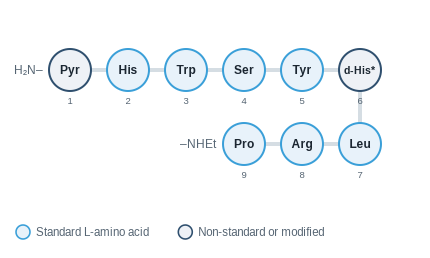
Also called Supprelin LA, histrelin acetate implant, Vantas (discontinued)
- US status
- Approved
- DEA
- Not a controlled substance
- WADA
- S2.2.1 GnRH agonist analogues (histrelin named); prohibited at all times in males
- Class
- Reproductive & hormonal peptides (approved)
Jump to doses reported ↓ Dose math calculator
What it is
Histrelin is a man-made version of gonadotropin-releasing hormone (GnRH), the brain hormone that tells the pituitary to release LH and FSH. In the US it is an approved prescription drug sold as Supprelin LA: a small flexible hydrogel rod that a doctor places under the skin of the inner upper arm through a small cut. It releases about 65 micrograms of histrelin a day for 12 months, and then has to be removed S1. Its only current US use is to pause central precocious puberty, puberty that starts too early because the brain switches it on early. An adult implant for prostate cancer (Vantas) is discontinued S2.
How it works
The pituitary expects GnRH in short pulses. Histrelin is a more potent copy delivered without a break, so after a short first-week rise in estrogen or testosterone, the pituitary becomes desensitized and LH drops to prepubertal levels within about a month S1. With LH and FSH low, the ovaries and testes quiet down, pubertal changes stop progressing in most children, and fast bone maturation slows, which improves the chance of reaching predicted adult height S1. When the implant comes out, puberty restarts S5.
Legal status
- FDA: Supprelin LA is approved for children with central precocious puberty S1. Vantas (a 50 mg histrelin implant for prostate cancer) is listed by FDA as discontinued S2.
- Who gives it: inserted and removed by a clinician in a minor surgical procedure S1.
- DEA: Not a controlled substance.
- WADA: GnRH agonists, with histrelin named, are prohibited at all times in males under S2.2.1 S6.
- International (short): Not reviewed for this page.
What the research actually shows
Evidence: A for its approved use. Approval rests on two single-arm studies in children, backed by later follow-up studies. There is no placebo group, which is normal in this condition because untreated early puberty has a known course.
| Study / source | Design | People | Dose studied | Result |
|---|---|---|---|---|
| Eugster 2007 / label Study 2 S3S1 | Phase 3, open-label, single-arm, 1 year | 36 children (33 girls, 3 boys); 20 never treated | One 50 mg implant, inner upper arm | Peak stimulated LH fell from 28.2 to 0.8 mIU/mL by month 1 in new patients; LH suppressed in all through month 12; estradiol suppressed in all 33 girls |
| Label Study 1 S1 | Open-label, single-arm | 11 previously treated girls | One 50 mg implant | Suppression maintained |
| Lewis 2013 S4 | Follow-up study | 33 children with CPP | One implant left in for 2 years | Suppression at 24 months equal to 12 months |
| Fisher 2014 S5 | Chart review | 43 children after implant removal | — | 26 of 30 girls treated for CPP reached first period about 12.75 months after removal on average; all 6 boys had testicular growth within a year |
What we don't know for this page: the label studies were small (47 children in total) and uncontrolled. Leaving an implant in longer than 12 months is outside the label; the 2-year data come from one center S1S4.
Reported benefits
Stops the progression of early puberty and the hormone-driven speed-up of bone age in most children, from a single procedure a year, with puberty resuming after removal S1S3S5.
Side effects
Common: implant-site reactions in 51.1% of children in the label studies (discomfort, bruising, soreness, pain, tingling, itching, swelling, the implant poking out); keloid or other scarring and stitch problems in about 6% each S1. A temporary rise in estrogen or testosterone in the first week can briefly worsen pubertal signs S1. Serious: implant breakage during removal; psychiatric events such as crying, irritability, anger and aggression; convulsions; severe skin reactions; pseudotumor cerebri (raised pressure inside the skull, with headache and vision changes) S1. In the trials, one child had a benign pituitary adenoma and one child stopped treatment because of an implant-site infection S1.
Dangers and red flags
- It is minor surgery. Insertion and removal need sterile technique; some implants have been hard to find or have broken, and imaging (ultrasound, CT or MRI) has been needed to locate them S1.
- Expulsion. The implant can rarely work its way out of the incision, sometimes unnoticed S1.
- Pregnancy. Contraindicated, because the hormone changes raise the risk of pregnancy loss S1.
- Lab tests. It changes the results of pituitary and gonadal hormone tests during and after treatment S1.
- Sport. Prohibited in males at all times S6.
- Who should avoid it: anyone allergic to GnRH or GnRH analogs S1.
Doses reported
We don't recommend sh*t. These are the doses studies, labels and harm-reduction sources report. That's information, not advice. Talk to a licensed clinician.
Histrelin is a pre-loaded implant inserted by a clinician; there is nothing to mix or measure, so the inline calculator does not apply.
| Source | Population | Dose | Route | Frequency and timing | Duration | Titration or escalation | Cite |
|---|---|---|---|---|---|---|---|
| Supprelin LA label | Central precocious puberty | One 50 mg implant (about 65 mcg/day released) | Subcutaneous implant, inner upper arm | One implant every 12 months; old implant removed | Until the age chosen to restart puberty | None | S1 |
| Eugster 2007 | Central precocious puberty | One 50 mg implant | Subcutaneous implant | Single implant | 1 year | None | S3 |
| Lewis 2013 | Central precocious puberty | One 50 mg implant | Subcutaneous implant | Left in place | 2 years (outside the label) | None | S4 |
There is no known non-medical use with published dosing, so we report no community doses.
Open the dose math calculator →
Monitoring a doctor would order
Before starting: confirmation of CPP with stimulated LH and FSH, sex steroids and bone age, plus brain imaging and other tests to rule out tumors or adrenal causes. During treatment: LH, FSH and estradiol or testosterone 1 month after insertion and then every 6 months; height and bone age every 6 to 12 months; and checks of the insertion site until it heals S1.
Bottom line
Histrelin (Supprelin LA) is a once-a-year implant that pauses early puberty in children by shutting down the pituitary's puberty signal. Small but consistent studies show strong suppression for a year, and puberty resumes after removal. The main problems are local: soreness, scarring, infection, and implants that break or are hard to find. Like other GnRH agonists, it carries rare warnings for mood changes, seizures and raised pressure inside the skull.
Sources
- [S1] SUPPRELIN LA (histrelin acetate) subcutaneous implant. US prescribing information (DailyMed), Endo. Central precocious puberty; one 50 mg implant every 12 months (about 65 mcg/day); implant breakage, psychiatric, convulsion, skin and pseudotumor cerebri warnings; clinical studies. Set ID d8fb000e-3cc9-4803-b71d-2cc597661977. (label)
- [S2] U.S. FDA, Drugs@FDA. VANTAS (histrelin acetate) 50 mg implant, NDA 021732: marketing status Discontinued. (regulator)
- [S3] Eugster EA, et al. Efficacy and safety of histrelin subdermal implant in children with central precocious puberty: a multicenter trial. J Clin Endocrinol Metab. 2007;92:1697-1704. PMID 17327379. (human-observational)
- [S4] Lewis KA, et al. A single histrelin implant is effective for 2 years for treatment of central precocious puberty. J Pediatr. 2013;163:1214-1216. PMID 23809043. (human-observational)
- [S5] Fisher MM, et al. Resumption of puberty in girls and boys following removal of the histrelin implant. J Pediatr. 2014;164:912-916.e1. PMID 24433825. (human-observational)
- [S6] World Anti-Doping Agency. 2026 Prohibited List, section S2.2.1 (testosterone-stimulating peptides in males, including GnRH agonist analogues such as histrelin). (regulator)