
Growth hormone & GH-axis peptides
Ibutamoren (MK-677)
Also called MK-677, MK-0677, ibutamoren mesylate, L-163191, oral GH secretagogue
- US status
- Not approved
- DEA
- Not a controlled substance
- WADA
- S2.2 Growth hormone secretagogues; prohibited at all times
- Class
- Growth hormone & GH-axis peptides
Jump to doses reported ↓ Dose math calculator
What it is
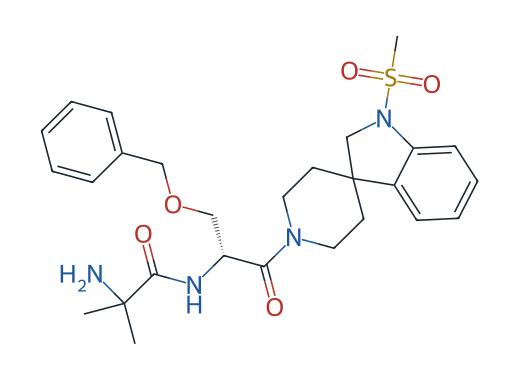
Ibutamoren, better known as MK-677 (Merck code MK-0677), is not a peptide but an orally active small molecule that raises growth hormone and IGF-1. Because it is taken by mouth and works for about a day per dose, it is popular in the grey market. Merck and others studied it for catabolic states, frailty, hip-fracture recovery and Alzheimer disease, and development was discontinued; it was never approved for any use.
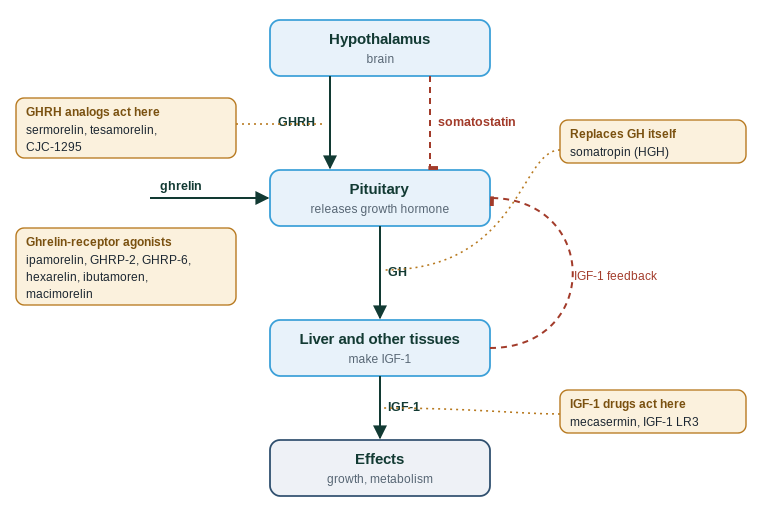
The growth-hormone axis, and where each drug class acts
How it works
Ibutamoren is a small molecule, not a peptide, that activates the growth hormone secretagogue receptor (GHS-R1a) — the ghrelin receptor. It amplifies the pituitary's own GH pulses and blunts somatostatin's braking effect, so GH and then liver IGF-1 rise, and because it is orally active with a roughly 24-hour effect, one dose a day restores GH and IGF-1 levels in older adults to those of young adults S1S2. The downstream effect on body composition is real: trials showed increased fat-free mass and reversal of diet-induced protein loss S1S5.
The limits are mechanistic too. Amplifying a physiological pulse is not the same as replacing a hormone: the GH it releases must come from the pituitary, and the increase in lean mass came without a gain in strength or physical function S2. And the same GH signalling that drives lean mass opposes insulin — the one-year trial in older adults found higher fasting glucose and reduced insulin sensitivity, exactly what sustained GH elevation predicts S2. Ghrelin-receptor activation also drives appetite and raises cortisol and prolactin, and a hip-fracture trial was stopped early over a heart-failure signal S3.
Legal status
- FDA: Not approved for any use. Development was discontinued after phase 2/3 trials.
- Compounding / HHS list: not in the October 2026 HHS enforcement-discretion peptide list; as a small molecule it also sits outside the "peptide" compounding debate.
- DEA: Not a controlled substance.
- "Research use only" product: sold as an oral powder, capsule or liquid labeled for research, meaning it has not been checked for human use. See our explainer.
- WADA: Prohibited at all times as a GH secretagogue under S2.2 S6.
- International (short): Not reviewed for this page yet.
What the research actually shows
Evidence: B for its hormonal and body-composition effects, which are real and repeatedly demonstrated; the clinical-outcome trials were largely negative, and one was stopped for a safety signal.
| Study | Design | People | Dose studied | Result |
|---|---|---|---|---|
| Murphy 1998 S1 | Crossover RCT, caloric restriction | 8 healthy volunteers | 25 mg oral once daily, 7 days | Reversed diet-induced nitrogen (protein) loss; raised GH and IGF-1 |
| Svensson 1998 S5 | RCT, 8 weeks | Obese men | 25 mg oral once daily | Raised GH, IGF-1, fat-free mass and energy expenditure |
| Nass 2008 S2 | 1-year RCT (2-yr exploratory), older adults | Healthy men and women 60–81 | 25 mg oral once daily | Raised GH/IGF-1 to young-adult levels; increased fat-free mass and body weight; raised fasting glucose and lowered insulin sensitivity; no strength or function gain |
| Adunsky 2011 S3 | Phase 2b RCT, hip-fracture recovery | 123 elderly patients | 25 mg/day | Raised IGF-1 but did not improve most function measures; terminated early for a congestive heart failure safety signal; unfavorable safety profile |
| Sevigny 2008 S4 | RCT, Alzheimer disease | Patients with mild-to-moderate AD | 25 mg/day | Raised IGF-1 but no effect on disease progression |
What we don't know: whether long-term use is safe (the glucose and heart-failure signals are the main concern), and whether a grey-market product contains MK-677 at the stated amount and purity.
Reported benefits
Consistently across trials: higher GH and IGF-1, increased fat-free mass and body weight, improved nitrogen balance during caloric restriction, and increased energy expenditure S1S2S5. Important caveat: the fat-free-mass gain in older adults did not translate into measurable strength or physical function S2.
Side effects
Common: increased appetite (often marked), fluid retention and mild lower-limb edema, muscle pain, and fatigue; these were frequent in the trials S2. Serious: raised fasting glucose and reduced insulin sensitivity, a consistent and clinically meaningful effect S2; a congestive-heart-failure safety signal led to early termination of the hip-fracture trial S3. Raised IGF-1 carries theoretical tissue-growth concerns.
Dangers and red flags
- Glucose and diabetes risk. MK-677 reliably worsens fasting glucose and insulin sensitivity S2.
- Heart-failure signal. The hip-fracture trial was stopped early for congestive heart failure and judged to have an unfavorable safety profile in that group S3.
- Benefit did not match the hype. Lean-mass gains did not improve strength or function, and outcome trials in frailty and Alzheimer disease were negative S2S4.
- Product quality. Sold as unregulated "research" material of unverified content.
- Sport: prohibited at all times S6.
- Who should especially avoid it: anyone with diabetes, prediabetes, heart failure or fluid-retention risk.
Doses reported
We don't recommend sh*t. These are the doses studies, labels and harm-reduction sources report. That's information, not advice. Talk to a licensed clinician.
There is no FDA label (never approved). Notably, across its clinical program MK-677 was studied at one oral dose, 25 mg once daily, so there is a consistent, well-documented study dose but no titration schedule and no approved range. All rows are oral.
| Source | Dose | Unit / route | Frequency | Duration | Context |
|---|---|---|---|---|---|
| S1 Murphy 1998 | 25 mg | mg, oral | Once daily | 7 days (within a 14-day diet period) | Healthy volunteers, caloric restriction |
| S5 Svensson 1998 | 25 mg | mg, oral | Once daily | 8 weeks | Obese men |
| S2 Nass 2008 | 25 mg | mg, oral | Once daily | 12 months (2-yr exploratory) | Healthy older adults |
| S3 Adunsky 2011 | 25 mg | mg, oral | Once daily | Up to 24 weeks (stopped early) | Elderly hip-fracture recovery |
| S4 Sevigny 2008 | 25 mg | mg, oral | Once daily | Trial duration | Alzheimer disease |
No validated survey or harm-reduction source with citable numbers beyond this 25 mg oral dose was found that we could cite. Because MK-677 is taken orally, the reconstitution calculator does not apply.
Monitoring a doctor would order
There is no guideline for this unapproved drug. Given the trial findings, the relevant checks would be fasting glucose and HbA1c (for the insulin-resistance effect), signs of fluid retention, and cardiac status, plus IGF-1 S2S3. No formal monitoring standard exists.
Bottom line
MK-677 (ibutamoren) is a never-approved oral ghrelin mimetic with the strongest evidence base of the GH-axis grey-market compounds: it reliably raises GH, IGF-1 and lean mass. But its clinical-outcome trials were negative, it consistently worsens blood glucose and insulin sensitivity, and one trial was stopped early for a heart-failure signal. It is sold as unregulated "research" material and is banned in sport at all times.
Sources
- [S1] Murphy MG, et al. MK-677, an orally active growth hormone secretagogue, reverses diet-induced catabolism. J Clin Endocrinol Metab. 1998;83:320-325. PMID 9467534. (rct)
- [S2] Nass R, et al. Effects of an oral ghrelin mimetic on body composition and clinical outcomes in healthy older adults: a randomized trial. Ann Intern Med. 2008;149:601-611. PMID 18981485. (rct)
- [S3] Adunsky A, et al. MK-0677 (ibutamoren mesylate) for the treatment of patients recovering from hip fracture: a multicenter, randomized, placebo-controlled phase IIb study. Arch Gerontol Geriatr. 2011;53:183-189. PMID 21067829. (rct)
- [S4] Sevigny JJ, et al. Growth hormone secretagogue MK-677: no clinical effect on AD progression in a randomized trial. Neurology. 2008;71:1702-1708. PMID 19015485. (rct)
- [S5] Svensson J, et al. Two-month treatment of obese subjects with the oral growth hormone (GH) secretagogue MK-677 increases GH secretion, fat-free mass, and energy expenditure. J Clin Endocrinol Metab. 1998;83:362-369. PMID 9467542. (rct)
- [S6] World Anti-Doping Agency. 2026 Prohibited List, section S2.2 (growth hormone secretagogues). (regulator)