
Other approved peptide drugs
Icatibant
Also called Firazyr, HOE 140, bradykinin B2 receptor antagonist
- US status
- Approved
- DEA
- Not a controlled substance
- WADA
- Not listed as prohibited
- Class
- Other approved peptide drugs
Jump to doses reported ↓ Dose math calculator
What it is
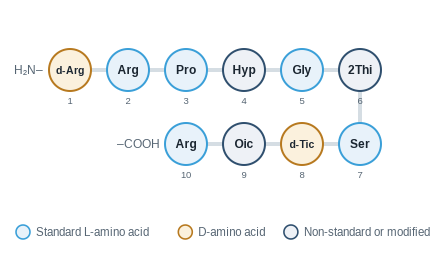
Icatibant is a 10-amino-acid peptide and an approved prescription drug (Firazyr) for acute attacks of hereditary angioedema (HAE) in adults. It is given as a single subcutaneous injection from a prefilled syringe that patients can use themselves when an attack starts S1.
How it works
Attacks of hereditary angioedema are driven by bradykinin. Lacking working C1-inhibitor, the contact pathway runs unchecked, kallikrein cleaves high-molecular-weight kininogen, and the bradykinin released binds the B2 receptor on the inner lining of blood vessels. B2 activation loosens the junctions between those cells, so plasma leaks into surrounding tissue — the swelling of an attack.
Icatibant is a ten-amino-acid peptide that competitively blocks the B2 receptor, so bradykinin already circulating cannot deliver its signal and the leak stops S1S2. Two features follow from that design. It is built with non-natural amino acids that resist the enzymes which destroy natural bradykinin, giving it a usable duration, and it is a receptor blocker rather than a replacement — it treats an attack in progress but does nothing to correct the underlying C1-inhibitor deficiency, so it is not a preventive S1. Because it works downstream of the whole pathway, it is effective in attacks regardless of which upstream step failed. The injection-site reaction almost everyone gets is a local effect of the peptide itself S1.
Legal status
- FDA: Approved for acute HAE attacks in adults S1.
- Compounding: an approved drug substance dispensed as a prescription prefilled syringe.
- DEA: Not a controlled substance.
- "Research use only" labels: not relevant; this is a prescription drug.
- WADA (sport): Not listed as prohibited.
- International (short): approved in multiple regions for HAE.
What the research actually shows
Evidence: A. Icatibant is approved, with randomized trials in acute HAE.
| Study | Design | People | Dose studied | Result |
|---|---|---|---|---|
| FAST S2 | Randomized, controlled | Adults with acute HAE attacks | 30 mg SC | Faster relief of attack symptoms than comparator/placebo |
| Label S1 | Approved indication | Acute HAE attacks | 30 mg SC | Basis of approval |
What we don't know for this page: nothing unusual for a well-characterized approved drug.
Reported benefits
Speeds resolution of acute HAE attacks, including laryngeal (airway) attacks, and can be self-administered S1S2.
Side effects
Common: injection-site reactions (redness, swelling, pain), which are very common, plus fever and dizziness S1. Serious: laryngeal attacks can still be life-threatening; the label advises people treating an airway attack to also get emergency care S1.
Dangers and red flags
- Airway attacks are emergencies; use the drug and still seek emergency care S1.
- Injection-site reactions are common but usually mild S1.
Doses reported
We don't recommend sh*t. These are the doses studies, labels and harm-reduction sources report. That's information, not advice. Talk to a licensed clinician.
Icatibant is a ready-to-use prefilled syringe at a fixed 30 mg dose, so there is no reconstitution and the inline calculator does not apply.
| Source | Dose | Unit / route | Frequency | Timing | Duration | Titration / escalation | Context |
|---|---|---|---|---|---|---|---|
| S1 Label | 30 mg | mg, SC (prefilled syringe) | At attack onset; may repeat at 6-hour intervals (max 3 in 24 h) | Abdomen | Per attack | Fixed dose | Acute HAE attack |
| S2 FAST | 30 mg | mg, SC | Per attack | — | Study duration | Fixed dose | Acute HAE trial |
Monitoring a doctor would order
Attack response and injection sites; for airway involvement, emergency evaluation regardless of the injection S1.
Bottom line
Icatibant is an approved, self-administered injection for acute hereditary angioedema attacks, a bradykinin B2 blocker with randomized trials behind it. It works quickly at a fixed dose; its main side effect is injection-site reactions, and airway attacks still require emergency care. It is a prescription medicine.