
Growth hormone & GH-axis peptides
IGF-1 LR3 (Long R3 IGF-I)
Also called Long R3 IGF-1, Long R3 IGF-I, LR3-IGF-1, IGF-1 Long R3
- US status
- Not approved
- DEA
- Not a controlled substance
- WADA
- S2.1 (IGF-1 and its analogues / releasing factors); prohibited at all times
- Class
- Growth hormone & GH-axis peptides
Jump to doses reported ↓ Dose math calculator
What it is
IGF-1 LR3 (Long R3 IGF-I) is a modified version of insulin-like growth factor 1, engineered in the lab so that it stays active longer in cell culture. It is a research reagent sold for use in laboratory cell growth, not a drug that was ever developed or tested as a medicine in humans. It is marketed in the grey market for muscle growth on the strength of IGF-1's known biology, not on any human study of this molecule.
The growth-hormone axis, and where each drug class acts
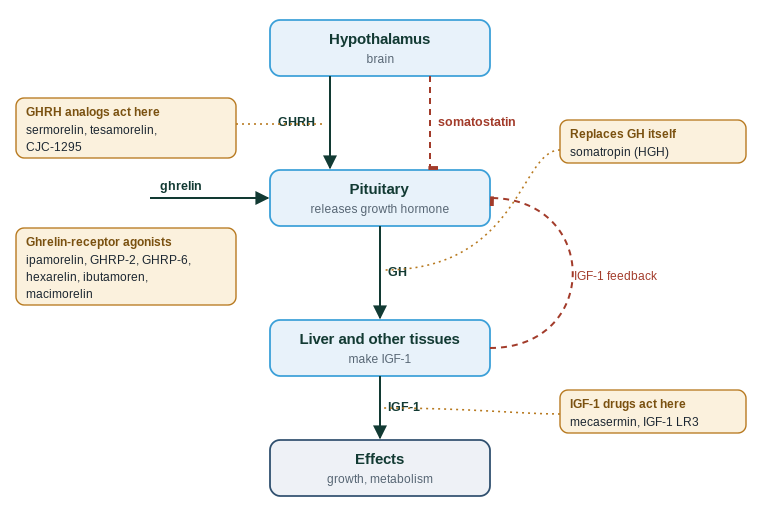
How it works
IGF-1 LR3 acts, in principle, through the IGF-1 receptor — the same tyrosine-kinase receptor the natural hormone uses, which drives PI3K/Akt and MAPK signalling, raising protein synthesis and reducing protein breakdown in muscle. Two engineered changes are meant to keep it active longer: arginine replaces glutamic acid at position 3, which greatly weakens binding to the IGF-binding proteins that normally hold IGF-1 inactive, and a 13-amino-acid extension is added at the front end. The result is a molecule that stays free and bioactive in cell culture, which is what it was built for — it is a laboratory reagent for growing cells, not a medicine S1.
Nothing about its behaviour in a person has been established. There is no human study of LR3 at all; the only directly relevant published work is forensic analysis of a seized vial, which found a His-tagged version of the molecule — a form made for laboratory purification, whose effects in humans the authors state "have not been elucidated" S1. The mechanism also implies the hazards: IGF-1 receptor signalling overlaps with the insulin receptor, so low blood sugar is a predictable effect, and it is a growth pathway active in every tissue carrying the receptor S2S3.
Legal status
- FDA: Not approved and never developed as a human drug. Long R3 IGF-I is a cell-culture reagent S1.
- Compounding / HHS list: not in the October 2026 HHS enforcement-discretion peptide list.
- DEA: Not a controlled substance.
- "Research use only": here the label is literally true, it is a lab reagent, which means it has never been assessed for human injection at all. See our explainer.
- WADA: IGF-1 and its analogues are prohibited at all times under S2.1 S5.
- International (short): Not reviewed for this page yet.
What the research actually shows
Evidence: E. There are no human clinical studies of IGF-1 LR3. The only directly relevant published work is forensic chemistry on seized black-market vials; the rest is general IGF-1 biology and reviews that place LR3 in the grey-market landscape.
| Study | Design | Subject | What it studied | Result |
|---|---|---|---|---|
| Kohler 2010 S1 | Analytical chemistry | A seized injection vial | What the "Long R3 IGF-I" product actually contained | Identified His-tagged Long-R³-IGF-I, a form made for lab studies; authors note its effects in humans "have not been elucidated" and it may be a biochemistry by-product, not made for injection |
| Mendias 2026 S2 | Narrative review | GH-IGF axis peptides | Regulatory status and evidence | Groups LR3 with unapproved peptides lacking rigorous human safety data |
| Dominikowski S3 | Review | GH-IGF1 axis PEDs | Landscape of GH/IGF-1 performance peptides | Context on IGF-1 analogues used outside medicine |
What we don't know: essentially everything about safety and effect in people, because it has never been studied as a human drug. The one analysis we have shows black-market vials may contain a His-tagged lab form of unknown human effect S1.
Reported benefits
None are established in humans. The muscle-growth claims rest on IGF-1's general anabolic biology and on animal/cell work with IGF-1, not on any human study of LR3 S2S3.
Side effects
There is no human safety data for IGF-1 LR3. By the known pharmacology of IGF-1, the main predictable risks are hypoglycemia (IGF-1 has insulin-like, blood-sugar-lowering activity) and, with sustained high IGF-1, theoretical promotion of tissue and tumor growth. The His-tag and lab-reagent origin add unknown immunogenicity risk S1.
Dangers and red flags
- Never a human drug. This is a cell-culture reagent; injecting it is entirely uncharacterized S1.
- Hypoglycemia. IGF-1's insulin-like action can drop blood sugar dangerously.
- Unknown contents. Seized product contained a His-tagged lab form; identity, dose and sterility are unverifiable S1.
- IGF-1 and cancer. Chronically raised IGF-1 is a theoretical tumor-growth concern.
- Sport: prohibited at all times S5.
- Who should avoid it: everyone, given the complete absence of human data.
Doses reported
We don't recommend sh*t. These are the doses studies, labels and harm-reduction sources report. That's information, not advice. Talk to a licensed clinician.
No human dosing data exists for IGF-1 LR3. It was never developed or tested as a human drug, so there is no label dose, no trial arm, and no validated harm-reduction figure we can cite. The approved IGF-1 drug mecasermin (Increlex) is a different molecule for a different, rare condition, so its label dosing does not transfer and is not reproduced here S4. We will not fill this gap with forum or vendor numbers.
Open the dose math calculator →
Monitoring a doctor would order
There is no guideline, because there is no accepted human use. The predictable concern from IGF-1 pharmacology would be blood glucose (risk of hypoglycemia); no monitoring standard exists for this reagent S2.
Bottom line
IGF-1 LR3 is a laboratory cell-culture reagent, not a medicine, and has never been studied as a human drug. The only directly relevant publication is forensic analysis showing black-market vials may contain a His-tagged lab form of unknown human effect. It is not the approved IGF-1 drug (mecasermin), carries a real hypoglycemia risk plus the theoretical cancer concerns of raised IGF-1, and is banned in sport at all times.
Sources
- [S1] Kohler M, et al. Detection of His-tagged Long-R³-IGF-I in a black market product. Growth Horm IGF Res. 2010;20:386-390. PMID 20675162. (in-vitro)
- [S2] Mendias CL, Awan TM. Safety and Efficacy of Approved and Unapproved Peptide Therapies for Musculoskeletal Injuries and Athletic Performance. Sports Med. 2026;56:1921-1935. PMID 41966639. (review)
- [S3] Dominikowski A, et al. The emerging landscape of performance-enhancing peptides modulating the GH-IGF1 axis. (GH-IGF1 axis review). PMID 42395176. (review)
- [S4] U.S. FDA. Increlex (mecasermin) prescribing information, DailyMed (for contrast only: the approved recombinant IGF-1 drug, a different molecule and indication). (label)
- [S5] World Anti-Doping Agency. 2026 Prohibited List, section S2.1 (IGF-1 and analogues). (regulator)