
Growth hormone & GH-axis peptides
Ipamorelin
Also called ipamorelin acetate, NNC 26-0161, ghrelin mimetic, GH secretagogue
- US status
- Not approved
- DEA
- Not a controlled substance
- WADA
- S2.2 Growth hormone secretagogues / GH-releasing peptides; prohibited at all times
- Class
- Growth hormone & GH-axis peptides
Jump to doses reported ↓ Dose math calculator
What it is
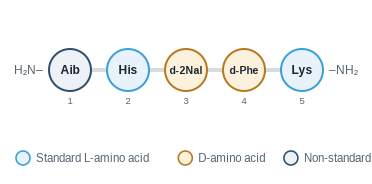
Ipamorelin is a synthetic pentapeptide that mimics ghrelin. It was studied as a drug candidate in the late 1990s and 2000s but was never approved for any use. The one modern clinical trial targeted a gut problem (postoperative ileus), not the muscle, fat-loss or anti-aging uses it is now sold for S4. Today it reaches people only as grey-market "research" powder.
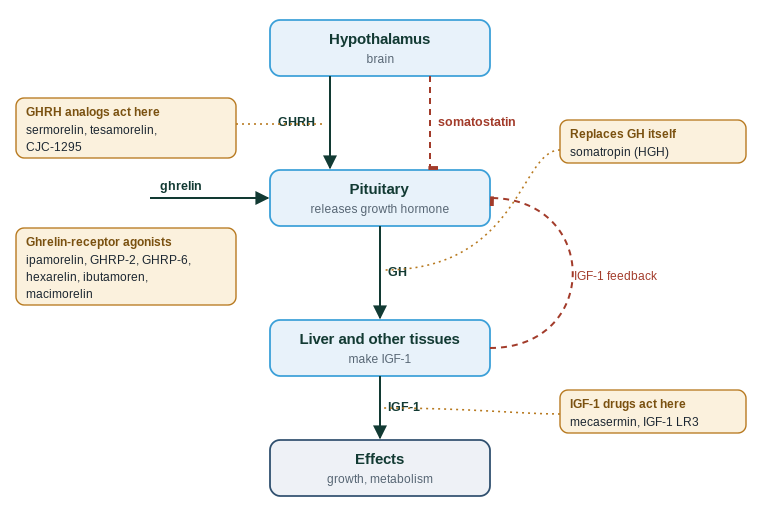
The growth-hormone axis, and where each drug class acts
How it works
Ipamorelin is a ghrelin mimetic: it binds the growth-hormone-secretagogue receptor (the ghrelin receptor) on the pituitary and triggers a short pulse of growth hormone release S2S3. Unlike earlier GH-releasing peptides, it was reported to be selective, raising GH without meaningfully raising ACTH, cortisol or prolactin S2. The higher GH in turn drives IGF-1, the hormone most of GH's growth and metabolic effects run through. Its action is brief, matching the short-lived GH pulse seen in pharmacokinetic work S3.
Legal status
- FDA: Not approved for any use. Ipamorelin acetate sits on the FDA 503B compounding category 2 list (added September 29, 2023), flagged for possible immunogenicity and because it contains unnatural amino acids that complicate characterization S1.
- Compounding: its category 2 placement signals FDA safety concern; it is not in the October 2026 HHS enforcement-discretion peptide list.
- DEA: Not a controlled substance.
- "Research use only" powder: this is the usual way it is sold; that label means no one has checked it for human use. See our explainer.
- WADA: Prohibited at all times as a GH secretagogue under S2.2 S6.
- International (short): Not reviewed for this page yet.
What the research actually shows
Evidence: C. Ipamorelin is one of the better-characterized grey-market peptides: there is a published human pharmacology study and a real randomized clinical trial. But neither tested the body-composition or anti-aging uses it is sold for, and the clinical trial was negative for its endpoint.
| Study | Design | Subjects | Dose studied | Result |
|---|---|---|---|---|
| Raun 1998 S2 | Animal / in-vitro | Rats, swine, cells | Various | Characterized ipamorelin as a selective GH releaser that, unlike older GHRPs, did not raise ACTH or cortisol |
| Gobburu 1999 S3 | Human PK/PD, dose-escalation | Healthy men (8 per dose level) | 4.21–140.45 nmol/kg IV over 15 min | Dose-proportional PK, ~2 h half-life; single GH pulse at every dose |
| Beck 2014 S4 | Phase 2 RCT (NCT00672074) | 114 bowel-resection patients | 0.03 mg/kg IV twice daily, up to 7 days | Well tolerated, but no significant benefit over placebo for time to first tolerated meal (25.3 vs 32.6 h, p=0.15) |
What we don't know: whether ipamorelin produces meaningful muscle, fat-loss or anti-aging effects in healthy adults (no trial has tested this), its long-term safety, and whether a grey-market vial contains real, sterile peptide at the stated amount.
Reported benefits
In studies: a clean, selective pulse of growth hormone without the cortisol/ACTH rise seen with older GH-releasing peptides S2S3. That is a pharmacology finding, not a demonstrated health benefit. The muscle, recovery and anti-aging claims made for ipamorelin have not been tested in trials S5.
Side effects
Common: in the one clinical trial, adverse events were frequent in both arms (87.5% ipamorelin vs 94.8% placebo), reflecting the surgical setting rather than the drug; ghrelin mimetics commonly cause increased appetite S4. Serious: no distinctive serious signal emerged in the small trial, but there is no long-term safety database. FDA's category 2 listing flags possible immunogenicity S1. Raising GH and IGF-1 carries the same theoretical concerns as growth hormone (glucose effects, tissue growth).
Dangers and red flags
- No approval, thin human data. One negative trial and one PK study do not establish benefit or long-term safety S3S4.
- FDA safety flag. Category 2 placement for immunogenicity and characterization problems S1.
- Product quality. Sold as "research" powder of unverified identity, dose and sterility.
- Marketed for untested uses. The body-composition and anti-aging claims have no trial support S5.
- Sport: prohibited at all times S6.
Doses reported
We don't recommend sh*t. These are the doses studies, labels and harm-reduction sources report. That's information, not advice. Talk to a licensed clinician.
There is no FDA label (never approved), so there is no label dose. The rows below are study doses. Note both human studies used the intravenous route; there is no published human subcutaneous dosing study, which is how grey-market ipamorelin is typically self-injected.
| Source | Dose | Unit / route | Frequency | Duration | Context |
|---|---|---|---|---|---|
| S3 Gobburu 1999 | 4.21, 14.02, 42.13, 84.27, 140.45 | nmol/kg, IV infusion over 15 min | Single dose per level | One PK session | Healthy men, pharmacology |
| S4 Beck 2014 | 0.03 mg/kg | mg per kg, IV infusion | Twice daily | Up to 7 days (postop day 1–7 / discharge) | Bowel-resection patients, phase 2 |
No validated survey or harm-reduction source with citable numbers specific to non-pharmacy subcutaneous ipamorelin use was found that we could cite; we will not fill that gap with forum or vendor numbers.
Open the dose math calculator →
Monitoring a doctor would order
There is no guideline for this unapproved drug. By analogy to other GH-axis drugs a clinician might check IGF-1 and glucose; the trials did not establish a monitoring standard S4.
Bottom line
Ipamorelin is a never-approved, selective GH-releasing peptide with real but limited human data: a pharmacology study and one randomized trial that was negative for its gut-motility endpoint. Nothing has tested the muscle, fat-loss or anti-aging uses it is sold for. FDA lists it as a category 2 compounding safety risk, it is sold as grey-market "research" powder of unknown quality, and it is banned in sport at all times.
Sources
- [S1] FDA. Certain Bulk Drug Substances for Use in Compounding that May Present Significant Safety Risks (Ipamorelin acetate, 503B category 2, added September 29, 2023: risk of immunogenicity, contains unnatural amino acids). Content current as of 04/22/2026. (regulator)
- [S2] Raun K, et al. Ipamorelin, the first selective growth hormone secretagogue. Eur J Endocrinol. 1998;139:552-561. PMID 9849822. (animal)
- [S3] Gobburu JV, et al. Pharmacokinetic-pharmacodynamic modeling of ipamorelin, a growth hormone releasing peptide, in human volunteers. Pharm Res. 1999;16:1412-1416. PMID 10496658. (human-pk)
- [S4] Beck DE, et al. Prospective, randomized, controlled, proof-of-concept study of the ghrelin mimetic ipamorelin for the management of postoperative ileus in bowel resection patients. Int J Colorectal Dis. 2014;29:1527-1534. PMID 25331030. ClinicalTrials.gov NCT00672074. (rct)
- [S5] Mendias CL, Awan TM. Safety and Efficacy of Approved and Unapproved Peptide Therapies for Musculoskeletal Injuries and Athletic Performance. Sports Med. 2026;56:1921-1935. PMID 41966639. (review)
- [S6] World Anti-Doping Agency. 2026 Prohibited List, section S2.2 (growth hormone secretagogues). (regulator)