
Healing / recovery research peptides
KPV
Also called Lys-Pro-Val, alpha-MSH(11-13), KPV acetate
- US status
- Not approved
- DEA
- Not a controlled substance
- WADA
- Not named; falls under the S0 catch-all if no health authority has approved it
- Class
- Healing / recovery research peptides
Jump to doses reported ↓ Dose math calculator
What it is
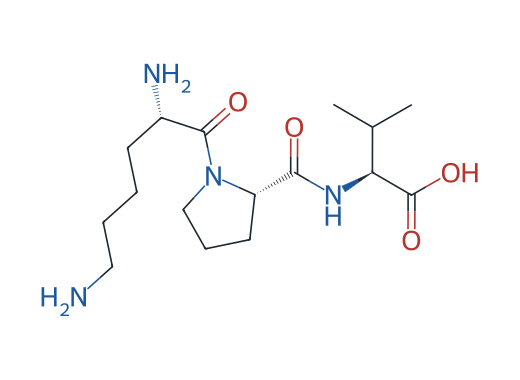
KPV is a three-amino-acid peptide (lysine, proline, valine). It is the tail end of alpha-melanocyte-stimulating hormone (alpha-MSH), a hormone the body makes that also calms inflammation. It has drawn interest for inflammatory bowel disease and skin S6S7S9. It is sold as a grey-market "research" peptide, usually as a powder for injection or as capsules. No KPV product has been approved anywhere we checked.
How it works
KPV is the C-terminal tripeptide of alpha-MSH and carries that hormone's anti-inflammatory activity in a minimal fragment S8. In cell and animal models it is taken up directly by gut epithelial and immune cells through the peptide transporter PepT1, then dampens pro-inflammatory signaling inside the cell S6S9. The net effect in mouse colitis models is less intestinal inflammation S6S7. Whether it does the same in humans has not been tested.
Legal status
- FDA: Not approved for any use.
- Compounding: FDA had placed KPV in Category 2 and wrote that it "has not identified any human exposure data on drug products containing KPV administered via any route of administration" S1. The nomination was later withdrawn, and FDA lists it under withdrawn nominations S1. FDA's Pharmacy Compounding Advisory Committee reviewed KPV on Jul 23 2026 for wound healing and inflammatory conditions S4; HHS says the committee voted in favor of listing it, while FDA's drug center had recommended against S3. On Oct 30 2026 HHS published a draft policy saying it does not intend to take enforcement action against state-licensed pharmacies or physicians compounding KPV acetate in topical and oral forms, under conditions that include a lot-level certificate of analysis, a single active ingredient, and adverse-event reporting S2S3. Injectable KPV is not covered. A draft enforcement stance is not approval, and HHS says it may revisit the policy if a safety or quality signal appears S2.
- DEA: Not a controlled substance.
- "Research use only" vials: that label means no one has checked the product for human use. See our explainer.
- WADA: Not named on the 2026 List. Section S0 covers any pharmacological substance with no current approval by any government health authority for human therapeutic use, prohibited at all times S5. We found no approval for KPV anywhere.
What the research actually shows
Evidence: D. We found no published human study of KPV. The studies below are mouse and cell work.
| Study | Design | Subjects | Dose studied | Result |
|---|---|---|---|---|
| Dalmasso et al 2008 S6 | Cell culture plus two mouse colitis models | Human intestinal and immune cell lines; mice | KPV in drinking water (mice); nanomolar concentrations (cells) | Reduced inflammatory signaling (NF-kappaB, MAP kinase) and colitis severity; uptake through the PepT1 transporter |
| Kannengiesser et al 2008 S7 | Two mouse colitis models | Mice | Not stated in the abstract | Faster recovery, less weight loss, fewer inflammatory cells in the colon |
| Getting et al 2003 S8 | Mouse peritonitis model | Mice | Systemic dosing (amount not stated in the abstract) | Fewer inflammatory white cells in the abdominal cavity; acted differently from the parent hormone |
| Xiao et al 2017 S9 | Mouse colitis, oral nanoparticle formulation | Mice | KPV packed in targeted nanoparticles | Less mucosal damage than a non-targeted formulation |
What we don't know: whether KPV does anything in people, what it does when injected rather than swallowed or applied, how much a person would need, what it does over months, and whether grey-market products contain what the label says.
Reported benefits
- In animal and cell studies: reduced gut inflammation and faster recovery in mouse colitis models S6S7S9.
- In people: none established. We found no human trial.
- User-reported: we found no peer-reviewed survey of KPV users, so we report none.
Side effects
Common: unknown. There are no human data S1. Serious: unknown. FDA said it lacks important safety information, "including whether it would cause harm if administered to humans" S1.
Dangers and red flags
- No human safety record. FDA found no human exposure data for any route S1.
- Product quality. HHS's draft policy exists partly because it wants to move people away from "research-use-only peptides supplied by foreign manufacturers that pose a safety risk" S3. Grey-market vials are not tested for identity, dose or sterility.
- Route mismatch. The only route HHS is willing to tolerate in compounding is topical or oral S3. Injecting it has no supporting data.
- Who should avoid it: with no human data, there is no evidence base for use in pregnancy, breastfeeding, children, or anyone with a serious illness.
- Sport: likely prohibited under S0 S5.
Doses reported
We don't recommend sh*t. These are the doses studies, labels and harm-reduction sources report. That's information, not advice. Talk to a licensed clinician.
No human dosing data found. There is no approved product and no FDA label, we found no human trial, and we found no peer-reviewed survey or harm-reduction source reporting KPV doses we could check. The mouse studies above dosed KPV in drinking water or as nanoparticles, and their abstracts do not give amounts that translate to people. Forum and vendor dosing write-ups are not cited here, and we do not fill the gap.
Open the dose math calculator →
Monitoring a doctor would order
No guideline exists. We found no source naming KPV-specific monitoring.
Bottom line
KPV is a small fragment of a natural anti-inflammatory hormone that calms gut inflammation in mice. Nobody has published a human study of it. HHS's October 2026 draft policy would let pharmacies compound it as a cream or an oral product while rulemaking continues, but that is an enforcement stance, not evidence that it works, and it does not cover injections.
Sources
- [S1] FDA. Certain Bulk Drug Substances for Use in Compounding that May Present Significant Safety Risks (KPV entry, 'Bulk drug substances nominated but withdrawn'). Content current as of 04/22/2026. (regulator)
- [S2] HHS. Enforcement Discretion Policy Regarding 503A Compounding Using Certain Peptide Bulk Drug Substances (notice of availability, draft policy). Federal Register FR Doc 2026-22192, Oct 30 2026. (regulator)
- [S3] HHS. Enforcement Discretion Policy Regarding 503A Compounding Using Certain Peptide Bulk Drug Substances, with Appendix A (list) and Appendix B (identities, routes and justifications). Policy PDF linked from FR Doc 2026-22192. (regulator)
- [S4] FDA. July 23-24, 2026: Meeting of the Pharmacy Compounding Advisory Committee (agenda: KPV reviewed for wound healing and inflammatory conditions). (regulator)
- [S5] World Anti-Doping Agency. 2026 Prohibited List, section S0 (Non-approved substances). (regulator)
- [S6] Dalmasso G, et al. PepT1-mediated tripeptide KPV uptake reduces intestinal inflammation. Gastroenterology. 2008;134(1):166-78. PMID 18061177. (animal)
- [S7] Kannengiesser K, et al. Melanocortin-derived tripeptide KPV has anti-inflammatory potential in murine models of inflammatory bowel disease. Inflamm Bowel Dis. 2008;14(3):324-31. PMID 18092346. (animal)
- [S8] Getting SJ, et al. Dissection of the anti-inflammatory effect of the core and C-terminal (KPV) alpha-melanocyte-stimulating hormone peptides. J Pharmacol Exp Ther. 2003;306(2):631-7. PMID 12750433. (animal)
- [S9] Xiao B, et al. Orally Targeted Delivery of Tripeptide KPV via Hyaluronic Acid-Functionalized Nanoparticles Efficiently Alleviates Ulcerative Colitis. Mol Ther. 2017;25(7):1628-1640. PMID 28143741. (animal)