
Healing / recovery research peptides
Larazotide acetate
Also called larazotide, AT-1001, AT1001
- US status
- Investigational
- DEA
- Not a controlled substance
- WADA
- Not named; falls under the S0 catch-all if no health authority has approved it
- Class
- Healing / recovery research peptides
Jump to doses reported ↓ Dose math calculator
What it is
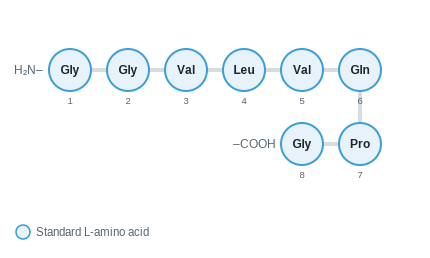
Larazotide acetate is a lab-made chain of eight amino acids taken by mouth as a capsule. It was developed to tighten the seal between cells lining the small intestine in people with celiac disease, an autoimmune condition triggered by gluten S1S2. Several randomized trials have tested it; one dose helped symptoms in one trial, the first phase 3 trial was terminated, and it has not been approved S2S6. It is sometimes discussed online as a "leaky gut" peptide.
How it works
- Tight junctions are the seals between gut cells. In celiac disease, gluten fragments slip through loosened seals into the gut wall, where they set off an immune attack S3.
- Zonulin opens the seals; larazotide is thought to block it. Larazotide is described as a zonulin antagonist that reduces zonulin-driven leakiness. It is linked to rearranging seal proteins and the cell's actin scaffolding, and more recently to blocking an enzyme (myosin light chain kinase) that pulls the seals open S1.
- It works inside the gut. The capsules in trials held enteric-coated beads, built to release the peptide in the intestine S6. It is not meant to be injected.
Legal status
- FDA: Not approved. It is an investigational drug S6S7.
- Compounding: Larazotide does not appear on FDA's 503A Category 1, 2 or 3 lists, and it is not in HHS's Oct 30 2026 draft enforcement-discretion policy.
- DEA: Not a controlled substance.
- "Research use only" products: anything sold online as larazotide is not the trial capsule. See our explainer.
- WADA: Not named. Section S0 covers pharmacological substances with no government approval for human therapeutic use, banned at all times S9.
What the research actually shows
Evidence: B. Four randomized trials with more than 600 patients. Results are mixed: some symptom benefit at low doses, no effect on the main gut-leakiness test, and higher doses often did no better than placebo S5.
| Study | Design | People | Dose studied | Result |
|---|---|---|---|---|
| Leffler et al 2015 S2 | Randomized, double-blind, placebo-controlled phase 2b | 342 adults with celiac symptoms despite a gluten-free diet | 0.5, 1 or 2 mg by mouth three times a day for 12 weeks | Only 0.5 mg reduced symptoms vs placebo (p = .022), with 26% fewer symptomatic days; 1 and 2 mg no different from placebo; safety similar to placebo |
| Kelly et al 2013 S4 | Randomized, placebo-controlled | 184 adults on a gluten-free diet, given 2.7 g gluten a day | 1, 4 or 8 mg three times a day for 6 weeks | Gut-leakiness test no different; 1 mg limited gluten symptoms (p = 0.002); celiac antibody rise smaller at all doses |
| Leffler et al 2012 S3 | Randomized, double-blind, dose-ranging | 86 adults on a gluten-free diet, some given 2.4 g gluten a day | 0.25, 1, 4 or 8 mg three times a day for 14 days | Gut-leakiness test not significant; symptoms limited at some lower doses but not the highest; headache and urinary tract infection the most common side effects |
| Hoilat et al 2022 S5 | Meta-analysis of 4 trials | 626 patients | — | Better symptoms during gluten challenge, not on a gluten-free diet alone; no difference in gut-leakiness test; side effects similar to placebo |
| NCT03569007 S6 | Randomized phase 3 | 307 adults | 0.25 or 0.5 mg capsules three times a day | Terminated; no results posted |
| Yonker et al 2022 S8 | Open-label case series | 4 children with MIS-C after COVID-19 | 10 µg/kg (max 500 µg) by mouth 4 times a day for 21 days | No side effects; faster resolution of gut symptoms than 22 comparison children (not randomized) |
What we don't know: whether it works in a large confirmatory trial (a new phase 3 trial is registered S7), whether it does anything for "leaky gut" outside celiac disease, and long-term safety.
Reported benefits
- In trials: fewer celiac symptoms at 0.5 mg three times a day in people still having symptoms on a gluten-free diet S2; smaller symptom and antibody responses during gluten challenge S4S5.
- User-reported, not tested: general "gut barrier" or "leaky gut" repair. No trial has tested that.
Side effects
Common: in trials, side effects were similar to placebo S2S4S5. Headache and urinary tract infection were the most common in one trial S3. Serious: none observed in the 2012 trial S3.
Dangers and red flags
- Not a substitute for a gluten-free diet. Every trial gave larazotide on top of a gluten-free diet or a measured gluten challenge.
- Higher doses did not work better. In two trials the lowest doses helped and higher doses did not S2S3.
- Non-trial products. The trial drug was an enteric-coated capsule S6. Powders or vials sold online are not the same product and are untested.
- Who should avoid it: there is no evidence base for use in pregnancy or breastfeeding. Children have only been studied in one small case series S8 and a planned trial S7.
Doses reported
We don't recommend sh*t. These are the doses studies, labels and harm-reduction sources report. That's information, not advice. Talk to a licensed clinician.
There is no FDA label. Every row below comes from a supervised clinical study. All doses are by mouth.
| Source | Population | Dose | Route | Frequency and timing | Duration | Titration or escalation | Cite |
|---|---|---|---|---|---|---|---|
| Leffler et al 2015 | Adults with celiac symptoms on a gluten-free diet | 0.5, 1 or 2 mg (only 0.5 mg beat placebo) | Oral | Three times a day | 12 weeks, after a 4-week placebo run-in | None (parallel dose groups) | S2 |
| Kelly et al 2013 | Adults on a gluten-free diet plus 2.7 g gluten a day | 1, 4 or 8 mg | Oral | Three times a day | 6 weeks | None | S4 |
| Leffler et al 2012 | Adults on a gluten-free diet, with or without 2.4 g gluten a day | 0.25, 1, 4 or 8 mg | Oral | Three times a day | 14 days | None | S3 |
| NCT03569007 (phase 3, terminated) | Adults with celiac symptoms on a gluten-free diet | 0.25 or 0.5 mg enteric-coated capsules | Oral | Three times a day | 12-week primary endpoint | None | S6 |
| NCT07944625 (phase 3, not yet recruiting) | Children and adults with well-controlled celiac disease | 0.25 or 0.5 mg capsules | Oral | Three times a day | 14 weeks | None | S7 |
| Yonker et al 2022 | Children 3–17 with MIS-C | 10 µg/kg, maximum 500 µg per dose | Oral | Four times a day | 21 days | None | S8 |
Because larazotide is taken by mouth, the reconstitution calculator does not apply to this page.
Monitoring a doctor would order
No guideline exists for an unapproved drug. In celiac trials, researchers tracked symptom scores and celiac antibodies (anti-tissue transglutaminase IgA) S4. We found no source naming a monitoring schedule outside a trial.
Bottom line
Larazotide is an oral peptide designed to tighten the seals between gut cells in celiac disease. In trials the lowest doses eased symptoms for some people while higher doses did not, the main gut-leakiness test never changed, and the first phase 3 trial was terminated. A new phase 3 trial is planned. It is not approved, and nothing supports using it for general "leaky gut".
Sources
- [S1] Slifer ZM, Krishnan BR, Madan J, Blikslager AT. Larazotide acetate: a pharmacological peptide approach to tight junction regulation. Am J Physiol Gastrointest Liver Physiol. 2021;320(6):G983-G989. PMID 33881350. (review)
- [S2] Leffler DA, et al. Larazotide acetate for persistent symptoms of celiac disease despite a gluten-free diet: a randomized controlled trial. Gastroenterology. 2015;148(7):1311-9.e6. PMID 25683116. (rct)
- [S3] Leffler DA, et al. A randomized, double-blind study of larazotide acetate to prevent the activation of celiac disease during gluten challenge. Am J Gastroenterol. 2012;107(10):1554-62. PMID 22825365. (rct)
- [S4] Kelly CP, et al. Larazotide acetate in patients with coeliac disease undergoing a gluten challenge: a randomised placebo-controlled study. Aliment Pharmacol Ther. 2013;37(2):252-62. PMID 23163616. (rct)
- [S5] Hoilat GJ, et al. Larazotide acetate for treatment of celiac disease: A systematic review and meta-analysis of randomized controlled trials. Clin Res Hepatol Gastroenterol. 2022;46(1):101782. PMID 34339872. (review)
- [S6] ClinicalTrials.gov NCT03569007. A phase 3, randomized, double-blind, placebo controlled study to evaluate the efficacy and safety of larazotide acetate for the relief of persistent symptoms in patients with celiac disease on a GFD (terminated; n = 307). (rct)
- [S7] ClinicalTrials.gov NCT07944625. A randomized, double-blinded, placebo-controlled study to evaluate the efficacy and safety of larazotide acetate to prevent gluten-induced celiac enteropathy and symptoms in pediatric and adult participants with well-controlled celiac disease (not yet recruiting; estimated n = 414). (rct)
- [S8] Yonker LM, et al. Zonulin Antagonist, Larazotide (AT1001), As an Adjuvant Treatment for Multisystem Inflammatory Syndrome in Children: A Case Series. Crit Care Explor. 2022;10(2):e0641. PMID 35211683. (human-case-series)
- [S9] World Anti-Doping Agency. 2026 Prohibited List, section S0 (Non-approved substances). (regulator)