
GLP-1 & incretin drugs (approved)
Liraglutide
Also called Saxenda, Victoza, generic liraglutide
- US status
- Approved
- DEA
- Not a controlled substance
- WADA
- Not on the 2026 Prohibited List
- Class
- GLP-1 & incretin drugs (approved)
Jump to doses reported ↓ Dose math calculator
What it is
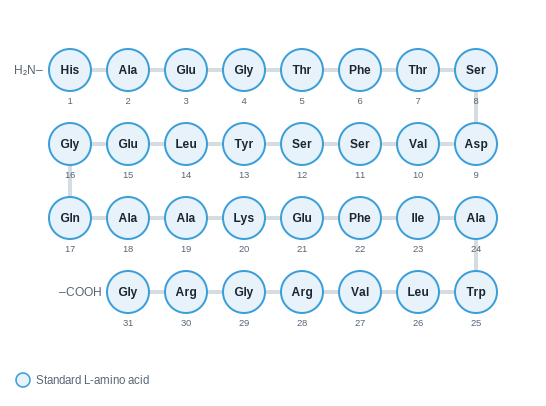
Liraglutide is a once-daily injected GLP-1 receptor agonist. It is sold as Saxenda for weight management and Victoza for type 2 diabetes, both in prefilled multi-dose pens, and as approved generic liraglutide S1S2. It is the older, shorter-acting relative of semaglutide, and in a head-to-head trial it produced less weight loss S6.
How it works
Liraglutide is a modified copy of the gut hormone GLP-1 that binds the GLP-1 receptor. It lowers appetite and slows stomach emptying, which reduces food intake, and it boosts insulin release while lowering glucagon when blood sugar is high, improving glucose control S1S2. A fatty-acid chain lets it bind albumin and resist breakdown, stretching its action to about a day so it can be dosed once daily S2. Its weight and glucose effects are smaller than those of the weekly GLP-1 drug semaglutide in a head-to-head trial S6.
Legal status
- FDA: Approved. Saxenda, with a reduced-calorie diet and more activity, for long-term weight management in adults with obesity (or overweight plus a weight-related condition) and in children 12 and older over 60 kg S1. Victoza for blood-sugar control in type 2 diabetes in adults and children 10 and older, and to lower the risk of major cardiovascular events in adults with T2D and established cardiovascular disease S2. Both labels advise against combining liraglutide with another GLP-1 drug S1S2.
- Compounding: Liraglutide is an approved small peptide drug with approved generics, so there is no drug-shortage basis for compounding it.
- DEA: Not a controlled substance.
- "Research use only" powder: not a legal route to a human-use drug; see our explainer.
- WADA: Not on the 2026 list S7.
- International (short): Not reviewed for this page yet.
What the research actually shows
Evidence: A. Large, randomized human trials in weight management, diabetes and cardiovascular outcomes.
| Study | Design | People | Dose studied | Result |
|---|---|---|---|---|
| SCALE S3 | Double-blind RCT, 56 weeks | 3,731 adults without diabetes, BMI ≥30 (or ≥27 with a condition) | 3.0 mg daily vs placebo | −8.4 kg vs −2.8 kg; 63.2% vs 27.1% lost ≥5%; 33.1% vs 10.6% lost >10% |
| LEADER S4 | Double-blind RCT, median 3.8 years | 9,340 adults with T2D at high CV risk | Up to 1.8 mg daily vs placebo | Major CV events 13.0% vs 14.9% (HR 0.87); CV death 4.7% vs 6.0% |
| Adolescent trial S5 | Double-blind RCT, 56 weeks | 251 adolescents 12–<18 with obesity | 3.0 mg daily vs placebo | Greater fall in BMI standard-deviation score; ≥5% BMI reduction in 43.3% vs 18.7% |
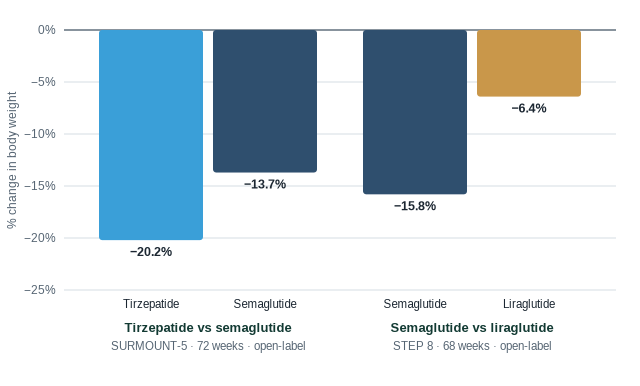
| STEP 8 S6 | Open-label RCT, 68 weeks | 338 adults with overweight/obesity | Liraglutide 3.0 mg daily vs semaglutide 2.4 mg weekly | −6.4% (liraglutide) vs −15.8% (semaglutide) body weight |
What we don't know: long-term outcomes beyond the trial windows, and what happens to weight after stopping in routine care (in the adolescent trial, BMI rose again after the drug was stopped) S5.
Head-to-head trials: mean body-weight change
Reported benefits
In trials: moderate weight loss, better blood-sugar control, and in people with established cardiovascular disease a lower rate of major cardiovascular events and cardiovascular death S3S4. Weight loss is smaller than with once-weekly semaglutide or tirzepatide S6.
Side effects
Common (≥5% in trials): nausea, diarrhea, constipation, vomiting, injection-site reactions, headache, low blood sugar (with insulin or a sulfonylurea), indigestion, fatigue, dizziness, abdominal pain S1S2. Serious (label warnings): thyroid C-cell tumors in rodents (boxed warning; human risk unknown), acute pancreatitis, gallbladder disease, acute kidney injury from dehydration, serious allergic reactions, raised heart rate, and pulmonary aspiration during anesthesia or deep sedation S1S2.
Dangers and red flags
- Not for everyone (label contraindications): personal or family history of medullary thyroid carcinoma, or Multiple Endocrine Neoplasia syndrome type 2; prior serious allergy to liraglutide S1S2.
- Do not combine with semaglutide or any other GLP-1 drug S1S2.
- Grey-market and "research" liraglutide: products sold for "research" or "not for human consumption" are of unknown identity, strength and sterility; FDA has warned sellers of falsely labeled GLP-1 drugs.
- Dosing errors: multi-dose pens deliver fixed, label-defined steps; drawing liraglutide from a non-label vial of unknown strength removes that safeguard.
- Sport: not currently on the WADA list, but lists change yearly S7.
Doses reported
We don't recommend sh*t. These are the doses studies, labels and harm-reduction sources report. That's information, not advice. Talk to a licensed clinician.
All doses below are subcutaneous (abdomen, thigh or upper arm), once daily, at any time of day without regard to meals S1S2.
| Source | Dose | Unit / route | Frequency | Timing | Duration | Titration / escalation | Context |
|---|---|---|---|---|---|---|---|
| S1 Saxenda label | Maintenance 3.0 mg | mg, subcutaneous | Once daily | Any time, with or without food | Long term | Start 0.6 mg/day week 1; then 1.2 (wk 2), 1.8 (wk 3), 2.4 (wk 4), 3.0 mg (wk 5 onward); delay a step ~1 week if not tolerated; stop if 3.0 mg is not tolerated | Adult weight management |
| S1 Saxenda label | Maintenance 3.0 mg (2.4 mg if 3.0 not tolerated) | mg, subcutaneous | Once daily | Any time | Long term | Escalation may take up to 8 weeks; may step back to the previous dose if not tolerated | Pediatric (12+, over 60 kg) |
| S2 Victoza label | 1.2 mg, then up to 1.8 mg max | mg, subcutaneous | Once daily | Any time | Long term | Start 0.6 mg/day for 1 week (not effective for glucose control, titration only); increase to 1.2 mg; if more control is needed, 1.8 mg after ≥1 week | Adult type 2 diabetes |
| S2 Victoza label | Up to 1.8 mg max | mg, subcutaneous | Once daily | Any time | Long term | Start 0.6 mg; increase in 0.6 mg steps after ≥1 week each | Pediatric T2D (10+) |
| S3 SCALE | 3.0 mg | mg, subcutaneous | Once daily | — | 56 weeks | 0.6 mg weekly increments to 3.0 mg | Adults with obesity, no diabetes |
| S4 LEADER | Up to 1.8 mg | mg, subcutaneous | Once daily | — | Median 3.8 years | Per Victoza label | T2D, CV outcomes |
Missed-dose and restart rules are on the labels: if more than 3 days have passed, restart at 0.6 mg daily and re-titrate S1S2. No survey or harm-reduction source with numbers for non-pharmacy liraglutide use was found that we could cite.
Open the dose math calculator →
Monitoring a doctor would order
From the labels: blood glucose if on insulin or a sulfonylurea; kidney function if vomiting or diarrhea cause dehydration; heart rate; evaluation for pancreatitis or gallbladder symptoms; tell the anesthesia team before procedures S1S2.
Bottom line
Liraglutide is a well-studied, FDA-approved GLP-1 drug for weight management and type 2 diabetes, with a cardiovascular-benefit indication in high-risk diabetes. It is a daily injection and produces less weight loss than once-weekly semaglutide or tirzepatide. Side effects are mostly gastrointestinal. The avoidable risks come from grey-market "research" versions and from drawing it out of vials of unknown strength instead of using a label pen.
Sources
- [S1] SAXENDA (liraglutide) injection. US prescribing information (DailyMed, Novo Nordisk, published Jun 15 2026). Set ID 3946d389-0926-4f77-a708-0acb8153b143. (label)
- [S2] VICTOZA (liraglutide) injection. US prescribing information (DailyMed, Novo Nordisk, published Nov 17 2025). Set ID 5a9ef4ea-c76a-4d34-a604-27c5b505f5a4. (label)
- [S3] Pi-Sunyer X, et al. A Randomized, Controlled Trial of 3.0 mg of Liraglutide in Weight Management (SCALE Obesity and Prediabetes). N Engl J Med. 2015;373:11-22. PMID 26132939. (rct)
- [S4] Marso SP, et al. Liraglutide and Cardiovascular Outcomes in Type 2 Diabetes (LEADER). N Engl J Med. 2016;375:311-322. PMID 27295427. (rct)
- [S5] Kelly AS, et al. A Randomized, Controlled Trial of Liraglutide for Adolescents with Obesity. N Engl J Med. 2020;382:2117-2128. PMID 32233338. (rct)
- [S6] Rubino DM, et al. Effect of Weekly Subcutaneous Semaglutide vs Daily Liraglutide on Body Weight (STEP 8). JAMA. 2022;327:138-150. PMID 35015037. (rct)
- [S7] World Anti-Doping Agency. 2026 Prohibited List. (regulator)