
GLP-1 & incretin drugs (approved)
Lixisenatide
Also called Adlyxin, Lyxumia, AVE0010, Soliqua 100/33 (with insulin glargine), iGlarLixi
- US status
- Approved
- DEA
- Not a controlled substance
- WADA
- Not on the 2026 Prohibited List
- Class
- GLP-1 & incretin drugs (approved)
Jump to doses reported ↓ Dose math calculator
What it is
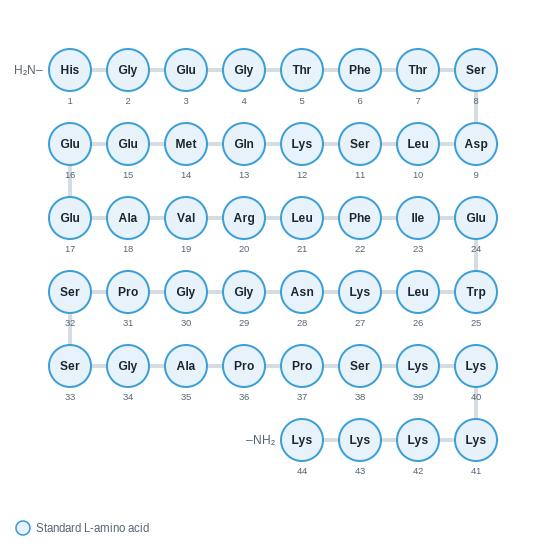
Lixisenatide is a once-daily GLP-1 receptor agonist: a synthetic 44-amino-acid peptide sold alone as Adlyxin and, more often, combined with long-acting insulin glargine in a single pen called Soliqua 100/33 S1S2. Both are for adults with type 2 diabetes S1S2.
How it works
Like the body's own GLP-1, lixisenatide makes the pancreas release insulin when blood sugar is high, lowers glucagon, and slows how fast the stomach empties S1. It is a shorter-acting GLP-1 drug than the weekly ones, so its biggest effect is on the blood-sugar spike after the meal it is taken before. In GetGoal-Mono it cut the after-breakfast glucose rise by about 75% S4. That is why the label times the shot to the hour before the first meal of the day S1. In Soliqua, the basal insulin handles fasting glucose and the lixisenatide handles the meal spike S2.
Legal status
- FDA: Adlyxin is approved, with diet and exercise, to improve blood-sugar control in adults with type 2 diabetes; first US approval in 2016 S1. Soliqua 100/33 is approved for the same purpose S2.
- Not approved for: weight loss, type 1 diabetes, children, or Parkinson's disease (studied only in a phase 2 trial) S6.
- Combination rule: Soliqua should not be used together with any other GLP-1 drug S2.
- DEA: Not a controlled substance.
- "Research use only" powder: not the approved product; nobody checks content or sterility. See our explainer.
- WADA: Not on the 2026 Prohibited List S7.
What the research actually shows
Evidence: A. A cardiovascular-outcomes trial of more than 6,000 people, the GetGoal program, the LixiLan trials behind Soliqua, and a Parkinson's trial S3S4S5S6.
| Study | Design | People | Dose studied | Result |
|---|---|---|---|---|
| ELIXA, Pfeffer et al 2015 S3 | Double-blind RCT, median 25 months | 6,068 adults with type 2 diabetes and a recent heart attack or unstable angina | Lixisenatide daily vs placebo | CV death, heart attack, stroke or unstable-angina hospitalization: 13.4% vs 13.2% (HR 1.02, 95% CI 0.89–1.17). Safe versus placebo, no benefit. No excess pancreatitis, severe low blood sugar or allergic reactions |
| GetGoal-Mono, Fonseca et al 2012 S4 | Double-blind RCT, 12 weeks | 361 adults with type 2 diabetes on no other drugs | 20 mcg daily after a 1-step or 2-step ramp | HbA1c −0.54% (2-step) and −0.66% (1-step) vs placebo. Weight down about 2 kg in all groups, including placebo. Nausea 23% vs 4.1% |
| LixiLan-O, Rosenstock et al 2016 S5 | Open-label RCT, 30 weeks | 1,170 adults with type 2 diabetes on metformin | Glargine + lixisenatide combo vs glargine vs lixisenatide 20 mcg | HbA1c −1.6% vs −1.3% vs −0.9%. Weight −0.3 kg vs +1.1 kg vs −2.3 kg. Nausea 9.6% on the combo vs 24% on lixisenatide alone |
| LIXIPARK, Meissner et al 2024 S6 | Double-blind phase 2 RCT, 12 months + 2-month washout | 156 people with Parkinson's diagnosed under 3 years earlier | Daily lixisenatide vs placebo | Motor score (MDS-UPDRS III) −0.04 vs +3.04 points (difference 3.08). Nausea 46%, vomiting 13% |
What we don't know: whether the Parkinson's result holds in larger, longer trials. The authors called for them S6. Lixisenatide is not approved for that use.
Reported benefits
In trials: lower HbA1c with a strong effect on after-meal glucose, modest weight loss, and, in the Soliqua combination, better HbA1c than insulin glargine alone without the weight gain S4S5. Cardiovascular safety was shown, but not a cardiovascular benefit S3. In early Parkinson's, one phase 2 trial found slower worsening of motor symptoms S6.
Side effects
Common (Adlyxin label, ≥5%): nausea, vomiting, headache, diarrhea, dizziness and low blood sugar S1. Common (Soliqua label, ≥5%): low blood sugar, nausea, nasopharyngitis, diarrhea, upper respiratory infection and headache S2. Serious (label warnings): anaphylaxis and serious allergic reactions; acute pancreatitis; low blood sugar with insulin or sulfonylureas; kidney injury from dehydration; severe GI reactions; antibodies to lixisenatide (with more allergic and injection-site reactions in antibody-positive patients); gallbladder disease; aspiration during anesthesia or deep sedation S1. Soliqua adds the insulin warnings: severe low blood sugar, which can cause seizures and death, and low potassium S2.
Dangers and red flags
- Who should not use it (Adlyxin label): severe allergy to lixisenatide. Not recommended with end-stage kidney disease or severe gastroparesis S1.
- Soliqua: do not use during an episode of low blood sugar; do not mix it with other insulins or use it in a pump or IV S2.
- Other pills: slowed stomach emptying affects absorption. The label says to take pills like antibiotics or acetaminophen 1 hour before lixisenatide, and oral contraceptives at least 1 hour before or 11 hours after it S1.
- Never share a pen, even with a new needle S1.
- Pregnancy: the label says to use it only if the potential benefit justifies the risk to the fetus S1.
- Sport: not prohibited S7.
Doses reported
We don't recommend sh*t. These are the doses studies, labels and harm-reduction sources report. That's information, not advice. Talk to a licensed clinician.
FDA label (Adlyxin), as written S1: - Start: 10 mcg under the skin once daily for 14 days. - Day 15 onward: 20 mcg once daily. - Timing: within the hour before the first meal of the day. - Pens: 50 mcg/mL (3 mL, 14 doses of 10 mcg) and 100 mcg/mL (3 mL, 14 doses of 20 mcg). Sites: belly, thigh or upper arm.
FDA label (Soliqua 100/33), as written S2: each mL holds 100 units insulin glargine and 33 mcg lixisenatide, and doses are dialed in insulin units. - New to basal insulin or GLP-1, on a GLP-1, or on under 30 units of basal insulin: label starting dose 15 units (15 units glargine + 5 mcg lixisenatide) once daily. - On 30–60 units of basal insulin: label starting dose 30 units (30 units glargine + 10 mcg lixisenatide). - Adjust by 2–4 units every week toward the fasting-glucose goal; the dose range is 15–60 units. Maximum 60 units daily (60 units glargine + 20 mcg lixisenatide). - Stop other basal insulin or GLP-1 drugs before starting. Inject within the hour before the first meal.
| Source | Population | Dose | Route | Frequency and timing | Duration | Titration or escalation | Cite |
|---|---|---|---|---|---|---|---|
| Adlyxin label | Adults with type 2 diabetes | 10 mcg, then 20 mcg | Subcutaneous pen | Once daily, within 1 h before first meal | Ongoing | 10 mcg × 14 days → 20 mcg on day 15 | S1 |
| Soliqua 100/33 label | Adults with type 2 diabetes | 15–60 units (5–20 mcg lixisenatide) | Subcutaneous pen | Once daily, within 1 h before first meal | Ongoing | Start 15 or 30 units; ±2–4 units weekly; max 60 units | S2 |
| GetGoal-Mono | 361 adults with T2D, no other drugs | 20 mcg | Subcutaneous | Once daily | 12 weeks | 2-step: 10 mcg × 1 wk, 15 mcg × 1 wk, then 20 mcg; 1-step: 10 mcg × 2 wk, then 20 mcg | S4 |
| LixiLan-O | 1,170 adults with T2D on metformin | Lixisenatide 20 mcg; combo titrated, max 60 units glargine | Subcutaneous | Once daily | 30 weeks | Combo titrated to fasting glucose under 100 mg/dL | S5 |
| ELIXA | 6,068 adults with T2D after acute coronary syndrome | Lixisenatide daily (dose per paper) | Subcutaneous | Once daily | Median 25 months | Per trial design | S3 |
| LIXIPARK | 156 adults with early Parkinson's | Lixisenatide daily (dose per paper) | Subcutaneous | Once daily | 12 months | Per trial design | S6 |
No survey or harm-reduction source with numbers for non-prescribed lixisenatide use was found that we could cite. We have not filled the gap.
The approved pens deliver fixed doses in micrograms (Adlyxin) or in units (Soliqua). There is nothing to mix. The calculator below does arithmetic only; inputs start blank. Open the full calculator →
Monitoring a doctor would order
Per the labels: blood glucose (closely with Soliqua and when combined with sulfonylureas); kidney function if vomiting or diarrhea cause dehydration; watching for pancreatitis, allergic reactions and gallbladder symptoms; potassium with Soliqua when the risk of low potassium is high; telling the anesthesia team before procedures S1S2.
Bottom line
Lixisenatide is a short-acting, once-daily GLP-1 drug that mainly blunts the after-meal glucose spike. It is mostly used today inside Soliqua with basal insulin. It was safe for the heart in ELIXA but did not lower events. Nausea is its signature side effect, and less so in the combination pen. A small Parkinson's trial is interesting but not a reason to use it.
Sources
- [S1] ADLYXIN (lixisenatide) injection. US prescribing information, Drugs@FDA label file NDA 208471 s012 (Sanofi, 2026). (label)
- [S2] SOLIQUA 100/33 (insulin glargine and lixisenatide) injection. US prescribing information (DailyMed, Sanofi-Aventis U.S., version published Mar 20 2026). Set ID 4bba538b-cf7c-4310-ae8f-cb711ed21bcc. (label)
- [S3] Pfeffer MA, et al. Lixisenatide in Patients with Type 2 Diabetes and Acute Coronary Syndrome (ELIXA). N Engl J Med. 2015;373:2247-2257. PMID 26630143. NCT01147250. (rct)
- [S4] Fonseca VA, et al. Efficacy and safety of the once-daily GLP-1 receptor agonist lixisenatide in monotherapy: a randomized, double-blind, placebo-controlled trial in patients with type 2 diabetes (GetGoal-Mono). Diabetes Care. 2012;35:1225-1231. PMID 22432104. (rct)
- [S5] Rosenstock J, et al. Benefits of LixiLan, a Titratable Fixed-Ratio Combination of Insulin Glargine Plus Lixisenatide, Versus Insulin Glargine and Lixisenatide Monocomponents in Type 2 Diabetes Inadequately Controlled on Oral Agents: The LixiLan-O Randomized Trial. Diabetes Care. 2016;39:2026-2035. PMID 27527848. (rct)
- [S6] Meissner WG, et al. Trial of Lixisenatide in Early Parkinson's Disease (LIXIPARK). N Engl J Med. 2024;390:1176-1185. PMID 38598572. (rct)
- [S7] World Anti-Doping Agency. 2026 Prohibited List (in force Jan 1 2026). (regulator)