
Anabolic-androgenic steroids (AAS)
Methasterone
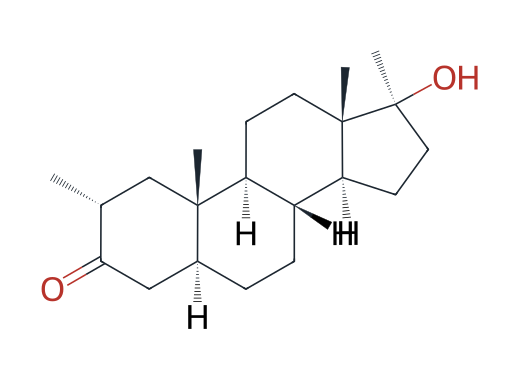
Also called methyldrostanolone, 17α-methyldrostanolone, Superdrol, methasteron, 2α,17α-dimethyl-5α-androstan-17β-ol-3-one
- US status
- Never approved. Designer steroid sold illegally as a dietary supplement before it was scheduled.
- DEA
- Schedule III anabolic steroid (21 CFR 1308.13(f)(48); 21 USC 802(41)(A)(lviii))
- WADA
- S1.1 Anabolic androgenic steroids; prohibited at all times
- Class
- Anabolic-androgenic steroids (AAS)
Jump to doses reported ↓ Dose math calculator
What it is
Methasterone, also written methyldrostanolone and sold illegally under the name "Superdrol", is an oral designer anabolic-androgenic steroid: the 17α-methylated version of drostanolone S1S2. It was never a medicine. It appeared on the US market inside products labelled as dietary supplements, which is how most of the people in the published case reports encountered it S9S15. It is now a Schedule III controlled substance by name S1S3.
How it works
Methasterone binds the androgen receptor and drives the same gene programme as testosterone — muscle protein synthesis, nitrogen retention, male secondary sex characteristics — and, like all androgens, suppresses LH and FSH and therefore the testicles' own testosterone and sperm output S20. Two structural features matter for its risk profile:
- It is a 5α-reduced (DHT-family) androgen, so it does not aromatize to estrogen the way testosterone does.
- It is 17α-alkylated, the modification that lets a steroid survive first-pass metabolism and work as a tablet. That same modification is the one associated with cholestatic liver injury across the oral steroid class, and the case literature on methasterone is almost entirely liver injury S8S14. In laboratory work, anabolic steroids including this class inhibit the hepatic enzyme AKR1D1, which is involved in bile-acid synthesis S19.
Human liver-model and urine studies have mapped its metabolites for anti-doping testing, which is the main reason it appears in the modern literature at all S17S18. Because no clinical study has ever tested it in people, its muscle-building effects are inferred from this shared androgen-receptor mechanism and from in-vitro steroid work rather than from any human efficacy data S18S19.
Legal status
- FDA: Never approved for any use, human or veterinary. It is not a dietary ingredient and never was; products containing it were unapproved drugs. FDA issued a warning letter over the product "Superdrol" and later a warning about body-building products containing steroid or steroid-like substances, both recounted in the DEA scheduling rule S2.
- DEA: Schedule III anabolic steroid, named in the regulation: 21 CFR 1308.13(f), item (48), "methasterone (2α,17α-dimethyl-5α-androstan-17β-ol-3-one or 2α,17α-dimethyl-17β-hydroxy-5α-androstan-3-one)" S1. DEA classified it administratively in a final rule at 77 FR 44456, covering the substance and its salts, esters and ethers S2. Congress then named it in statute: the Designer Anabolic Steroid Control Act of 2014 (Pub. L. 113-260) added methasterone to the list at 21 USC 802(41)(A)(lviii), and DEA's implementing rule reconciled the two chemical names used S3S4.
- What that means in practice: possession without a valid prescription is a federal crime S5, and manufacturing, distributing or dispensing it is a felony S6. Because no approved methasterone product exists, there is no prescription that could make possession lawful.
- "Research use only" or "supplement" labels: neither changes any of the above. A supplement label was the original delivery route for this drug, and it is what put people in hospital S9S15.
- WADA (sport): Prohibited at all times under S1.1 S7. Anti-doping laboratories have published urinary markers for it, one detectable for up to 10 days after a single dose S17.
- International (short): Not reviewed for this page.
What the research actually shows
Evidence: E. No clinical trial has ever tested methasterone in humans for any purpose. There is no efficacy data at all: nobody has measured how much muscle it builds, in whom, or at what dose. The entire human literature is case reports of harm, plus analytical studies run so that drug-testing laboratories can detect it.
| Study | Design | People | What was given / found | Result |
|---|---|---|---|---|
| Shah 2008 S8 | Case series | 5 previously healthy patients | Methasterone-containing products | All developed jaundice about 2 weeks after stopping, presented 2 weeks later, and bilirubin peaked 2–3 weeks after that. All resolved by about 12 weeks with supportive care |
| Abeles 2020 S14 | 2 cases plus systematic review of 52 cases of steroid liver injury | 52 patients (50 male, median age 29) | Methyldrostanolone was the most commonly taken steroid, alone or with others | Median presentation 56 days after starting. Peak bilirubin 705 µmol/L, ALT 125 U/L, ALP 262 U/L. Biopsies showed bland canalicular cholestasis. 43% developed kidney injury (peak creatinine 225 µmol/L). No deaths or transplants in this series |
| Jasiurkowski 2006 S9 | Case report | 1 | "Superdrol" bought over the counter | Cholestatic jaundice and IgA nephropathy — the kidney finding had not previously been linked to testosterone-type drugs |
| Nasr 2009 S10 | Case report and literature review | 1 | "Superdrol" (methasterone) | Severe cholestasis with renal failure |
| Singh 2009 S11; Krishnan 2009 S12 | Case reports | 1; 4 | Methasterone-containing performance supplements | Severe hepatotoxicity; prolonged intrahepatic cholestasis, one case of renal failure |
| Khurana 2014 S13 | Case report | 1 young man | Methasterone | Transient cholestatic hepatitis followed by severe aplastic anemia (hepatitis-associated aplastic anemia) |
| Tran 2023 S15 | Analytical and epidemiological investigation | ~16 New York residents reporting fatigue, scalp-hair loss and muscle aches | B-50 vitamin and multimineral supplements from one supplier | Supplements contained methasterone, dimethazine (a methasterone dimer) and methylstenbolone; extracts were strongly androgenic in receptor assays. One patient was hospitalised for liver damage and a child showed symptoms of severe virilization |
| Geyer 2008 S16 | Market surveillance of supplements | — | — | Designer steroids including methasterone were being sold through the supplement market, and undeclared steroids were found in ordinary vitamin products |
| Zhang 2016 S17; Zheng 2025 S18 | Analytical (excretion study; human liver S9 model) | 1 volunteer; in vitro | 40 mg orally, once | Metabolites mapped for doping control; one marker detectable up to 10 days |
What we don't know: everything a label would tell you. There is no tested dose, no exposure-response data, no long-term follow-up, and no idea how often liver injury happens per user, because the only people counted are the ones who got sick enough to reach a hepatology service.
Reported effects
- Measured in humans: nothing beneficial has been measured. There is no published trial of muscle, strength, body-composition or any other outcome.
- Measured in the laboratory: methasterone and extracts of products containing it were strongly androgenic in androgen-receptor reporter assays, and that androgenicity persisted for days after exposure S15. That is a cell-based measure of potency, not a human result.
- User-reported, not tested: rapid size and strength gains. No study has tested that claim, and the people who documented their use in the medical literature did so from a hospital bed S8S14.
Side effects
Reported in the case literature: jaundice and itching, often beginning after the person had already stopped taking it S8; dark urine, fatigue, nausea, weight loss and other constitutional symptoms S14; kidney impairment S9S12S14; in the supplement-contamination investigation, fatigue, scalp-hair loss and muscle aches, and virilization in a child exposed to the product S15. Expected across the oral 17α-alkylated steroid class, not quantified for methasterone: suppression of the body's own testosterone, testicular shrinkage and infertility, acne, male-pattern hair loss, sharply lowered HDL-cholesterol and raised LDL, high blood pressure, and mood and aggression changes S20.
Dangers and red flags
- Cholestatic liver injury is the signature harm, and it is severe. Across 52 pooled cases, peak bilirubin reached 705 µmol/L — many times the upper limit of normal — with bland canalicular cholestasis on biopsy, and methyldrostanolone was the single most common drug involved S14. Jaundice typically appears after stopping, so quitting does not mean you are in the clear S8.
- Kidney injury travels with it. 43% of the pooled cases developed kidney injury S14; separate reports describe renal failure S10S12 and IgA nephropathy S9.
- Bone-marrow failure. At least one documented case progressed from cholestatic hepatitis to severe aplastic anemia S13.
- You may not know you are taking it. It has been found in products sold as vitamins and multiminerals from a single supplier, with no steroid declared on the label, and in supplement market surveillance more broadly S15S16. A child in one household showed signs of severe virilization S15.
- Cardiovascular risk of the drug class. People who use anabolic steroids have substantially higher rates of heart attack and cardiomyopathy than non-users, and the Endocrine Society's review catalogues the lipid, blood-pressure and cardiac effects S20S21.
- Legal exposure is real. This is a named Schedule III substance: possession without a prescription is a federal crime S1S5, and supplying it is a felony S6.
- Sport: banned at all times, and detectable for days after a single dose S7S17.
- Who should never use it: there is no label, so there are no labeled contraindications — but the published record points hardest at anyone with any liver or kidney condition, anyone taking other hepatotoxic drugs, women (virilizing effects can be permanent), and anyone under 18. The honest reading of the evidence is that no one has shown a safe way to take it.
Doses reported
We don't recommend sh*t. These are the doses studies, labels and harm-reduction sources report. That's information, not advice. Talk to a licensed clinician.
There is no label dose and no trial dose, because no regulator ever approved it and no trial ever tested it. The rows below are the only amounts and exposure times we could trace to a published source. Most case reports describe what happened, not how much was taken. These are reported figures, not guidance, not a range, and not a starting point. Methasterone is an oral tablet, so the reconstitution calculator does not apply.
| Source | Dose | Route | Frequency | Duration | Context |
|---|---|---|---|---|---|
| S17 Zhang 2016 | 40 mg | Oral | Once | Single administration | Anti-doping excretion study: one healthy male volunteer (44 years, 65 kg), with informed consent and ethics-committee approval. The purpose was metabolite detection, not effect |
| S14 Abeles 2020 (pooled 52 cases) | Not reported | Oral | Not reported | Median 56 days (IQR 42–72) from starting to presenting with liver injury | Taken for performance enhancement; methyldrostanolone the most common agent. Bilirubin peaked a median of 28 days after stopping |
| S14 Abeles 2020, case 1 | Not reported | Oral | Not reported | Started 6 weeks and stopped 2 weeks before presentation | A single documented exposure window ending in hospital admission |
| S8 Shah 2008 | Not reported | Oral | Not reported | Jaundice appeared about 2 weeks after stopping | 5 previously healthy patients at tertiary-care centres |
| S15 Tran 2023 | Undeclared content of products sold as B-50 vitamin and multimineral supplements | Oral | As directed on the product | Unknown | The people affected did not know they were taking a steroid at all |
Monitoring a doctor would order
There is no monitoring standard for a drug nobody approved. In the published cases, clinicians worked up liver function tests (bilirubin, ALT, AST, ALP, GGT, INR), kidney function (creatinine), a full liver screen to exclude viral and autoimmune causes, imaging to exclude biliary obstruction, and in some cases a liver biopsy; treatment was supportive, with antipruritics, ursodeoxycholic acid and, in some patients, corticosteroids S8S14. Tell a clinician what you actually took, including anything bought as a supplement — causality assessment in these cases depended on the patient eventually admitting it S14. Jaundice, dark urine, pale stools, severe itching or confusion need urgent medical care.
Bottom line
Methasterone is a designer steroid that was sold as a supplement, never tested as a medicine, and is now named in both the DEA regulation and the federal statute as a Schedule III controlled substance. Its entire human medical literature consists of people who were hurt by it: severe cholestatic liver injury, kidney injury in nearly half of pooled cases, and at least one case of aplastic anemia. There is no efficacy evidence of any kind, no established dose, and no way to know what an illicit tablet contains — some victims did not know they were taking a steroid. The liver damage often shows up after the person has already stopped.
Sources
- [S1] 21 CFR 1308.13(f), Schedule III anabolic steroids, item (48) methasterone (2α,17α-dimethyl-5α-androstan-17β-ol-3-one or 2α,17α-dimethyl-17β-hydroxy-5α-androstan-3-one) (eCFR). (regulator)
- [S2] U.S. Drug Enforcement Administration. Classification of Two Steroids, Prostanozol and Methasterone, as Schedule III Anabolic Steroids Under the Controlled Substances Act. Final rule, 77 FR 44456. (regulator)
- [S3] U.S. Drug Enforcement Administration. Implementation of the Designer Anabolic Steroid Control Act of 2014 (Pub. L. 113-260). Final rule, 88 FR 50036 (noting methasterone is named at 21 USC 802(41)(A)(lviii) and in the regulatory definition at 21 CFR 1300.01(b)). (regulator)
- [S4] 21 U.S.C. 802(41), definition of 'anabolic steroid' (statutory list, as amended by the Designer Anabolic Steroid Control Act of 2014). (regulator)
- [S5] 21 U.S.C. 844, Penalties for simple possession. (regulator)
- [S6] 21 U.S.C. 841, Prohibited acts A (manufacture, distribution or dispensing of a controlled substance). (regulator)
- [S7] World Anti-Doping Agency. 2026 Prohibited List, section S1.1 (anabolic androgenic steroids). (regulator)
- [S8] Shah NL, Zacharias I, Khettry U, Afdhal N, Gordon FD. Methasteron-associated cholestatic liver injury: clinicopathologic findings in 5 cases. Clin Gastroenterol Hepatol. 2008;6(2):255-8. PMID 18187367. (human-case-series)
- [S9] Jasiurkowski B, Raj J, Wisinger D, Carlson R, Zou L, Nadir A. Cholestatic jaundice and IgA nephropathy induced by OTC muscle building agent superdrol. Am J Gastroenterol. 2006;101(11):2659-62. PMID 16952289. (human-case-series)
- [S10] Nasr J, Ahmad J. Severe cholestasis and renal failure associated with the use of the designer steroid Superdrol (methasteron): a case report and literature review. Dig Dis Sci. 2009;54(5):1144-6. PMID 18720005. (human-case-series)
- [S11] Singh V, Rudraraju M, Carey EJ, et al. Severe hepatotoxicity caused by a methasteron-containing performance-enhancing supplement. J Clin Gastroenterol. 2009;43(3):287. PMID 18813027. (human-case-series)
- [S12] Krishnan PV, Feng ZZ, Gordon SC. Prolonged intrahepatic cholestasis and renal failure secondary to anabolic androgenic steroid-enriched dietary supplements. J Clin Gastroenterol. 2009;43(7):672-5. PMID 19238093. (human-case-series)
- [S13] Khurana A, Dasanu CA. Hepatitis associated aplastic anemia: case report and discussion. Conn Med. 2014;78(8):493-5. PMID 25314890. (human-case-series)
- [S14] Abeles RD, Foxton M, Khan S, et al. Androgenic anabolic steroid-induced liver injury: two case reports assessed for causality by the updated RUCAM score and a comprehensive review of the literature. BMJ Open Gastroenterol. 2020;7(1):e000549. PMID 33214235. (human-case-series)
- [S15] Tran BN, Okoniewski R, Spink BC, LeMaster DM, Aldous KM, Spink DC. Androgenic steroids in Over-the-Counter dietary Supplements: Analysis for association with adverse health effects. Steroids. 2023;193:109199. PMID 36796473. (human-observational)
- [S16] Geyer H, Parr MK, Koehler K, Mareck U, Schänzer W, Thevis M. Nutritional supplements cross-contaminated and faked with doping substances. J Mass Spectrom. 2008;43(7):892-902. PMID 18563865. (human-observational)
- [S17] Zhang J, Lu J, Wu Y, et al. New Potential Biomarker for Methasterone Misuse in Human Urine by LC-QTOF-MS. Int J Mol Sci. 2016;17(10):1628. PMID 27669235. (human-observational)
- [S18] Zheng S, Ge Y, Fang X, et al. Characterization and metabolic profiling of oxymetholone and methasterone metabolites studied with human liver S9 model using GC-Orbitrap-HRMS for anti-doping purposes. Anal Bioanal Chem. 2025;417(24):5499-5512. PMID 40866528. (in-vitro)
- [S19] Kędzierski J, Allard JA, Odermatt A, et al. Assessment of the inhibitory potential of anabolic steroids towards human AKR1D1 by computational methods and in vitro evaluation. Toxicol Lett. 2023;384:1-13. PMID 37451653. (in-vitro)
- [S20] Pope HG Jr, Wood RI, Rogol A, Nyberg F, Bowers L, Bhasin S. Adverse health consequences of performance-enhancing drugs: an Endocrine Society scientific statement. Endocr Rev. 2014;35(3):341-75. PMID 24423981. (review)
- [S21] Windfeld-Mathiasen J, Heerfordt IM, Dalhoff KP, et al. Cardiovascular Disease in Anabolic Androgenic Steroid Users. Circulation. 2025;151:828-834. PMID 39945117. (human-observational)