
Brain, sleep & 'longevity' research peptides
MOTS-c
Also called MOTSc, MOTs-C, mitochondrial open reading frame of the 12S rRNA-c, MOTS-c acetate
- US status
- Not approved
- DEA
- Not a controlled substance
- WADA
- Prohibited at all times: S4.4.1 (AMPK activators, MOTS-c named)
- Class
- Brain, sleep & 'longevity' research peptides
Jump to doses reported ↓ Dose math calculator
What it is
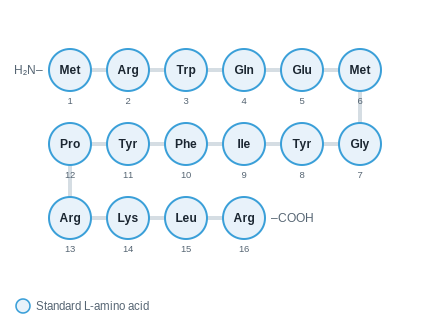
MOTS-c is a 16-amino-acid peptide the body makes from instructions in mitochondrial DNA, the small genome inside the cell's energy-producing mitochondria S6. It is sold online as an injectable "exercise mimetic" for fat loss, metabolism and longevity.
How it works
MOTS-c is a mitochondrial-derived peptide that acts mainly on skeletal muscle. In mice it activates AMPK, the cell's low-fuel sensor — the same pathway switched on by exercise and by metformin — which shifts cells toward burning glucose and fat and improves insulin sensitivity S6. It also moves into the nucleus under metabolic stress to influence stress-response genes, and exercise raises MOTS-c levels in human muscle and blood S6S7. This is why it is marketed as an "exercise mimetic," though the metabolic data are from animal work S6S7.
Legal status
- FDA: Not approved for any use in the US.
- Compounding: FDA had placed MOTS-c in Category 2, saying it "may pose significant risk for immunogenicity" and that FDA "has not identified any human exposure data on drug products containing MOTs-C administered via any route of administration" S1. The nomination was withdrawn; it is on FDA's withdrawn list S1. FDA's compounding advisory committee reviewed it for obesity and osteoporosis on Jul 23 2026 S4; per HHS, the committee voted in favor while FDA's drug center recommended against S3.
- HHS draft policy (Oct 30 2026): HHS does not intend to take enforcement action against state-licensed pharmacies or physicians compounding MOTS-c acetate as a subcutaneous or intramuscular injection, from ingredient lots with a full certificate of analysis, with a patient-specific prescription and adverse-event reporting S2S3. HHS's reasoning leans on "a randomized placebo-controlled trial of a MOTS-c analogue" that "reported no serious adverse events" S3. That analog is a different molecule (see below), and a draft enforcement stance is not approval S2.
- DEA: Not a controlled substance.
- "Research use only" products: see our explainer.
- WADA: Prohibited at all times, in and out of competition. The 2026 List names MOTS-c under S4.4.1, AMPK activators S5.
What the research actually shows
Evidence: D. The case for MOTS-c rests on mouse studies. We found no published human trial of MOTS-c itself. The one registered human trial tested an analog, CB4211; it finished in 2021 and its registry entry has no posted results or disclosed doses S8.
| Study | Design | Model | Dose studied | Result |
|---|---|---|---|---|
| Lee et al 2015 S6 | Animal study | Mice | Not stated in the abstract | Prevented age-related and high-fat-diet insulin resistance and diet-induced obesity |
| Reynolds et al 2021 S7 | Animal study plus human exercise samples | Young, middle-aged and old mice; humans exercising | Mice: 3 times a week in late life (dose not in the abstract) | Better physical performance and healthspan in mice; exercise raised MOTS-c in human muscle and blood |
| CB4211 phase 1a/1b, NCT03998514 S8 | Randomized, double-blind, placebo-controlled; single and multiple ascending doses | 88 healthy non-obese adults and adults with fatty liver disease | Undisclosed doses, subcutaneous | No results posted on the registry |
What we don't know: what MOTS-c does in people when injected, what dose, for how long, and whether the CB4211 analog results (unpublished, as far as we found) apply to it.
Reported benefits
- In mice: less obesity and insulin resistance, better physical capacity in old age S6S7.
- In people: no outcome data for injected MOTS-c.
Side effects
Common: not characterized in people. FDA found no human exposure data for MOTS-c by any route S1. Serious: none documented, because there is no human record to document them. HHS cites "no serious adverse events" in a trial of an analog S3; that is not the same molecule.
Dangers and red flags
- No human data on the product actually sold. FDA's words: no human exposure data by any route S1.
- Immune reactions: FDA flagged a "significant risk for immunogenicity" S1.
- Sport: a positive test is an anti-doping rule violation at any time S5.
- Product quality. HHS listed missing impurity, solvent, endotoxin and microbial testing as gaps FDA had found S3; grey-market vials carry no such documentation.
- Who should avoid it: tested athletes; anyone pregnant or breastfeeding; people with diabetes on glucose-lowering drugs, given its proposed effect on insulin sensitivity S6 and no human interaction data.
Doses reported
We don't recommend sh*t. These are the doses studies, labels and harm-reduction sources report. That's information, not advice. Talk to a licensed clinician.
No human dosing data found in a source we could check. There is no FDA label and no published human trial of MOTS-c. The registered analog trial (CB4211) lists six single-dose cohorts, then groups dosed once daily for 7 days and for 28 days, all subcutaneous, but does not disclose the amounts and has posted no results S8. HHS refers to "the compounded regimen" without publishing it S3. We found no peer-reviewed survey of community use. We do not fill the gap with vendor or forum figures.
| Source | Population | Dose | Route | Frequency and timing | Duration | Titration or escalation | Cite |
|---|---|---|---|---|---|---|---|
| CB4211 (MOTS-c analog) phase 1a/1b | 88 healthy non-obese adults and adults with fatty liver disease | Not disclosed | Subcutaneous, abdomen or thigh | Part A: one dose. Parts B and C: once daily | Part A: single dose. Part B: 7 days. Part C: 28 days | Six single ascending dose cohorts, then three multiple ascending dose cohorts; amounts listed only as "Dose 1" to "Dose 6" and "to be determined" | S8 |
Open the dose math calculator →
Monitoring a doctor would order
No guideline exists. We found no source naming MOTS-c-specific monitoring.
Bottom line
MOTS-c is a real mitochondrial peptide that exercise raises, and in mice it fights obesity and age-related decline. Nobody has published a human trial of injecting it. FDA found no human exposure data at all, WADA bans it at all times, and HHS's draft policy rests partly on an unpublished trial of a different molecule.
Sources
- [S1] FDA. Certain Bulk Drug Substances for Use in Compounding that May Present Significant Safety Risks (MOTs-C entry, 'Bulk drug substances nominated but withdrawn'). Content current as of 04/22/2026. (regulator)
- [S2] HHS. Enforcement Discretion Policy Regarding 503A Compounding Using Certain Peptide Bulk Drug Substances (notice of availability, draft policy). Federal Register FR Doc 2026-22192, Oct 30 2026. (regulator)
- [S3] HHS. Enforcement Discretion Policy Regarding 503A Compounding Using Certain Peptide Bulk Drug Substances, Appendix A and Appendix B (MOTS-c identity, routes and justification). Policy PDF linked from FR Doc 2026-22192. (regulator)
- [S4] FDA. July 23-24, 2026: Meeting of the Pharmacy Compounding Advisory Committee (Jul 23 agenda: MOTs-C reviewed for obesity and osteoporosis). (regulator)
- [S5] World Anti-Doping Agency. 2026 Prohibited List, section S4.4.1 (AMPK activators, e.g. AICAR, MOTS-c); S4 substances prohibited at all times. (regulator)
- [S6] Lee C, et al. The mitochondrial-derived peptide MOTS-c promotes metabolic homeostasis and reduces obesity and insulin resistance. Cell Metab. 2015;21(3):443-54. PMID 25738459. (animal)
- [S7] Reynolds JC, et al. MOTS-c is an exercise-induced mitochondrial-encoded regulator of age-dependent physical decline and muscle homeostasis. Nat Commun. 2021;12(1):470. PMID 33473109. (animal)
- [S8] ClinicalTrials.gov. NCT03998514: A Phase 1a/1b Study of Safety, Tolerability, and Pharmacokinetics of CB4211 in Healthy Non-obese Subjects and Subjects With Nonalcoholic Fatty Liver Disease (sponsor CohBar; completed Apr 2021; 88 enrolled). (registry)