
Brain, sleep & 'longevity' research peptides
NAD+ (injection and IV)
Also called NAD, nicotinamide adenine dinucleotide, NAD IV, NAD drip, NAD injection
- US status
- Not approved as a drug
- DEA
- Not a controlled substance
- WADA
- Not named as a substance; IV infusions or injections over 100 mL per 12 hours are a prohibited method (M2.2)
- Class
- Brain, sleep & 'longevity' research peptides
Jump to doses reported ↓ Dose math calculator
What it is
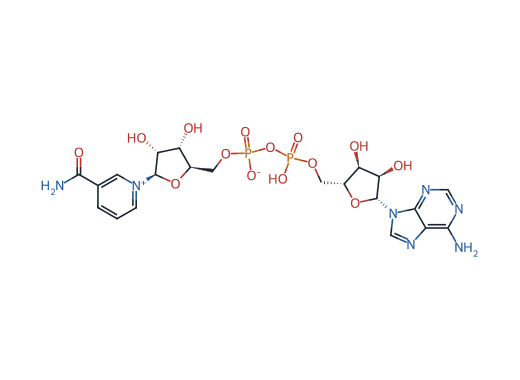
NAD+ (nicotinamide adenine dinucleotide) is a coenzyme found in every living cell S5S6. Strictly, it is not a peptide; we cover it because it is sold through the same clinics and channels. This page is about NAD+ itself given by IV drip or injection. Oral precursors such as nicotinamide riboside (NR) and nicotinamide mononucleotide (NMN) are a different question with more trial data S6.
How it works
NAD+ is a coenzyme that shuttles electrons in the reactions that turn food into cellular energy, and it is the required substrate for enzymes such as the sirtuins and PARPs that handle DNA repair and other maintenance tasks S5S6. Levels fall with age, so the longevity pitch is that topping it up by IV should restore these functions S6S7. Whether infused NAD+ actually raises useful intracellular NAD+ — rather than being broken down and salvaged as simpler precursors — is unsettled, and the clinical evidence for anti-aging benefit is weak S4S6S7.
Legal status
- FDA: There is no FDA-approved NAD+ injection or infusion.
- Compounding: "Nicotinamide Adenine Dinucleotide (NAD)" is in 503A Category 1, substances under evaluation S1. Under FDA's interim policy, FDA "does not intend to take action against a compounder" using a Category 1 substance if the policy's conditions are met S2. That is enforcement discretion while FDA evaluates it, not approval. One salt form, beta-NAD disodium salt trihydrate, is in Category 3, nominated without adequate support, which the interim policy does not cover S1S2.
- DEA: Not a controlled substance.
- "Research use only" vials: see our explainer.
- WADA: NAD+ is not named as a substance S3. The method matters more: IV infusions or injections of more than 100 mL in any 12-hour period are prohibited unless received in hospital treatment, surgery or clinical diagnostic work (M2.2) S3.
What the research actually shows
Evidence: C. A 2026 systematic review of 33 human trials of NAD-related compounds found "no eligible outcomes trials evaluated intravenous or intramuscular NAD+ itself for anti-aging or wellness indications" S6. What exists for IV NAD+ is a small pharmacokinetic pilot and a retrospective tolerability review S4S5. A 2026 review of IV "longevity therapy" called it "an experimental intervention rather than an evidence-based... anti-aging practice" S7.
| Study | Design | People | Dose studied | Result |
|---|---|---|---|---|
| Grant et al 2019 S4 | Pilot, randomized to NAD+ or saline | 11 healthy men aged 30–55 (8 NAD+, 3 saline) | 750 mg NAD+ IV over 6 hours (about 2 mg/min) | No rise in blood NAD+ for the first 2 hours: it was cleared as fast as it went in. No adverse events observed |
| Reyna et al 2026 S5 | Retrospective chart review, commercial infusion setting | Clients receiving NAD+ IV or NR IV | 500 mg IV on 4 consecutive days, 30-day follow-up | NAD+ caused moderate to severe stomach symptoms, faster heart rate and chest pressure during infusion, and infusions took longer as a result (average 97 min vs 37 min for NR). HDL ("good") cholesterol fell in the NAD+ group |
| Gallagher et al 2026 S6 | Systematic review | 33 human and 80 rodent studies | Various | Oral precursors raise NAD-related markers; outcome effects mixed or null; no outcome trials of IV or IM NAD+ |
What we don't know: whether IV or injected NAD+ improves any health outcome, energy, cognition or aging, and what repeated drips do over months.
Reported benefits
- Blood and urine levels: IV NAD+ is broken down quickly; its breakdown products show up in urine S4.
- Health outcomes: none shown for IV or injected NAD+ S6S7.
Side effects
Common (during IV infusion): moderate to severe stomach and gut symptoms, faster heart rate and chest pressure, which resolved when the infusion ended and made infusions take longer S5. Serious: none reported in the two small human studies S4S5. A 4-day course lowered HDL cholesterol in one retrospective study; what that means long term is unknown S5. The IV route itself carries procedural risks S7.
Dangers and red flags
- No outcome evidence for the drip or the shot S6.
- Infusion symptoms were common enough in one study to stretch the average drip to over an hour and a half S5.
- Clinic marketing outruns the data. The 2026 IV longevity review found few studies used validated aging biomarkers and placebo-controlled trials were "scarce and underpowered" S7.
- Tested athletes: more than 100 mL by IV in 12 hours outside a hospital is a doping violation regardless of what is in the bag S3.
- Product quality. Compounded NAD+ is not FDA-approved; "research use only" vials have no oversight at all.
Doses reported
We don't recommend sh*t. These are the doses studies, labels and harm-reduction sources report. That's information, not advice. Talk to a licensed clinician.
There is no FDA label. These are the only human IV doses we could tie to a published source. Grant et al describe their 750 mg dose as "derived empirically" from common clinic practice, not from dose-finding research S4. We found no published human data on NAD+ given as a subcutaneous or intramuscular injection, and no peer-reviewed survey of community use.
| Source | Population | Dose | Route | Frequency and timing | Duration | Titration or escalation | Cite |
|---|---|---|---|---|---|---|---|
| Grant et al 2019 | 8 healthy men, 30–55 | 750 mg in normal saline | IV infusion | Single continuous infusion at about 2 mg/min (3 µmol/min) | 6 hours, one session | None; fixed rate | S4 |
| Reyna et al 2026 | Adults at a commercial infusion setting | 500 mg | IV infusion | Once daily on 4 consecutive days; average infusion time 97 minutes, longer because of symptoms | 4 days, then 30-day follow-up | No dose escalation reported | S5 |
Open the dose math calculator →
Monitoring a doctor would order
No guideline exists. The published studies tracked blood pressure, heart rate and liver tests during and after infusion S4S5; that reflects study design, not a standard of care.
Bottom line
NAD+ is a real and essential molecule, and levels fall with age. Dripping it into a vein has not been shown to do anything for health, energy or aging: there are no outcome trials, the body clears it fast, and in the one real-world comparison it caused enough nausea, racing heart and chest pressure that infusions ran long. FDA tolerates pharmacy compounding while it evaluates the substance, and WADA bans large-volume IVs outside hospitals.
Sources
- [S1] FDA. Bulk Drug Substances Nominated for Use in Compounding Under Section 503A of the FD&C Act (Category 1: Nicotinamide Adenine Dinucleotide (NAD); Category 3: Beta-Nicotinamide Adenine Dinucleotide Disodium Salt Trihydrate). Updated May 14, 2026. (regulator)
- [S2] FDA. Bulk Drug Substances Used in Compounding Under Section 503A of the FD&C Act (interim policy and categories 1-3). (regulator)
- [S3] World Anti-Doping Agency. 2026 Prohibited List, section M2.2 (intravenous infusions and/or injections of more than a total of 100 mL per 12-hour period) and section S0. (regulator)
- [S4] Grant R, et al. A Pilot Study Investigating Changes in the Human Plasma and Urine NAD+ Metabolome During a 6 Hour Intravenous Infusion of NAD. Front Aging Neurosci. 2019;11:257. PMID 31572171; PMC6751327. (human-observational)
- [S5] Reyna K, et al. Intravenous infusion of nicotinamide adenine dinucleotide (NAD+) versus nicotinamide riboside (NR): a retrospective tolerability pilot study in a real-world setting. Front Aging. 2026;7:1652582. PMID 41704678. (human-observational)
- [S6] Gallagher C, et al. NAD+ supplementation for anti-aging and wellness: A PRISMA-guided systematic review of preclinical and clinical evidence. Ageing Res Rev. 2026;116:103057. PMID 41655607. (review)
- [S7] Godic A, et al. Intravenous longevity therapy: a critical review of evidence, mechanisms, and clinical utility. Acta Dermatovenerol Alp Pannonica Adriat. 2026;35(1):39-43. PMID 41915584. (review)