
Reproductive & hormonal peptides (approved)
Nafarelin
Also called Synarel, nafarelin acetate nasal spray
- US status
- Approved
- DEA
- Not a controlled substance
- WADA
- S2.2.1 GnRH agonist analogues (nafarelin named); prohibited at all times in males
- Class
- Reproductive & hormonal peptides (approved)
Jump to doses reported ↓ Dose math calculator
What it is
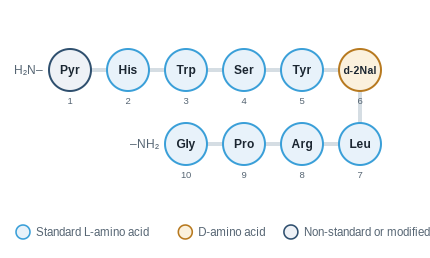
Nafarelin (Synarel) is a man-made version of gonadotropin-releasing hormone (GnRH), the brain hormone that tells the pituitary gland to release LH and FSH. Unlike most drugs in its class, which are injections or implants, it is a nasal spray. It is an approved prescription drug for endometriosis in adult women and for central precocious puberty (puberty that starts too early) in children S1.
How it works
The pituitary normally gets GnRH in brief pulses. Nafarelin is a stronger, longer-lasting copy, and taking it every day keeps the receptors constantly switched on. After an early burst of stimulation, the pituitary stops responding, LH and FSH fall, and the ovaries or testes make much less estrogen or testosterone S1. In women, low estrogen shrinks endometriosis and usually stops periods; in children, it pauses puberty. The spray is absorbed through the lining of the nose and reaches peak blood levels within about 10 to 45 minutes S1. Effects reverse after stopping: in the label's endometriosis trial, periods returned in all women who did not become pregnant by the third month after treatment S1.
Legal status
- FDA: Approved for endometriosis (pain relief and reduction of lesions; studied in women 18 and older for 6 months) and for central precocious puberty in children of both sexes S1.
- DEA: Not a controlled substance.
- WADA: GnRH agonists, with nafarelin named, are prohibited at all times in males under S2.2.1 S3.
- International (short): Not reviewed for this page.
What the research actually shows
Evidence: A. Nafarelin was tested against the standard drugs of its time in randomized trials.
| Study / source | Design | People | Dose studied | Result |
|---|---|---|---|---|
| Henzl 1988 S2 | Randomized, double-blind vs danazol | 213 women with endometriosis confirmed by laparoscopy | 400 or 800 mcg/day nasal vs danazol 800 mg/day, 6 months | Over 80% in each group had less disease on repeat laparoscopy; severe pain fell from about 40% to 5 to 10%; danazol worsened cholesterol, nafarelin did not, but caused more hot flashes and lower libido |
| Label, vs leuprolide depot S1 | Controlled trial | Women with endometriosis | 400 mcg/day nasal vs leuprolide 3.75 mg IM monthly | Symptom relief clinically comparable |
| Label, endometriosis outcomes S1 | Clinical trial data | Women on 400 mcg/day | 400 mcg/day | Periods stopped in about 65%, 80% and 90% after 60, 90 and 120 days; at the end, 60% had no symptoms, 32% mild, 7% moderate, 1% severe |
| Label, CPP S1 | Clinical trials | Children with central precocious puberty | 1,600 to 1,800 mcg/day | Breast development stopped or regressed in 82% of girls; genital development stopped or regressed in 100% of boys |
What we don't know for this page: the label says safety data for retreatment beyond 6 months in endometriosis are not available S1.
Reported benefits
- Endometriosis: less pelvic pain, painful periods and painful sex, and smaller lesions over 6 months, comparable to danazol and to leuprolide depot S1S2.
- Central precocious puberty: halts pubertal development driven by the pituitary S1.
- Fertility after treatment: of 149 women in Henzl 1988 who tried to conceive after treatment, 39% succeeded, similar across groups; the label says there is no evidence that nafarelin raises or lowers pregnancy rates S2S1.
Side effects
Common (adult women): mostly from low estrogen: hot flashes, headaches, mood swings, decreased libido, vaginal dryness, acne, muscle aches and smaller breasts S1. Some women have vaginal bleeding during the first two months S1. Common (children, 155 treated): mostly in the first 6 weeks, from the early stimulation: acne (10%), temporary breast enlargement (8%), vaginal bleeding (8%), mood swings (6%), more pubic hair (5%), body odor (4%) and oily skin (3%) S1. Serious: bone loss (below); ovarian cysts in the first two months in some women with endometriosis; allergic-type reactions (2.6% of children reported symptoms such as shortness of breath, chest pain, hives or rash); psychiatric events (crying, irritability, anger, aggression); convulsions; and, with other GnRH agonists, severe skin reactions S1.
Dangers and red flags
- Bone loss. After 6 months, spinal trabecular bone density fell an average of 8.7% by CT scan (3.2% by DEXA), with only partial recovery after stopping. People with risk factors such as heavy alcohol or tobacco use or a strong family history of osteoporosis need extra caution S1.
- Pregnancy and breastfeeding. Contraindicated; it may cause fetal harm S1.
- Missed doses. Skipping successive sprays can cause breakthrough bleeding or ovulation, and pregnancy is possible; nafarelin is not a contraceptive, and the label advises a non-hormonal method during treatment; nasal decongestants should wait at least 2 hours after a dose, and sneezing right after a dose can reduce absorption S1.
- Sport. Prohibited in males at all times S3.
- Who should avoid it: anyone allergic to GnRH, GnRH agonists or the spray's ingredients, and anyone with undiagnosed abnormal vaginal bleeding S1.
Doses reported
We don't recommend sh*t. These are the doses studies, labels and harm-reduction sources report. That's information, not advice. Talk to a licensed clinician.
Nafarelin is a metered nasal spray (about 200 mcg per spray), so doses are counted in sprays and the inline calculator does not apply.
| Source | Population | Dose | Route | Frequency and timing | Duration | Titration or escalation | Cite |
|---|---|---|---|---|---|---|---|
| Synarel label | Endometriosis | 400 mcg/day: 1 spray (200 mcg) in one nostril in the morning, 1 in the other nostril in the evening | Nasal | Twice daily, starting on days 2 to 4 of the menstrual period | 6 months | If regular periods continue after 2 months: 800 mcg/day (1 spray in each nostril morning and evening) | S1 |
| Synarel label | Central precocious puberty | 1,600 mcg/day: 2 sprays in each nostril morning and evening (8 sprays) | Nasal | Twice daily | Until the age chosen to restart puberty | May be raised to 1,800 mcg/day (3 sprays into alternating nostrils three times daily) if suppression is inadequate | S1 |
| Henzl 1988 | Endometriosis | 400 or 800 mcg/day | Nasal | Daily | 6 months | Two fixed arms | S2 |
There is no known non-medical use with published dosing, so we report no community doses.
Open the dose math calculator →
Monitoring a doctor would order
- Endometriosis: pregnancy ruled out before starting; bone density assessed before any retreatment S1.
- Children: LH response to GnRH stimulation and sex-steroid levels, especially in the first 6 to 8 weeks, to confirm suppression and adherence; growth and bone age S1.
Bottom line
Nafarelin (Synarel) is a GnRH agonist nasal spray that shuts down estrogen or puberty hormones after a short initial surge. Randomized trials showed it works about as well as danazol and leuprolide for endometriosis, and it is approved for early puberty in children. Its main risks come from low estrogen, especially bone loss over 6 months, plus the class warnings on mood changes and seizures. Missing sprays undercuts the effect.
Sources
- [S1] SYNAREL (nafarelin acetate) nasal solution 2 mg/mL. US prescribing information (DailyMed), Pfizer. Endometriosis and central precocious puberty; dosing, contraindications, warnings, bone-density data, pediatric adverse events. Set ID d0aa57cb-d2f4-46d7-af43-7c8b06aa81a6. (label)
- [S2] Henzl MR, et al. Administration of nasal nafarelin as compared with oral danazol for endometriosis. A multicenter double-blind comparative clinical trial. N Engl J Med. 1988;318:485-489. PMID 2963213. (rct)
- [S3] World Anti-Doping Agency. 2026 Prohibited List, section S2.2.1 (testosterone-stimulating peptides in males, including GnRH agonist analogues such as nafarelin). (regulator)