
Anabolic-androgenic steroids (AAS)
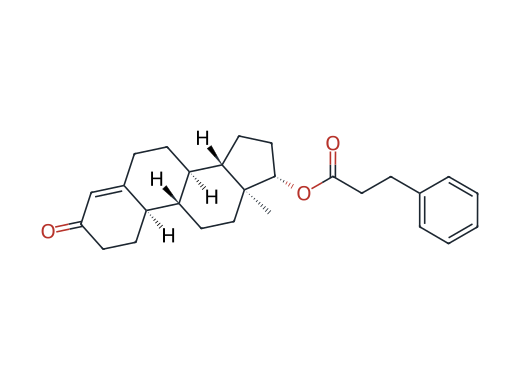
Nandrolone phenpropionate
Also called NPP, Durabolin, nandrolone phenylpropionate, 19-nortestosterone phenylpropionate
- US status
- Withdrawn
- DEA
- Schedule III (21 CFR 1308.13(f))
- WADA
- S1.1 Anabolic androgenic steroids; prohibited at all times
- Class
- Anabolic-androgenic steroids (AAS)
Jump to doses reported ↓ Dose math calculator
What it is
Nandrolone phenpropionate, usually shortened to NPP, is an injectable anabolic-androgenic steroid: the phenpropionate ester of nandrolone, the same active steroid as the better-known Deca-Durabolin, which carries the longer decanoate ester. It was an approved American medicine: Durabolin, a 25 and 50 mg/mL injection approved in 1959 and long since discontinued S1. There is no current US product, so there is no current label. Today it circulates almost entirely as underground-lab oil, and it remains a Schedule III controlled substance S2.
How it works
The ester is an oily side-chain attached to the steroid that slows its release from the muscle after injection; it is inactive in itself and is cleaved off by tissue esterases to free nandrolone. The short phenpropionate ester leaves the depot and clears faster than the decanoate, which is why NPP is injected more often and why its blood levels peak higher and fall sooner. The active steroid released is identical for both esters, so the pharmacology below is nandrolone's pharmacology.
Nandrolone is testosterone with the carbon-19 methyl group removed (19-nortestosterone). Free nandrolone binds the androgen receptor; the complex enters the nucleus and increases transcription of genes governing muscle protein synthesis while reducing catabolic signalling, producing nitrogen retention and a gain in lean mass. Androgens also drive red-cell production, through erythropoietin and through direct stimulation of marrow progenitors, which is the historical reason this drug was studied for blood-cell production and used in anemia before better treatments existed S4.
The feature that distinguishes nandrolone from testosterone is its handling by 5α-reductase. In skin, scalp and prostate, that enzyme converts nandrolone to 5α-dihydronandrolone, which binds the androgen receptor more weakly than the parent steroid, the opposite of what happens to testosterone, which 5α-reduction turns into the more potent dihydrotestosterone. Androgenic signalling in those tissues is therefore damped relative to the effect in muscle, which is the basis for nandrolone being described as relatively more anabolic than androgenic. Virilizing effects still happen, and in women the label's stated risks of voice deepening, hair growth and menstrual change are real S6.
Nandrolone aromatizes to an estrogenic metabolite much less readily than testosterone, but it and its metabolites act at the progesterone receptor. That progestogenic activity is the explanation usually offered for the breast tissue growth and sexual dysfunction reported with nandrolone, though it is not firmly established.
As an androgen, nandrolone suppresses the hypothalamic-pituitary-testicular axis by negative feedback: less GnRH, less LH and FSH, and therefore less endogenous testosterone and reduced sperm production. With a short ester the drug itself clears faster than the decanoate, but the axis suppression it causes is not short, and recovery after stopping is not guaranteed S6. The same androgen signalling that builds muscle also drives sodium and water retention and lowers HDL cholesterol, which is how the benefits and the harms arrive together.
Legal status
- FDA: Approved as Durabolin in 1959 and now discontinued, with no marketed US product and no current label S1. Not approved for athletic, physique or anti-aging use.
- Compounding: there is no approved US product behind it; a compounded nandrolone preparation is a question for counsel and the pharmacy's own rules, not something this page can call lawful.
- DEA: Schedule III controlled substance. Nandrolone and its esters are listed in the anabolic steroid schedule at 21 CFR 1308.13(f) S2. Possessing it without a valid prescription is a federal crime, and distributing it is a felony.
- "Research use only" labels: an oil in a vial labelled for research is still a Schedule III anabolic steroid in the eyes of federal law; the label does not change that. See our explainer.
- WADA: Prohibited at all times under S1.1, and nandrolone metabolites are detectable long after the last injection S7.
- International (short): Not reviewed for this page yet.
What the research actually shows
Evidence: C. NPP's own human record is thin and mostly old: a 1960s-era literature of palliative use in metastatic breast cancer and anemia, plus one small modern randomized surgical study S3S4S5. The modern randomized evidence for nandrolone's anabolic effects, in HIV-associated wasting, was produced with the decanoate ester, not this one, and we do not borrow those results for this page beyond noting that the active steroid is the same.
| Study | Design | People | Dose studied | Result |
|---|---|---|---|---|
| Pourmand 2008 S3 | Randomized, placebo-controlled pilot | 54 men, mean age 70, having open prostatectomy for benign prostatic enlargement | 100 mg intramuscularly, single pre-operative dose | Lower self-reported symptom score at 24 hours versus sesame-oil placebo (6.18 versus 9.77; p<0.001); the 48-hour difference was not significant (p=0.06); no complication was attributed to the drug. A pilot study, in older men, around surgery |
| Kahn 1974 S4 | Human study of blood-cell production | Patients studied for myelopoiesis | Per the study | Examined the effect of nandrolone phenpropionate on bone-marrow blood-cell production, the historical rationale for androgens in anemia |
| Malmio 1960 S5 | Clinical series, historical | Patients with metastasizing breast cancer | Per the study | Reported the clinical effect of the drug then marketed as Durabolin in metastatic breast cancer: the original approved-era use |
| Drugs@FDA record S1 | Regulatory record | — | 25 and 50 mg/mL injectable | Approval in 1959 and discontinuation; the product and its label no longer exist |
What we don't know, for the use it is actually bought for: nothing in the published record describes the high-dose, long-duration physique use NPP is sold for. There is no modern trial of this ester at those doses, no long-term safety data, and no information about what is in an underground vial.
Reported benefits
In the approved era: palliative benefit in metastatic breast cancer and support of red-cell production in anemia, which is why androgens were used before better treatments existed S4S5. In the one modern randomized study: less symptom burden 24 hours after prostate surgery in older men from a single 100 mg injection S3. Users seek muscle growth and relief of joint discomfort; those uses are off-label, were never the basis of approval, and for this ester are not supported by published trials.
Side effects
Common: the class effects of nandrolone, drawn from the current label for the same steroid in its decanoate form: suppression of the body's own testosterone, acne, fluid retention, and reductions in HDL ("good") cholesterol S6. Because nandrolone is weakly androgenic and has progestogenic activity, sexual dysfunction and breast tissue growth in men are commonly reported with nandrolone generally. In women, virilizing effects, voice deepening, hair growth and menstrual change, are the label's stated risk S6. Serious: the nandrolone label contraindicates use in prostate cancer, male breast cancer, and pregnancy, and warns about fluid retention in cardiac, kidney and liver disease; androgens as a class carry liver, lipid and cardiovascular warnings S6. Prolonged suppression of the hormonal axis after stopping is a well-recognized problem with nandrolone esters.
Dangers and red flags
- It is a controlled substance. Possession without a prescription is a federal crime and distribution is a felony S2.
- There is no legal supply and no current label. The approved product was discontinued, so every vial in circulation is an unapproved product of unverified identity, concentration and sterility S1.
- Hormonal suppression that can last. Nandrolone suppresses natural testosterone, and recovery after stopping is not guaranteed S6.
- Sexual and cardiovascular effects. Sexual dysfunction and worsened cholesterol are the commonly reported pattern for nandrolone S6.
- Injection risks. Oil injected from a non-sterile source carries abscess, infection and embolism risk on top of the drug's own effects.
- Who should never use it: the label's absolute contraindications, prostate or male breast cancer and pregnancy, plus anyone without a genuine medical indication and a prescription S6.
- Sport: prohibited at all times, with long detection windows for nandrolone metabolites S7.
Doses reported
We don't recommend sh*t. These are the doses studies, labels and harm-reduction sources report. That's information, not advice. Talk to a licensed clinician.
There is no current FDA label for nandrolone phenpropionate, so there is no label dose to quote; the only product strengths on record are the 25 and 50 mg/mL of the discontinued injection S1. The one citable human dose is the single pre-operative injection in the modern randomized pilot study. We do not list illicit physique doses, which have no citable medical source.
| Source | Dose | Unit / route | Frequency | Timing | Duration | Titration / escalation | Context |
|---|---|---|---|---|---|---|---|
| S1 Discontinued US product | 25 mg/mL and 50 mg/mL (strengths, not a dose) | mg/mL, injectable | — | — | — | — | Product strengths on the Drugs@FDA record; the product is discontinued and the label no longer current |
| S3 Pourmand 2008 | 100 mg | mg, intramuscular | Single dose | Before surgery | One injection | None | Randomized pilot in 54 men having open prostatectomy |
| S5 Malmio 1960 | Per the study | Injectable | Per the study | — | Per the study | — | Historical palliative use in metastatic breast cancer, during the approved era |
Open the dose math calculator →
Monitoring a doctor would order
For nandrolone in medical use the label directs clinicians to watch the condition being treated and to look for virilizing effects and fluid retention, with periodic liver and lipid assessment expected of androgens generally S6. For any androgen a clinician would check testosterone, LH and FSH, a lipid panel, blood pressure, liver tests, hematocrit, and in men prostate health. There is no monitoring standard for the non-medical use this ester is bought for.
Bottom line
Nandrolone phenpropionate is the short-ester form of nandrolone, once an approved American injection sold as Durabolin and now discontinued, leaving no legal product and no current label. It remains a Schedule III controlled substance, so possession without a prescription is a federal crime. Its own human evidence is sparse and mostly historical, with one modern randomized pilot using a single 100 mg injection around prostate surgery; the physique use it is bought for has never been studied. Expect marked and potentially lasting testosterone suppression, sexual and cholesterol effects, underground supply of unknown content, and a long anti-doping detection window.
Sources
- [S1] U.S. FDA, Drugs@FDA (openFDA drug/drugsfda). DURABOLIN (nandrolone phenpropionate) injectable, 25 mg/mL and 50 mg/mL, NDA 011891, Organon USA; marketing status: Discontinued. (label)
- [S2] U.S. Drug Enforcement Administration. Anabolic steroids list, 21 CFR 1308.13(f) (Schedule III; nandrolone and its esters). (regulator)
- [S3] Pourmand G, Salem S, Karami A, Baradaran N, Mehrsai A. Anabolic-androgenic steroid effects on early morbid symptoms after open prostatectomy: a pilot study. Aging Male. 2008;11(3):123-127. PMID 18821287. (rct)
- [S4] Kahn SB, Conroy JF, Brodsky I. Effect of nandrolone phenpropionate on myelopoiesis. J Med. 1974;5(6):303-309. PMID 4528544. (human-observational)
- [S5] Malmio K, Hisi-Brummer L, Hortling H. The clinical effect of norandrostenolone phenylpropionate (durabolin) in metastasizing mammary cancer patients. Ann Med Intern Fenn. 1960;49:121-129. PMID 14420398. (human-observational)
- [S6] Nandrolone Decanoate injection, CIII. US prescribing information (DailyMed), the nearest current label for the same active steroid (nandrolone) in a different ester. Set ID a586b484-1b46-40b9-9508-fd28002ad383. (label)
- [S7] World Anti-Doping Agency. 2026 Prohibited List, section S1.1 (anabolic androgenic steroids). (regulator)